Poker Writer


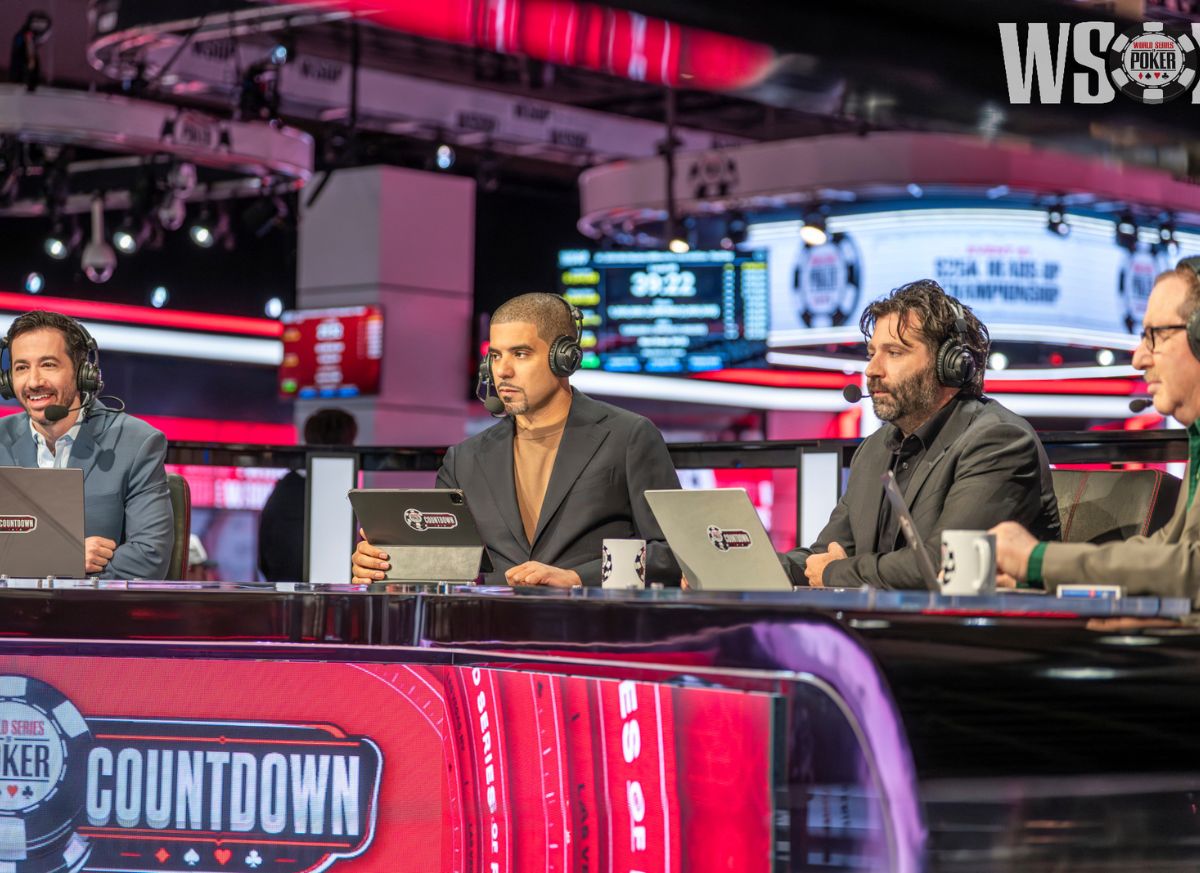
The commentary on the WSOP stream has been under fire from fans who seem to me to be long on complaints and short on solutions. Most of the criticism amounts to there being too much of some type of commentary, so if the streams were to take all the feedback to heart, we’d be left with no commentary at all. Given that every style of commentary is displeasing to someone, stream organizers are left in with a problem as hard to solve as poker itself.
Poker is one of the most challenging games or sports to narrate. The game inevitably includes long periods of time with little action worth commenting on. Inevitably, some kind of chatter needs to fill the void to keep viewers engaged. The players themselves are often silent and provide little entertainment — with a few notable and controversial exceptions — leaving the commentary team with the burden of providing entertainment.
At the same time, commentators are expected not to talk so much that they distract from the action when it happens, which is why viewers are tuning in in the first place. It is a very difficult balance to strike. The same commentator can even have good days and bad days in striking the balance, as it is an inexact science that constantly needs recalibration.
The 2026 WSOP streaming has led to more coverage, meaning more hours to fill with announcing and a lot of opinions on which announcers are good. But one thing is pretty consistent: Every style of commentary displeases someone.
Commentators Are Too Intense
Jared Bleznick has been one recent commentator to catch heat. In his case, critics have focused on his intensity and manner of speaking, which some find abrasive. He tends to be dramatic and raise his voice to build the hype around hands, even ones that may not be particularly noteworthy. His attempts to make every hand feel like a big deal likely please his producers, but feel exhausting to some viewers.
Another point of criticism has been his tendency to self-congratulate when his predictions prove correct.
Many said that his commentary “ruined” the action in the $250,000 High Roller. The YouTube stream chat also seemed to get under the skin of Bleznick, who responded loudly to some of the jabs.
Most critiques of Bleznick are a matter of taste. However, I do happen to agree with one critique of his commentary, which is the condescending way he speaks about events that are not high rollers.
Drew “BetOnDrew” Gonzales summed up that point of criticism, which was echoed by many others:
Last night was the 1st time I turned off a WSOP broadcast. IMO, Blez was disrespectful not only to WSOP production, but also his fellow commentators with his “I don’t want to see this Seniors final table” bit. That wasn’t it, but this bothered me the most.
Bleznick was likely exaggerating for comedic effect, but his disdain for the Seniors’ event did rub me the wrong way. It made it seem as if the broadcast had no respect for any player who wasn’t a high roller.
The comments also came across as tone-deaf, given the recent complaints that WSOP streaming has been showing too many high rollers. It just re-emphasized the perception that WSOP’s focus is moving away from the everyman player, which is who at least some viewers want to see.
Commentators Crack Too Many Jokes
Another common complaint about WSOP announcers regards their attempts at humor. Joe Stapleton, who also performs as a stand-up comic, has been getting the majority of the flak along these lines. It may not be what WSOP viewers are used to, as this is his first year with the series after ending a 15-year run with PokerStars.
In fact, some suggested that “Stapes” is the entire issue with the streaming. Several agreed with the idea that Stapes commentary leaves something to be desired, while there were several comments that defended him.
Even with his long history with poker, Stapleton is still a comedian first and foremost. His style centers around establishing a few recurring “bits” that become a theme for the duration of the stream. These running gags, when they land, can make a stream entertaining regardless of what is happening on the felt. However, the same repetition can be cloying to viewers who didn’t appreciate the joke the first time.
Once again, like Bleznick, his style works for some and is grating for others.
Commentators Provide Too Much Analysis
Yet another popular criticism is that poker commentary is often too analytical and results-oriented. Every hand has to be broken down to determine the “right” play, rather than just letting the action breathe.
Alex Foxen is one of the most prominent advocates for this opinion:
We desperately need commentators to focus on calling the action. Say what is happening in case people can’t follow. This trend of turning live streams into training videos needs to die ASAP.
Foxen reiterated this on one of the streams, taking a jab at the commentators in the midst of the RFID controversy between Martin Kabrhel and Sam Soverel. Sovereal had refused to scan his cards until after the hand, which irked Kabrhel.
In the video of the discussion, Foxen says, “That might make the commentary better, they are so results-oriented in everything they say anyway. That will help them out.”
By “results-oriented,” he meant that the analysis was being done with full knowledge of the hands, rather than from the perspective of a player with incomplete information. Mike Lavin echoed the sentiment, saying he wished that announcers would sometimes admit they do not know what is correct in a given situation instead of “speaking out of their ass”.
Without Hype, Jokes, or Analysis, What is Left?
If commentators were to take all this feedback together and abandon every approach that catches flak, they’d be left with just calling the action, as Foxen proposes. Yet, that wouldn’t go over well either, especially during slow periods of the game.
Along those lines, there have been general complaints about commentators Randy Lew and David Williams. These have been less specific overall, some calling them too boring or not insightful enough, which sounds a lot like a request to spice things up with some jokes, hype, or analysis.
Fortunately, the WSOP streams use a rotating mix of commentators to avoid overloading the audience with one announcer’s style. The complaints are across the board and everyone’s style is bashed to some extent. Even old WSOP legends Lon McEachern and Norman Chad have taken heat in recent years for being out of date, for their tired shtick, and for not understanding the game anymore.
The lone exception to this is Nick Schulman, who receives far fewer complaints than other announcers. But Schulman rarely announces and tends to save his skills for the Main Event.
Poker Announcing an Inexact Science
In my opinion, there is no perfect science for announcing poker at all times. Sometimes the action calls for dramatic effect, sometimes for analysis, and sometimes for entertainment and humor. The reason for these complaints is that there is often too much of one thing when coverage spans several hours. Too much analysis can grow tiresome, too much humor can get annoying and too much intensity can become grating.
It would be strange to ask each announcer to change their style and do what is unnatural to them. For instance, Stapleton suddenly attempting high-level analysis would not land. Understanding that each announcer has their own style is a part of enjoying the streams. There is a split opinion on each announcer as well. For every critique that each one receives, they also receive as many people defending them. Like each time someone called Bleznick the worst they have ever heard, there was a response from someone else calling him the “GOAT”.
Also, many viewers seem to bash whoever is commentating, regardless of their style. It is interesting to note that many of the same people called both Bleznick and Stapleton’s commentary the worst they had ever heard, despite the two having different styles.
Just as one example, Barstool Nate called Stapes’ commentary “as bad as it gets.” And also called Bleznick’s commentary “painful“. There have been many like that who have bashed multiple announcers.
Stop the Unfocused Complaints
Are there announcers whom I prefer to others? Yes. But there is no announcer that is so bad that it ruins the experience for me. The announcers often act as a release valve for viewers’ frustrations. The poker isn’t exciting? The players are a little boring or taking too long? Take it out on the announcers for not picking up the slack.
I know it is a fool’s errand to ask poker players to stop complaining, but I do think it would be wise to just accept that each announcer has their own unique style. Some you may not like as much as others, but instead of just calling every announcer inherently terrible, understand that what other people enjoy with poker commentary varies wildly.
The art of poker commentary is an unsolvable science for an unsolvable game. After all, isn’t the unsolvable nature what we love about poker anyway?