Poker Expert


Disclaimer: This guide is provided for informational purposes only. It does not constitute legal/financial advice or a recommendation to engage in online gambling. Always verify local regulations before playing for real money.
Online poker in the U.S. occupies one of the most complex and continually evolving legal spaces in modern gaming. While millions of Americans enjoy poker recreationally at home or in casinos, the right to play the same game online depends entirely on where a person resides.
Since there is no unified federal law authorizing or prohibiting poker platforms, every state determines for itself whether real-money poker may be offered within its borders. Understanding how this system developed is essential for players who hope to participate safely and legally.
All You Need to Know
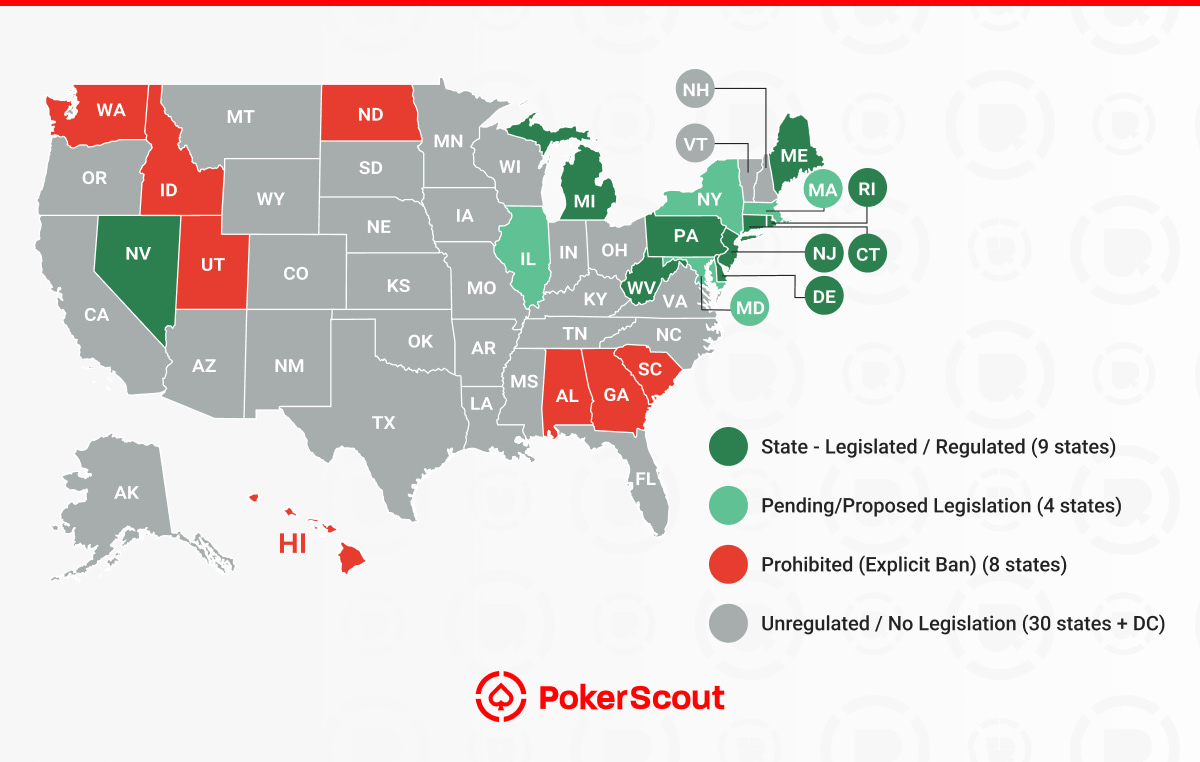
- As of 2026, online poker is legal in nine U.S. states. These are Nevada, New Jersey, Delaware, Michigan, Pennsylvania, West Virginia, Connecticut, Rhode Island, and Maine.
- In January 2026, Maine became the latest state to offer legal online poker for real money.
- A handful of jurisdictions explicitly ban poker, while in most states, it remains unregulated or exists in a legal gray area
- Check our comprehensive, up-to-date list below to see the US online poker laws for your area.
Is Online Poker Legal in the U.S. in 2026?
So, is it legal to play online poker in the US? Yes – but only if you’re located in a state that has legalized and regulated real-money online poker. Another question that routinely emerges is: ”What states have legal online poker?”
As of 2026, New Jersey, Michigan, Pennsylvania, Nevada, Delaware, and West Virginia have legalized and regulated online poker. Connecticut and Rhode Island have legal frameworks in place, but don’t yet have regulated sites available to play on. In early 2026, Maine became the ninth state to legalize online poker.
Players must be physically located within one of these states to play on licensed sites. Six of these states operate under the Multi-State Internet Gaming Agreement (MSIGA), allowing for shared liquidity and larger player pools.
Although there is a growing list of states where online poker is legal, playing poker on the Internet remains unregulated or illegal in the majority of them, depending on state law.
Legal vs Regulated & Gray Area – What This Means for Players
In the nine states mentioned above, online poker is now a legal and regulated marketplace.
For players, you can rest assured that playing poker is legal as long as you do so on a platform that is licensed within your state. In some states, such as Alabama and Utah, online poker is explicitly banned. Usually, these laws target operators rather than players, but in stricter states, it’s theoretically possible for players to commit offenses.
In many U.S. states, online poker falls into a legal gray area.
There’s no legislation to regulate the industry, but there are also no laws specifically banning it. In these jurisdictions, it’s often possible to access offshore poker sites, although it’s up to you to do the necessary research and due diligence before taking to the tables.
The key point is that regulated poker sites accessible to US players are licensed in-state, utilize geolocation, and adhere to consumer protection rules that offshore rooms don’t.
A Brief History of U.S. Online Poker Law
The modern legal environment stems from several key federal actions:
- 2006 – UIGEA Targets the Money Flow
The Unlawful Internet Gambling Enforcement Act cut off banks and processors from handling “unlawful internet gambling” payments. It didn’t ban poker itself – but it made funding sites nearly impossible, forcing operators to move offshore.
- 2011 – Black Friday Shuts It Down
The DOJ indicted PokerStars, Full Tilt Poker, and Absolute Poker under the Wire Act, freezing player funds and collapsing the first U.S. poker boom. Later that year, a new DOJ opinion limited the Wire Act to sports betting, reopening the door for state-licensed poker.
- 2018 – PASPA Repeal Empowers States
The Supreme Court’s PASPA repeal confirmed that states could legalize their own forms of wagering. Courts later clarified that the Wire Act applies only to sports betting, paving the way for interstate poker compacts like MSIGA (now spanning DE, MI, NV, NJ, PA, and WV).
- Present Day – A Patchwork System
The legality of Internet poker depends on where you play. States like New Jersey run licensed platforms, while others block access entirely.
In this climate, many U.S. players choose to play on reputable offshore poker sites licensed in international jurisdictions, where real-money games remain widely available.
What Are Offshore Poker Sites? All You Need to Know
Some U.S. players access poker through offshore online platforms licensed in jurisdictions such as Curaçao, Malta, or the Isle of Man. These sites are not regulated by U.S. authorities but often continue to accept American players, depending on state restrictions.
Offshore operators typically block play from jurisdictions with explicit prohibitions on gaming. States like Washington, Utah, and sometimes New York or Maryland are often blocked to comply with local laws or to reduce risk.
Under federal law, no statute directly criminalizes individuals for playing poker through offshore sites. The Unlawful Internet Gambling Enforcement Act (UIGEA) primarily applies to operators and payment processors, rather than players.
However, all states with legal online poker have their own rules restricting unlicensed online gambling, so legality depends on a player’s physical location. To date, there are no recorded cases of U.S. players prosecuted solely for using offshore poker sites.
In practice, many offshore poker rooms mirror state-regulated U.S. platforms, offering active cash games, multi-table tournaments, and a range of stakes around the clock. Traffic is often high, player pools are diverse, and major sites match global standards in software and gameplay quality.
CoinPoker is a great example, and you can even get $10 for free if you sign up using the bonus code POKERSCOUT.

While U.S. consumer protection frameworks do not cover offshore platforms, many of the major brands maintain strong reputations for fair play, secure transactions, and responsible gaming standards.
Use this US legal poker tracker to quickly check whether your state allows regulated online poker, prohibits it, or sits in a gray area. Below, we break down online poker legality by state, including where licensed sites are live and where online poker still isn’t authorized.
U.S. Online Poker Laws by State
As mentioned, there are no federal laws governing online gambling and poker, allowing each state to establish its own legal framework. The question of whether online poker is legal in the USA very much depends on your location.
The laws are almost always in a state of flux, and as of 2026, only a handful of states have fully legalized online poker. Here is where each state is now regarding legalized online poker:
Alabama
Prohibited (Explicit Ban) 
Mobile / Desktop Access: Prohibited
There is no state-regulated poker in Alabama, where state law forbids almost all forms of gambling. The only legal exceptions are limited charitable bingo operations and pari-mutuel betting.
Since there are no laws or regulatory agencies that permit or oversee the practice, anyone who offers or plays real-money poker for profit online runs the risk of violating state law. This prudence extends to the digital realm, as Alabama has a long history of opposing the expansion of iGaming.
Internet poker has remained largely unaffected by the interest in gambling expansion, which has been primarily directed toward lottery proposals and sports betting. House Bill 151 (2024) was one of several bills that attempted to modernize gambling, but was unsuccessful.
There is currently no active movement or regulatory body with the authority to grant online licenses, so the likelihood of Alabama becoming one of the U.S. online poker legal states in the near future remains low.
Alaska
Prohibited (Explicit Ban)
Mobile / Desktop Access: Prohibited
Alaska has no state-regulated Internet poker market. The state constitution and gambling laws prohibit most betting and gaming activities unless specifically authorized. As such, locally-based poker sites are not legally permitted to operate in the state.
Over the years, Alaska legislators have occasionally discussed gaming revenue opportunities, but bills to legalize poker or online casinos have consistently died in committee. The small population and lack of a commercial-casino industry make widespread legalization unlikely. No current proposals are under review in the Alaska Legislature.
Arizona
Unregulated / No Legislation ⚪
Mobile / Desktop Access: Not authorized ⚪
Arizona law currently does not include a provision for state-licensed poker through online platforms.
The state’s gaming landscape centers on tribal casino compacts; however, these agreements do not cover internet poker. A handful of live poker rooms, operated by tribes, offer low to mid-stakes limit and spread-limit games, while no-limit games are not permitted.
The Arizona Department of Gaming oversees all legal gambling activities, and its statutes do not authorize online card games for real money. Online poker remains unaddressed, but there are no laws explicitly prohibiting playing on offshore sites.
Since legalizing mobile sports wagering in 2021, some legislators have explored extending online gambling rights to include poker and casino games. No bills have advanced beyond preliminary discussion.
Future progress will likely require amendments to tribal compacts or new legislation outlining an online poker framework.
Arkansas
Prohibited (Explicit Ban)
Mobile / Desktop Access: Prohibited
The Arkansas legislation says that online poker is against the law. The Arkansas Racing Commission is in charge of land-based casinos and sportsbooks, but all forms of online gambling are explicitly banned. Residents can only legally play poker in person at licensed casinos, which typically offer poker as a table game, rather than cash games or tournaments.
Rare discussions on gambling legislation in Arkansas focus on lotteries or casinos. As of January 2026, there are no active bills that propose a method for licensing poker sites. Without a clear regulatory path, any progress would require a major rewrite of the state’s gaming laws.
California
Unregulated / No Legislation ⚪
Mobile / Desktop Access: Not authorized ⚪
California represents a huge potential market of players in the U.S., but it has not yet made online poker legal. Currently, there are no state-regulated platforms that allow people to play for real money. Tribal sovereignty disputes and the conflicting interests of cardrooms and tribal casinos have repeatedly slowed progress.
Meanwhile, live poker is legal and thriving, with more than 60 licensed card rooms offering cash games and tournaments operating within jurisdictions that are approved by the California Gambling Control Commission.
Over the past decade, several bills, including Assembly Bill 167 (2016), have attempted to establish a licensing system but have failed due to disagreements over who could be an operator and how to allocate the revenue.
As of January 2026, no laws are in effect, despite some industry stakeholders still advocating for regulation. It’s unlikely that gaming will be legalized in California in the short term. There are naturally quite a few offshore sites for poker play that accept Californians for registration for both tournament and cash game play.
Colorado
Unregulated / No Legislation ⚪
Mobile / Desktop Access: Not authorized ⚪
Colorado does not regulate online poker. The state allows regulated sports betting and daily fantasy contests but excludes internet-based casino games and peer-to-peer poker. The Colorado Division of Gaming enforces strict limits on what can be offered online, while live poker is only available at a select number of tribal casinos.
Although lawmakers have successfully expanded gaming through voter-approved initiatives, most recently with the legalization of sports betting in 2019, poker has not been part of these efforts. Any future legislation would likely require constitutional approval via statewide referendum, making immediate change unlikely.
Connecticut
State-Legislated / Regulated (Legalized but Not Launched) 
Mobile / Desktop Access: Authorized under tribal compacts; no live platforms
Connecticut’s 2021 iGaming law made online poker legal. Under the direction of the Connecticut Department of Consumer Protection, the state permitted the Mashantucket Pequot and Mohegan tribes to run virtual poker and casino platforms. However, licensed poker platforms have not yet partnered with the tribes to make their debut.
Current law also prohibits shared liquidity, making standalone launches less viable. Operator selection and market size are the main causes of implementation delays. A 2025 proposal, SB 1464, aims to allow Connecticut to join interstate compacts such as the MSIGA.
Delaware
State-Legislated / Regulated (Legal and Licensed)
Mobile / Desktop Access: Permitted (geofenced within state borders)
Delaware is one of the few states where online poker is legal, and was one of the first states to legalize and regulate poker platforms, passing its Delaware Gaming Competitiveness Act of 2012.
The Delaware Lottery oversees all iGaming operations, including poker, casino games, and slots. Licensed sites operate under partnerships with land-based casinos.
Delaware is also a founding member of the MSIGA, which allows shared liquidity with other participating states. This compact has enabled larger tournaments and consistent player traffic. Delaware remains a model for early-state adoption of regulated internet poker.
Florida
Unregulated / No Legislation ⚪
Mobile / Desktop Access: Not authorized ⚪
Although live poker is widely available at licensed pari-mutuel establishments and tribal casinos in Florida, the state does not regulate any online poker. Legal gambling in Florida is regulated by the Florida Gaming Control Commission. Live poker is legal at land-based venues, but online and remote poker are not permitted.
Renegotiating the Seminole Tribe Compact is frequently at the center of initiatives to increase gaming. This compact did not cover poker sites, but sports betting was legalized after the court approved its resumption in 2023.
The legalization of online poker is unlikely until lawmakers reach a consensus on a framework that aligns with tribal interests. Many choose to play online poker in Florida on a variety of trusted offshore sites, which are increasingly popular in the state and offer a range of cash games and poker tournaments.
Georgia
Prohibited (Explicit Ban)
Mobile / Desktop Access: Prohibited
Georgia’s constitution forbids most forms of gambling, including online poker. The legal foundation required to permit or regulate online gaming is absent from the state. As a result, players who choose to use offshore poker sites do so without state protection or formal avenues for recourse if issues arise.
Legislators who support gaming have tried, but failed, to establish a statewide gaming commission through measures such as Sports Betting and Casino Gambling Activities (Senate Resolution 131) in 2023.
Because of the public’s strong opposition to gambling expansion, poker reform is not currently on the legislative agenda and is unlikely to be in the future.
Hawaii
Prohibited (Explicit Ban)
Mobile / Desktop Access: Prohibited
Hawaii maintains a total prohibition on gambling, both online and offline. The penal code of this state criminalizes most betting activities, and no licensed gaming venues exist in Hawaii. Online poker is, therefore, explicitly illegal.
Occasional proposals, such as House Bill 2422, have sought to establish a gaming commission, but have failed. Lawmakers consistently cite social and economic concerns about introducing gambling.
Given Hawaii’s historical opposition, legalization is extremely unlikely in the near future.
Idaho
Prohibited (Explicit Ban)
Mobile / Desktop Access: Prohibited
Idaho does not allow online poker or any form of internet-based casino gambling. The Idaho State Lottery oversees limited gaming, but no statute authorizes peer-to-peer card play, and playing poker for real money is explicitly illegal under state law.
In 2014, a tribal casino opened a live poker room, only for the state to eventually shut it down, effectively ending live poker in Idaho.
Legislative efforts to legalize or regulate poker have been nonexistent in recent years. The state’s strong religious and conservative influences make expansion improbable. Without legislative momentum, Idaho will likely remain closed to poker sites for the foreseeable future.
Illinois
Pending / Proposed Legislation 🕓
Mobile / Desktop Access: Not yet authorized 🕓
Illinois does not currently regulate online poker, although the Illinois Gaming Board does have licenses for in-person casinos and poker rooms, which are legal. Physical and online sports betting have also been available in the state since 2019, with the first legal bet taken in 2020.
A number of bills have attempted to incorporate digital poker and online casino games into the state’s current regulatory framework, such as the Internet Gaming Act (Senate Bill 1656) (2023). None has progressed past the committee stage.
Illinois’s well-established gaming industry and generally liberal gambling laws make it a potential candidate for legalization, but the timing is still up in the air.
Indiana
Unregulated / No Legislation ⚪
Mobile / Desktop Access: Not authorized ⚪
Online poker is not permitted in Indiana by state law. No internet licenses pertaining to poker have been authorized by the Indiana Gaming Commission, which regulates gambling activities. However, sports betting and daily fantasy sports are allowed, while live poker is available at state-licensed casinos.
Poker and other forms of iGaming have occasionally been the subject of legislative attempts to legalize. The most recent of these was House Bill 1432. Although the bill was unsuccessful, it demonstrates an increasing interest in expanding the state’s options for online gambling.
Political backing and tax negotiations will determine future consideration.
Iowa
Unregulated / No Legislation ⚪
Mobile / Desktop Access: Not authorized ⚪
Online poker is not currently regulated in the state of Iowa. Although it has no authority over poker sites, the Iowa Racing and Gaming Commission oversees casinos that hold licenses. Live poker can be found in casinos and card rooms, but residents are currently unable to access authorized U.S. poker sites lawfully.
Although some bills, such as House Study Bill 227, have suggested legalizing online poker sites and casinos, none of them have been approved by the relevant committees. The Iowa legislature favors sports betting over casino-style gaming, which is limited to tribes and riverboats.
Kansas
Unregulated / No Legislation ⚪
Mobile / Desktop Access: Not authorized ⚪
In Kansas, there’s no state-legislated poker. Although it oversees casino operations for live gaming, the Kansas Lottery lacks the power to grant licenses for online gambling.
Some lawmakers considered regulating poker after Kansas successfully implemented mobile sports betting in 2022, but no specific poker bill has been submitted. Internet poker is not expected to grow anytime soon because of the emphasis on sports betting revenue.
Kentucky
Unregulated / No Legislation ⚪
Mobile / Desktop Access: Not authorized ⚪
Kentucky has a law prohibiting unlicensed operators and does not permit online poker within its state borders. Live gambling is restricted to a few racinos, bingo halls, and a state lottery. The state has even taken active steps against online gambling in the past, including the attempted seizure of offshore site domain names.
House Bill 106 (2023), a recent legislative effort that attempted to add Kentucky to the list of states with legal poker, was unsuccessful. Poker reform has stalled due to political differences and conflicting agendas; however, Kentucky’s increasing acceptance of online sports betting, which was legalized in 2023, may eventually pave the way for further discussion.
Louisiana
Unregulated / No Legislation ⚪
Mobile / Desktop Access: Not authorized ⚪
Online poker is currently not permitted in the state of Louisiana, but it is also not explicitly outlawed. Real-money gambling, including live poker, is available at dozens of tribal, riverboat, and state-licensed casinos and is governed by the Louisiana Gaming Control Board.
Sports betting has been the main focus of previous attempts to legalize online gambling in this state, and it became legal in 2021. There’s currently no proposal that addresses poker. Coordination with commercial and tribal operators would be needed for any expansion on this.
Maine
State-Legislated / Regulated (Legal and Licensed)
Mobile / Desktop Access: Authorized pending rollout 🕓
Maine is now one of the states where poker is legal. The state has been sliding towards legalized gambling in many forms for over two decades. In 2012, two casinos opened, one of which offers live poker. In 2022, sports betting was legalized, paving the way for other online gambling industries.
In 2024, Maine debated comprehensive legislation pertaining to online gaming, which includes provisions for online poker. An Act to Create Economic Opportunity for the Wabanaki Nations Through Internet Gaming (LD 1164) (2025) gives tribal gaming authorities the right to collaborate with online operators.
As of January 2026, Maine has officially become the ninth state to legalize online poker and the eighth state to legalize online casinos. Tribes can now offer both, although no regulated sites are yet operational. It could be a slow start, as shared liquidity is not yet offered in the state.
When the market stabilizes, observers anticipate a limited rollout that concentrates on current casino brands, with the possibility of joining the interstate liquidity compact later on.
Maryland
Pending / Proposed Legislation 🕓
Mobile / Desktop Access: Not yet authorized 🕓
Maryland does not currently legislate for online poker. The Maryland Lottery and Gaming Control Agency oversees the state’s thriving land-based casinos and mobile sports betting, but poker has not yet made its way into the online market.
The direction is favourable, though. In 2018, a bill was passed allowing poker home games with stakes of up to $1,000 to be played and hosted. This would previously have been an offense punishable with a fine or even incarceration.
HB 17, a significant proposal, aims to permit all forms of online gaming under state supervision, including poker. Lawmakers are still researching possible tax arrangements and consumer protection measures.
Given its established gaming infrastructure and readiness to consider online expansion, the state’s poker laws are likely to change soon.
Massachusetts
Pending / Proposed Legislation 🕓
Mobile / Desktop Access: Not yet authorized 🕓
Unlike sports betting, online poker is currently not provided or permitted by law in the state of Massachusetts. Although it does not have the power to license remote poker platforms, the Massachusetts Gaming Commission oversees the state’s casino properties.
There have been several attempts to add poker to the state’s list of iGaming options, including an Act relative to internet gaming (House Bill 4431). The growing legislative interest in matching neighboring states, such as Connecticut, is reflected in these initiatives.
Proponents argue that allowing authorized virtual poker rooms would increase revenue without necessitating the expansion of physical casinos. The earliest practical window for legalization, according to ongoing debate and the bill, is March 2026.
Michigan
State-Legislated / Regulated (Legal and Licensed)
Mobile / Desktop Access: Permitted (geofenced within state borders)
The online poker market in Michigan is completely state-regulated; the Lawful Internet Gaming Act (2019) made it legal, and the first hand was dealt in January 2021. Major national brands and other licensed operators are supervised by the Michigan Gaming Control Board.
In 2022, Michigan became a member of the MSIGA, which went into effect the following year. At that time, Delaware, Nevada, and New Jersey were permitted to share liquidity, while Pennsylvania joined recently. The change significantly improved tournament variety and player traffic.
Many players in the state also enjoy the broad game variety available on Michigan poker sites based overseas that continue to cater to local players.
Minnesota
Unregulated / No Legislation ⚪
Mobile / Desktop Access: Not authorized ⚪
Online poker remains unregulated in Minnesota. The Minnesota Racing Commission and state lottery handle limited gambling activities, but no statute authorizes internet poker.
Bills proposing iGaming expansion focused on sports betting, not poker. Tribal compact negotiations dominate the gaming conversation, and tribes have been cautious about digital wagering.
There have even been active pushbacks against online lottery ticket and scratch sales, which were subsequently banned in late 2014. Given the backward direction of online gambling laws, internet poker will remain firmly off the table.
Mississippi
Unregulated / No Legislation ⚪
Mobile / Desktop Access: Not authorized ⚪
Mississippi does not currently legislate for online poker. The state’s casino market is vibrant, yet its legal structure restricts gaming to licensed premises.
The Mississippi Gaming Commission has studied online gambling frameworks but has not endorsed formal legislation. Past attempts have failed to advance, and analysts expect Mississippi to revisit the topic only after evaluating revenue results from sports betting and the experiences of neighboring states.
Missouri
Unregulated / No Legislation ⚪
Mobile / Desktop Access: Not authorized ⚪
In Missouri, playing poker online is not permitted under state law. While it does not grant licenses for digital platforms, the Missouri Gaming Commission regulates gaming at casinos and charitable organizations.
Legislative efforts have mostly focused on sports betting in Missouri, but even that has failed. Recently, online betting was covered by the Senate Bill 1046 (2024), but poker was left out. Lawmakers have prioritized incremental reforms at best so far.
Given that online sports betting hasn’t yet gained traction, the future of state-regulated virtual poker rooms in Missouri is still up in the air and unlikely to change in the near future.
Montana
Prohibited (Explicit Ban)
Mobile / Desktop Access: Prohibited
Montana has an unusual set of legislation around gambling. It is the only state to allow casino-style gambling and poker outside of actual casino venues. As a result, there are hundreds of bars and entertainment venues offering live poker, video poker, video lottery, and off-track betting.
At the same time, Montana completely prohibits online poker and most internet wagering under a 2005 law against iGaming. Limited forms of betting occur through state-regulated sports pools, but poker does not qualify.
Legislators have shown minimal appetite for iGaming expansion. Given Montana’s population size and limited casino base, the economic incentive for Internet poker legalization is weak. As of January 2026, no active legislation proposes change.
Nebraska
Unregulated / No Legislation ⚪
Mobile / Desktop Access: Not authorized ⚪
Nebraska has traditionally been an anti-gambling state and doesn’t license or regulate poker. The state legalized certain forms of casino gambling back in 2020, but regulations have focused exclusively on gaming at racetracks.
In-person sports betting was approved in 2022 and launched in 2023, although mobile and online sports betting were explicitly banned, which perhaps hints at the state’s overall attitude towards iGaming.
Lawmakers have introduced measures, such as a constitutional amendment to permit an authorized gaming expansion, but none have yet actually passed. No bill currently addresses online gaming, and legalization remains unlikely without a broader rewrite of state gaming law. Internet poker doesn’t look to be reaching Nebraska anytime too soon.
Nevada
State-Legislated / Regulated (Legal and Licensed)
Mobile / Desktop Access: Permitted (geofenced within state borders)
Nevada remains the birthplace of regulated online poker in the U.S and one of the states where online poker is legal. The Nevada Gaming Control Board licenses and supervises all real-money sites. AB 114 (2013) legalized intrastate Internet poker, making Nevada one of the first to do so.
The state participates in the MSIGA liquidity network. Although Nevada’s small population limits site diversity, it is a hearthstone for legal poker in the U.S., just as it is for casino-based poker, hosting WSOP.com and other licensed brands under stringent oversight.
Many residents also turn to Nevada poker sites based offshore, which welcome local players and offer a wide range of games, from Texas Hold’em to many others.
New Hampshire
Unregulated / No Legislation ⚪
Mobile / Desktop Access: Not authorized ⚪
Online poker is not regulated in New Hampshire. The state operates an online lottery and a charitable gaming program. Sports betting was legalized in 2019, but poker remains off the cards.
A new bill, HB 168, proposes a study commission on internet gambling and poker, yet it remains excluded from legislative priorities. Until lawmakers adopt comprehensive iGaming statutes, poker will remain unregulated.
New Jersey
State-Legislated / Regulated (Legal and Licensed)
Mobile / Desktop Access: Permitted (servers based in Atlantic City)
New Jersey is a state where you can play legal online poker, and it operates one of the most successful online poker markets in the country. A2578 amended the Casino Control Act in 2013, legalizing internet poker and casino games under the Division of Gaming Enforcement.
The state joined MSIGA in 2015, allowing cross-border liquidity. Major operators like WSOP.com, BetMGM Poker, and PokerStars NJ were among the first to join and now operate under full state supervision. New Jersey demonstrates how state-regulated poker sites can generate revenue by establishing strong responsible gaming standards.
All New Jersey poker servers must be physically located within Atlantic City casinos, as regulated by the state. Many players also explore New Jersey poker options through offshore sites for the expanded tournaments and international player pools they offer.
New Mexico
Unregulated / No Legislation ⚪
Mobile / Desktop Access: Not authorized ⚪
New Mexico does not legislate for online poker. Gaming is conducted under tribal compacts managed by the New Mexico Gaming Control Board, and these agreements exclude internet wagering.
There have been informal discussions about future expansion, but no bills have gained traction. Until new compacts are negotiated, Internet poker will remain illegal.
New York
Pending / Proposed Legislation 🕓
Mobile / Desktop Access: Not yet authorized 🕓
New York has not legalized online poker, but it is considered a key battleground state for upcoming iGaming legislation. The New York State Gaming Commission currently regulates land-based casinos and mobile sports betting. In 2013, an amendment was made allowing for the development of commercial casinos alongside tribal casinos.
Since 2014, several proposals have been made to legalize online poker, but none have passed. Senator Joseph Addabbo Jr. continues to sponsor bills like Senate Bill 9226 (2024) to authorize Internet poker and casino gaming. More recently, Senate Bill 2614 was put forward for online casinos.
Proponents argue the move would capture tax revenue now flowing to neighboring states. Debate continues over how to integrate tribal partners and protect responsible gaming interests.
Meanwhile, many turn to offshore providers, including poker sites catering to New Yorkers, which offer a wide variety of tournaments and cash games.
North Carolina
Unregulated / No Legislation ⚪
Mobile / Desktop Access: Not authorized ⚪
North Carolina does not authorize playing poker online. The North Carolina State Lottery Commission supervises gambling operations limited to sports betting and lottery games. Live poker is only available at two tribal casinos.
Recent legislation, House Bill 347 (2023), focused on sports wagering, excluding poker. Online and in-person sports betting are legal as of 2024. Lawmakers may revisit broader iGaming once the sports-betting framework stabilizes, but there is no formal proposal at present.
North Dakota
Prohibited (Explicit Ban)
Mobile / Desktop Access: Prohibited
Online poker is illegal in North Dakota. The North Dakota Attorney General’s Office enforces state gambling laws, which permit only charitable and tribal gaming.
Attempts have been made to let voters decide on expanded gambling, but the 2021 proposal was rejected. No momentum currently exists for legal digital poker rooms within the state.
Ohio
Unregulated / No Legislation ⚪
Mobile / Desktop Access: Not authorized ⚪
Ohio does not authorize or legislate for state-governed online poker yet. The Ohio Casino Control Commission regulates a handful of land-based casinos and mobile sportsbooks, but lacks the authority to approve poker websites.
Past proposals have surfaced intermittently, yet no dedicated bill, such as Senate Bill 197 from 2025, has advanced. Analysts expect Ohio to revisit the issue once tax data from its new sports betting market becomes available.
Oklahoma
Unregulated / No Legislation ⚪
Mobile / Desktop Access: Not authorized ⚪
Oklahoma prohibits poker platforms under its gaming compacts and criminal statutes. The state’s tribal gaming framework centers on physical casinos overseen by the Oklahoma Gaming Compliance Unit.
Efforts to modernize compacts have faced political challenges. No active legislation authorizes online poker, and without tribal consensus, progress appears remote. Residents currently lack access to licensed U.S. poker sites.
Oregon
Unregulated / No Legislation ⚪
Mobile / Desktop Access: Not authorized ⚪
Online poker is not legally permitted in-state in Oregon. The state’s gambling laws permit limited betting through the Oregon Lottery, but poker is not among the authorized digital offerings. iGaming and online poker are explicitly prohibited, and operators are not permitted to accept online payments.
Lawmakers have considered iGaming expansion studies but have taken no formal action. Given Oregon’s cautious regulatory stance and established tribal compacts, legalization discussions remain preliminary, although there is little hope after sports betting was given the green light in 2021.
Pennsylvania
State-Legislated / Regulated (Legal and Licensed)
Mobile / Desktop Access: Permitted (MSIGA member since April 2025)
Pennsylvania maintains a state-regulated online poker market under the 2017 Gaming Expansion Act (House Bill 271). Poker sites first launched statewide in 2019, licensed under the Pennsylvania Gaming Control Board.
In April 2025, Pennsylvania officially joined the MSIGA, with BetMGM and Borgata becoming the first operators to share liquidity. The Pennsylvania Gaming Control Board oversees integration with other compact members.
You can now enjoy a range of poker sites in Pennsylvania, offering great games, tournaments, cash games, and Internet poker bonuses.
Rhode Island
State-Legislated / Regulated (Legalized but Not Launched)
Mobile / Desktop Access: Authorized; rollout pending 2025–2026
Rhode Island, through Senate Bill 948, legalized online casino gaming in 2023, explicitly including poker. However, no operator has launched beyond casino gaming into online poker. The Rhode Island Lottery oversees regulation in partnership with Bally’s Corporation.
While poker platforms are still under development and no operator has yet launched, the statute provides a clear legal pathway. Analysts anticipate a gradual rollout in 2026 once technology providers complete testing.
Rhode Island has therefore joined the growing list of states supporting fully licensed virtual poker rooms. A future step would be to join shared player pools under MSIGA, although this will likely occur once the industry develops.
South Carolina
Prohibited (Explicit Ban)
Mobile / Desktop Access: Prohibited
South Carolina’s constitution bans nearly all gambling, and poker platforms are explicitly illegal.
The South Carolina Law Enforcement Division enforces strict prohibitions, with limited exceptions for charitable raffles. Though individual legislators occasionally introduce gaming-study bills, none have progressed.
The state’s strong anti-gambling stance makes Internet poker legalization highly improbable in the foreseeable future.
South Dakota
Prohibited (Explicit Ban)
Mobile / Desktop Access: Prohibited
Poker sites are prohibited in South Dakota.
Gambling is restricted to Deadwood casinos and tribal facilities under the oversight of the South Dakota Gaming Commission. Occasional bills have proposed constitutional amendments for expanded gaming, but none have succeeded.
Without voter approval, the legal status of poker remains unchanged.
Tennessee
Unregulated / No Legislation ⚪
Mobile / Desktop Access: Not authorized ⚪
Tennessee allows online sports wagering but doesn’t legally enshrine any provision for poker platforms. The Tennessee Sports Wagering Council governs digital betting operations, and poker falls outside its remit.
Proposals to expand gaming face resistance from conservative lawmakers. Until significant political momentum builds, licensed poker sites are unlikely to appear.
Texas
Prohibited (Explicit Ban)
Mobile / Desktop Access: Prohibited
The majority of gambling activities, including poker platforms, are illegal in Texas.
Although social cardrooms are based on “membership” models, the legality of these is hotly debated. House Joint Resolution 97 (2023) is one of several bills that lawmakers have submitted to legalize casinos and internet gambling, but none of them have progressed.
A state-regulated poker system is still a long way off, given constitutional obstacles and fierce opposition.
Utah
Prohibited (Explicit Ban)
Mobile / Desktop Access: Prohibited
Utah enforces a constitutional ban on all gambling, making online poker entirely illegal. The state’s criminal code outlaws any game of chance played for money.
No proposals have emerged to alter this stance. Utah’s unique legal environment, rooted in religious and cultural opposition to gambling, ensures it will remain outside all forms of Internet poker legalization.
Vermont
Unregulated / No Legislation ⚪
Mobile / Desktop Access: Not authorized ⚪
Vermont has no law authorizing poker sites to operate in the state. The Department of Liquor and Lottery regulates gaming limited to lottery products.
A 2023 study bill explored potential iGaming frameworks but excluded poker. Without legislative appetite or existing casinos to anchor licenses, digital poker expansion is improbable in the short term.
Virginia
Pending / Proposed Legislation 🕓
Mobile / Desktop Access: Not yet authorized 🕓
Virginia permits sports betting but not poker platforms in-state. The Virginia Lottery manages gaming oversight and has yet to develop poker regulations.
Legislators have shown cautious openness to broader iGaming, as seen in Senate Bill 827 (2025). The measure proposed a study of internet casino gaming that could later include poker. While state-regulated poker sites remain unavailable, observers see Virginia as a potential mid-term adopter.
Washington (State)
Prohibited (Explicit Ban)
Mobile / Desktop Access: Prohibited
Washington has one of the strictest stances in the nation: online poker is explicitly illegal under RCW 9.46.240. The statute criminalizes transmitting or receiving gambling information over the internet. For live poker, the state has dozens of tribal casinos.
Despite some legal scholars urging modernization, lawmakers have not amended the prohibition. Enforcement remains active, and residents risk penalties for playing on unlicensed sites. The state takes an active stance against online gambling, so don’t expect any changes anytime soon.
As a poker player, understanding online poker regulations in the state will help prevent any confusion over the game’s legitimacy.
West Virginia
State-Legislated / Regulated (Legal and Licensed)
Mobile / Desktop Access: Permitted (MSIGA member since 2024)
West Virginia legalized online casino gaming in 2019 through the Interactive Wagering Act (HB 2934). The West Virginia Lottery oversees implementation. Poker and the use of mobile or desktop poker apps are legal, but their rollout has been slow due to this state’s limited population size.
The state joined MSIGA in 2023, opening up the route to shared liquidity. West Virginia’s regulatory model now mirrors that of other small markets, which use interstate cooperation to sustain player pools.
Offshore providers continue to attract the state’s players, offering poker sites to West Virginians that provide access to larger player pools and global competition.
Wisconsin
Unregulated / No Legislation ⚪
Mobile / Desktop Access: Not authorized ⚪
Online poker is not legislated for in Wisconsin. Tribal gaming compacts, which limit operations to actual casino properties, are overseen by the Wisconsin Department of Administration.
Currently, there are no bills that would legalize Internet poker. Sports betting is often the focus of expansion initiatives, and public opinion remains divided.
Wyoming
Unregulated / No Legislation ⚪
Mobile / Desktop Access: Not authorized ⚪
Wyoming has not legalized online poker; however, it does permit online sports betting. Under the 2021 Online Sports Wagering Act, licensees are supervised by the Wyoming Gaming Commission. There are also several tribal casinos.
Lawmakers have not yet discussed the addition of casino or poker provisions. Given the small population and low demand, any legalization movement is more likely to follow national trends rather than initiate locally.
District of Columbia
Unregulated / No Legislation ⚪
Mobile / Desktop Access: Not authorized (land-based proposals only) ⚪
Real-money poker sites are not legalized in Washington, D.C. All gambling operations are overseen by the Office of Lottery and Gaming, which specializes in sports betting.
Poker has not been included in proposed amendments, despite lawmakers’ occasional discussions about increasing the availability of digital gaming options. Future reform would probably resemble that of Maryland and other nearby states.
Residents won’t have access to any authorized U.S. poker sites until then.
However, Mayor Muriel Bowser of D.C. is attempting to legalize land-based poker in the city for the second time. She has included poker and blackjack in some physical venues as part of her 2026 budget proposal, just like she did last year. Legal poker sites are not included in this, but introducing land-based options could be a first step toward broader reform.
How to Know If Online Poker Is Legal in Your State

The following states have regulated online poker with legal US poker sites available:
- Nevada
- New Jersey
- Delaware
- Michigan
- Pennsylvania
- West Virginia
The following states have legal online poker, but don’t yet have regulated sites operating:
- Connecticut
- Rhode Island
- Maine
All other states either have legislation against online gambling or don’t yet have a regulatory framework. Check our list to find your state, then follow up with your own research.
How U.S. Online Poker Regulation Works
Online poker regulation in the U.S. follows a state-based model, with each jurisdiction managing its own licensing as well as compliance and enforcement. The system combines verification and shared liquidity agreements to strike a balance between player safety and market growth.
Federal Legal Framework
Federal courts have confirmed that the Wire Act of 1961 applies only to sports betting. After many years of uncertainty, this has basically granted states broad authority over poker. Other federal laws, including the Illegal Gambling Business Act and the UIGEA, still shape payment processing and compliance matters. The UIGEA remains core to these issues, requiring gambling transactions to come from licensed, legal operations.
State Licensing and Oversight
When a state legalizes online poker, its gaming commission or lottery board oversees the licensing and compliance. Licenses are generally limited to companies holding land-based casino rights or tribal compacts, linking online operations to U.S.-based entities rather than foreign firms.
Geolocation, KYC, and Payment Systems
State-regulated sites use geolocation to confirm players are within state borders and require KYC checks for identity and age. Meeting federal banking standards allows legal processing of deposits and withdrawals much more easily.
Player Eligibility and Legal Alternatives
Most state-regulated establishments set a minimum age of 21. Playing from unauthorized locations may violate local gaming laws; therefore, players must confirm their eligibility.
In states where Internet poker is illegal, some individuals use sweepstakes-style or social platforms that utilize virtual currencies or prize systems; these platforms occupy a legal gray area and lack state-level consumer protections. In some jurisdictions, they are banned.
Multi-State Internet Gaming Agreement (MSIGA)
Poker depends on liquidity, which refers to the number of active players. Smaller states often struggle to sustain a strong variety of games or prize pools, so MSIGA allows approved states to share player pools while maintaining independent regulation.
States Participating in MSIGA
Delaware, Michigan, Nevada, New Jersey, West Virginia, and Pennsylvania participate in MSIGA. Pennsylvania was the latest to join in April 2025. Their shared networks show that pooled liquidity supports steady traffic and large tournaments, and more states may follow as regulation expands. Because poker has become such a significant part of the gaming environment, they all offer extensive resources on how to play legal online poker in the U.S.
The Evolving Landscape of U.S. Poker Legislation
The U.S. poker legislation landscape continues to shift as more states explore regulation and shared player pools. Each region’s political culture, tribal agreements, and market priorities shape the pace of legalization and the structure of oversight.
State-by-State Differences
Online poker laws reflect each state’s culture and politics. Nevada and New Jersey led by extending casino industries online, while Utah and Hawaii still ban gambling entirely. Larger markets, such as California and New York, remain stalled over issues related to tribal sovereignty, commercial rights, and tax allocation, creating a fragmented “patchwork” system. Tribal compacts remain central to these disputes and often delay the introduction of new legislation.
Current and Emerging State Regulated Markets
As of 2026, nine states have legalized online poker: Connecticut, Delaware, Michigan, Nevada, New Jersey, Pennsylvania, Rhode Island, West Virginia, and, as of January 2026, Maine. Six share liquidity through MSIGA. Illinois, Maryland, Massachusetts, and New York are next in line, with legislation or hearings already advancing.
Barriers and Future Outlook
Most U.S. states either prohibit poker sites or have yet to address them in law. Opposition includes constitutional bans and concerns about revenue from land-based sources. However, trends suggest a gradual liberalization driven by tax potential and consumer demand.
Economic and Consumer Protection Impact
State-regulated markets provide stable tax revenue and better player safeguards. Pennsylvania and New Jersey each generate tens of millions annually, funding budgets and responsible-gaming programs.
Forecast for Future Legalization
Modern geolocation, KYC, and AML systems have eased earlier concerns over fraud and security. Many states have also legalised online sports betting in recent years, paving the way for online iGaming markets. We expect to see several more states provide a regulatory framework for online poker in the coming years.
FAQs
Is online poker legal in the United States?
What are the US states where online poker is legal?
What is the MSIGA?
What are the top licensed poker sites in legal U.S. states?
Is it illegal to play poker online in the states without regulation?
Can you play poker online for money in the USA?
When will online poker be fully legal in the U.S.?
References
AL HB151 | 2024 | Regular Session (LegiScan)
AB-167 Gambling: Internet poker: unlawful gambling activity.(2015-2016) (California Legislature)
CT SB01464 | 2025 | General Assembly (LegiScan)
AN ACT TO AMEND TITLES 4 AND 29 OF THE DELAWARE CODE RELATING TO THE STATE LOTTERY (Legis Delaware)
GA SR131 | 2025-2026 | Regular Session (LegiScan)
A Bill for an Ac. Relating to Internet Gaming (CapitolWebsite AzureWebsites)
SB1656 – 103rd General Assembly (2023-2024) (ILGA.gov)
IGA | House Bill 1432 – Various gaming matters (IGA.in)
IA HSB227 | 2023-2024 | 90th General Assembly (LegiScan)
23RS HB 106 (Kentucky Legislative Research Commission)
132nd Maine Legislature, First Special Session (Legislature Maine)
Breaking: Maine Becomes Ninth State to Legalize Online Poker (Pokerfuse)
MD HB17 (BillTrack50)
Bill H.4431 (Malegislature)
MCL – Act 152 of 2019 (Michigan Legislature)
SB1046 – Authorizes sports wagering (Senate MO)
Nebraska Legislature – Legislative Document (Nebraska Legislature)
AB114 (Leg State NV)
SB 168, regulating online gambling and directing net proceeds to reimburse municipalities
for elderly tax exemptions (Revenue NH)
A2578 AS 1R (Pub.njleg)
NJ Casino Control Commission – The Act (NJ.gov)
NY State Senate Bill 2023-S9226 (NY Senate)
NY S02614 | 2025-2026 | General Assembly (LegiScan)
House Bill 347 / SL 2023-42 (2023-2024 Session) (North Carolina General Assembly)
Senate Bill 197 | 136th General Assembly (Ohio Legislature)
2017 Act 42 (PA General Assembly)
Bill Text: RI S0948 | 2023 | Regular Session | Comm Sub (LegiScan)
Texas Legislature Online – 88(R) History for HJR 97 (Capitol Texas)
SB827 – 2025 Regular Session (LIS Virginia)
RCW 9.46.240: Gambling information, transmitting or receiving (App Leg WA)
ARTICLE 22E. WEST VIRGINIA LOTTERY INTERACTIVE WAGERING ACT (WV Legislature)
Bill Text: DC B26-0379 | 2025-2026 | 26th Council | Introduced (LegiScan)