Poker Expert & Author


Chinese poker is a fast-paced variant of the famous table game that’s gaining popularity for its simplicity and excitement. Unlike traditional poker games, it doesn’t involve betting rounds or bluffing. It’s all about how you arrange your cards.
Say goodbye to the learning curves of games like Texas Hold’em and Omaha. Chinese poker is fast and fun, and as long as you have an understanding of the basics of hand rankings in poker, you should be able to learn how to play it rather quickly.
The rules are easy to get to grips with, and this card game incorporates a strong element of luck. You don’t even need to know how to put on a poker face, as you can play online!
What Is Chinese Poker?
Chinese poker refers to a card game for 2 to 4 players, where each player is dealt 13 cards. The aim is to arrange these 13 cards into three hands of descending strength order.
Because there are no multiple betting rounds, the game plays quickly and relies more on chance. Winners are determined by hand strength and points scored against opponents. It is an attractive poker game to seasoned players and beginners alike.
In this guide, we’ll explain the rules step by step in simple terms.
How to Play Chinese Poker
Chinese poker is similar to other variants of the iconic table game, but there are key differences. Here, we’ve got all you need to know to learn how to play Chinese poker and master this popular game.
Setting Up the Game
Chinese poker is played with a minimum of two and a maximum of four players. This is because every player is dealt 13 cards. It’s mathematically impossible to play with more than four players using a standard 52-card deck.
Here’s how you arrange your hands in Chinese poker:
- 5-card back hand (strongest).
- 5-card middle hand (medium strength).
- 3-card front hand (weakest).
Points are awarded based on how your hands stack up against your opponents’ hands.
Chinese poker rules and structure are simple:
 All bets must be placed before the cards are dealt.
- There is only one round.
- Each player must arrange their cards in the order that they think will yield them the most points.
 All bets must be placed before the cards are dealt.
Arranging Hands

So you have been dealt your cards, now what? At this point, you must arrange them into three distinct groups as follows:
You must follow these Chinese poker rules for setting your hands.
Failure to follow this hierarchy results in a penalty, known as a “mis-set,” and forfeits all potential points for the round. When a player fouls a hand, they automatically lose all points for that round and usually incur a scoop penalty of -3 points per opponent. Any royalties that would have applied are forfeited. A fouled hand generally counts as a scoop for each opponent, awarding them automatic points for all three rows.
It’s important to note that royalties are not universal to all versions of Chinese poker and may be excluded in more traditional formats.
Chinese Poker differs significantly from traditional Texas Hold’em. While Hold’em can be played for hours on the US online poker sites, this variant is faster-paced and more comparable to blackjack: you can get into the action right away. While you can definitely play the game for extended periods, many players enjoy it as a quick side game during breaks or while waiting for a new table to become available. Chinese poker online is even quicker.
Chinese Poker Scoring
Scoring is straightforward. Unlike other poker games where chips are assigned value, the Chinese poker scoring system is all about points.
The players decide between themselves what value is attributed to each point. For example, one dollar for one point. An alternative Chinese poker game scoring method is to award a fixed amount per game. If the agreed-upon wager is a flat $20, then the player who accumulated the most points would win the 20 bucks.
To earn points, you must win a comparative showdown against your opponent with each of the three hand arrangements. In games with more than two players, each player compares hands head-to-head with every opponent, scoring points separately for each matchup.
Each of your hands is compared against your opponent’s corresponding hands. Winning a comparison earns you 1 point, while losing gives your opponent 1 point. So, if I won the back and middle hands but you won the front hand, our score would be 2 points vs. 1 point. If you win all three hands against an opponent, this is called a “scoop” or “sweep,” and it typically earns bonus points in most rule sets. If two corresponding hands tie, that row is considered a “push,” and no points are exchanged.
Bonus points, called royalties, may be awarded for special hands in some rule sets, such as:
- Back Hand: Royal Flush (25 points), Four of a Kind (10 points).
- Middle Hand: Straight Flush (30 points), Full House (12 points).
- Front Hand: Three of a Kind (9 points), High Pair (2 points).
Some house rules include special “natural” or “dragon” hands: for example, achieving three straights or three flushes across all rows, which may yield instant bonuses.
Regional variations, such as Vegas, Manila, or European rules, may use different royalty values or scoring scales, so players should agree on rules before play begins.
Surrendering a Hand in Chinese Poker
Knowing when to surrender is key when learning how to play Chinese poker.
If a player decides their 13 cards can only produce weak back, middle, and front hands that are very likely to be second best vs. their opponents, then the player can decide to “surrender” rather than play their hand.
If your chosen rule set allows surrendering, it usually comes with a penalty fee of 2 to 3 points.
The benefit of surrendering a weak hand in a Chinese poker scoring system is damage control. It is better to lose 2.5 points than to likely lose 3 points plus the potential 3-point sweep penalty and all the royalties that may apply. Common scoring systems include the 1-6 and 2-4 rules, where players receive multiple points per row and additional points for scoops, depending on house or regional variation.
Chinese Poker Hands Ranking
Chinese poker hands use the same poker hands ranking as traditional ‘high’ variants.
Here’s a quick table of hand rankings, starting with the strongest:
| Rank | Poker Hand | Description | Example |
|---|---|---|---|
| 1 | Royal Flush | A, K, Q, J, 10 of the same suit | A♠K♠Q♠J♠10♠ |
| 2 | Straight Flush | Five cards in sequence, all of the same suit | 9♥8♥7♥6♥5♥ |
| 3 | Four of a Kind | Four cards of the same rank | K♣K♦K♥K♠3♣ |
| 4 | Full House | Three of a kind and a pair | Q♠Q♣Q♥8♠8♦ |
| 5 | Flush | Five cards of the same suit (not in sequence) | 2♣6♣8♣10♣K♣ |
| 6 | Straight | Five cards in sequence, different suits | 10♦9♣8♠7♥6♣ |
| 7 | Three-of-a-Kind | Three cards of the same rank | 7♠7♦7♣Q♦2♥ |
| 8 | Two Pair | Two different pairs | A♠A♦9♣9♠5♣ |
| 9 | One Pair | Two cards of the same rank | 4♠4♣K♥9♦2♠ |
| 10 | High Card | If no player has a pair or better, the highest-ranking card wins | A♣10♠8♦6♥4♠ |
Chinese poker hands are ranked the same as most popular variants of the game, including Texas Hold’em, Omaha, Seven Card Stud, and Five Card Draw.
Chinese Poker Strategy
Winning Chinese poker hands isn’t just good luck – there still is an element of skill.
Here are a few key tips to give you an edge over your opponents:
- Maximize bonuses: Arrange your cards to aim for royalties without jeopardizing the hierarchy of your hands.
- Double-check: Avoid mis-set hands by carefully checking the strength order of your hands. One mistake is fatal.
- Don’t be afraid to surrender: While surrendering should be done sparingly, the option is there for a reason. Sometimes your draw is so weak that there is simply no way to win. Keep this in mind for Mayday scenarios.
What Is Open-Face Chinese Poker (OFC)?
Open-Face Chinese poker (OFC) is the most popular variation of the game. The objective remains the same: arrange cards into back, middle, and front hands.
The difference is that players receive cards gradually, acting in turn, and arrange them face-up for everyone to see.
Seeing your opponents’ hands – and not knowing all the cards you will be dealt – creates more unpredictability.
How to Play Open-Face Chinese Poker
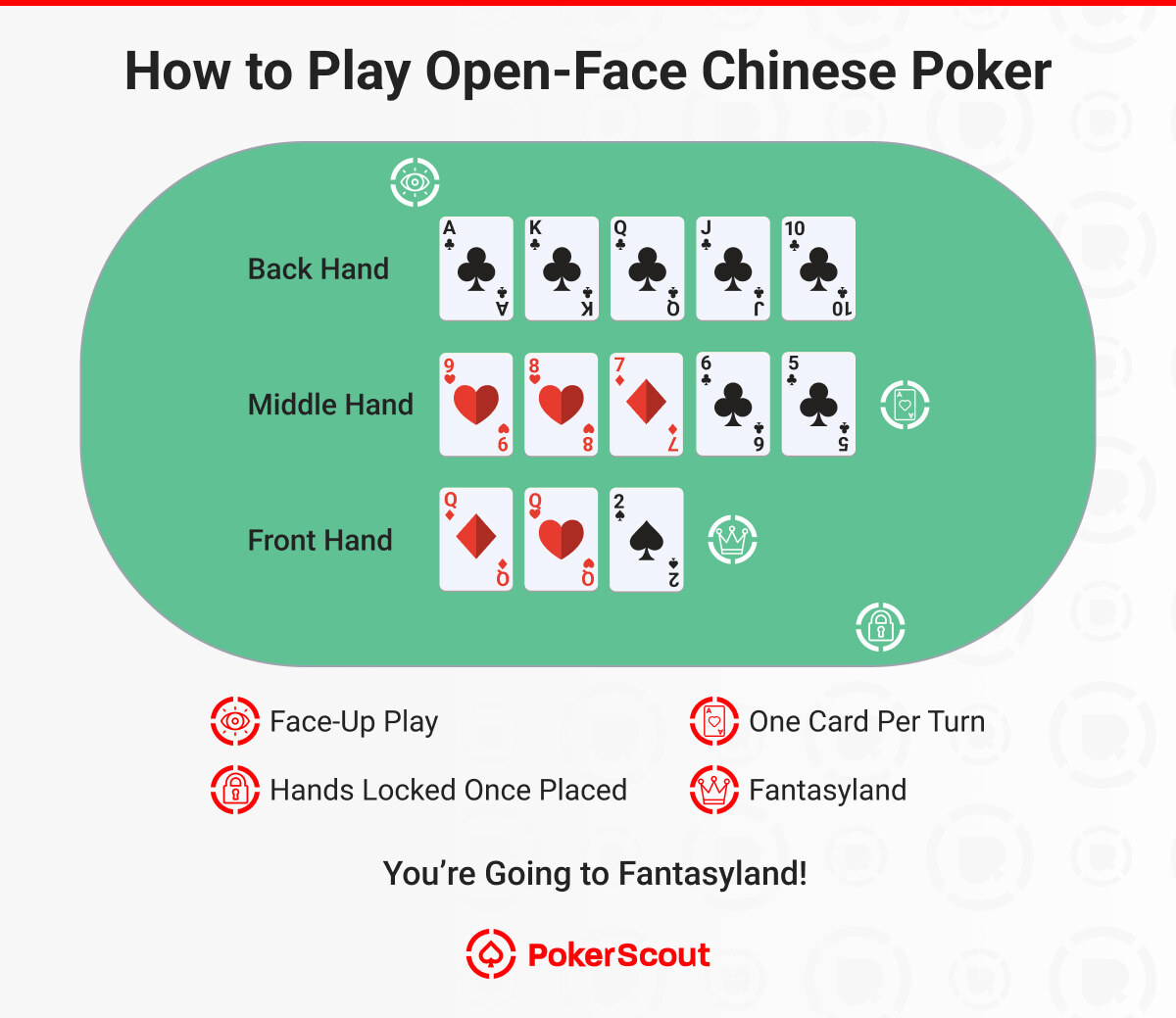
In Open-Face Chinese poker, players initially receive five cards, placing them into their hands face-up. Subsequent cards are dealt one at a time, and players must decide where to place each new card. Once set, Chinese poker combinations of hands cannot be rearranged.
Just to be clear: once you’ve created your hand arrangement, the player to your left will make their hand arrangement next. The turn finishes once the player declares their hand complete. It’s one at a time, as opposed to the typical Chinese poker rules, where everyone acts at the same time.
The most common modern version of OFC is Pineapple Open-Face Chinese Poker, where players receive three cards per turn, set two, and discard one.
How to Play OFC Poker: Fantasyland
“Fantasyland” provides an added twist on Open-Face Chinese poker scoring.
To enter Fantasyland, a player must set a pair of Queens or better (e.g., QQ, KK, AA, or any three of a kind) in the top 3-card hand arrangement. All other rows must still be set in proper order (the middle row still must beat the top row).
After qualifying for this mode of the game, a player will receive all 13 cards at once in the next hand. This allows them to make their back, middle, and front arrangements with complete information and a significant strategic advantage.
A player can also stay in Fantasyland for subsequent rounds by setting either four of a kind or better in any row, or three of a kind in the top row. If a player fouls their hand or fails to qualify again, they lose access to Fantasyland in the following round.
This mode of play significantly enhances your chances of making strong hands and potentially sweeping all opponents.
If you’d like to switch from Chinese Poker to more traditional online poker, CoinPoker is worth a look. There’s a spread of soft games, high-stakes action, tournament play, and you can even wager in crypto!
[bm_offer id=”67034″ cta=”PLAY NOW”]Conclusion
Overall, learning how to play Chinese poker is less complicated than other poker games. It’s luck-heavy, but it still offers opportunities for strategy, especially in variations like Open-Face Chinese.
Remember to follow the hand hierarchy, aim for bonuses, and double-check for placement errors. Chinese poker rules are not forgiving; fortunately, you can always play another round. Playing this game may take a little practice, but once you get the hang of it, it can be a lot of fast fun.
Or, if you’d rather play classics such as Hold’em and PLO, you can join a site like CoinPoker. If you use the code POKERSCOUT when signing up, you’ll unlock a $10 bonus on top of the standard welcome offer.