Poker Expert


If you’re just starting out on your poker journey, you don’t need to memorize a 500-page poker textbook to become a winning player. What you do need is to learn solid fundamentals and to drill those until they become second nature.
We’ve put together a selection of poker cheat sheets designed to teach you basic strategy and elevate your game. This article explains five card combinations in poker (from strongest to weakest), position, starting hand strengths, pot odds, and more, all complete with charts, visual aids, and images that you can download.
Scan through, take notes, save files, and see your poker game immediately improve with these cheat sheets for poker.
All You Need to Know
- A poker cheat sheet is the perfect way for beginners to learn new concepts and memorize common situations.
- Here you can learn the rankings, premium starting hands, and the hand ranges to play from different positions.
- A poker cheat sheet can make the maths behind the game, such as pot odds and outs, simpler and easier to understand.
- Serious players can also use them for poker bankroll management to select the optimal strategy for buy-ins.
Poker Cheat Sheet
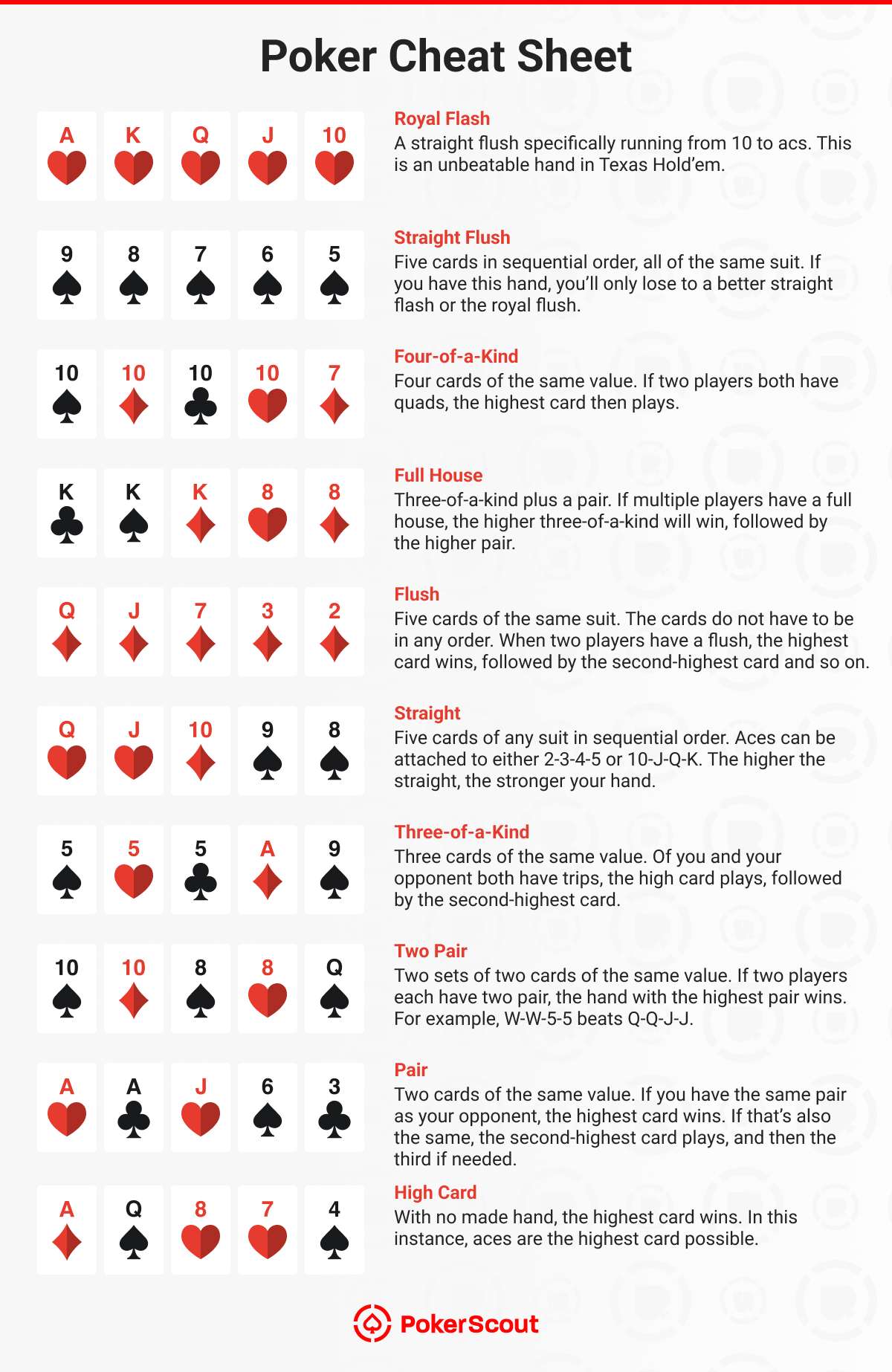
Below, you’ll find a cheat sheet that shows you all made card combinations in poker from the strongest to the weakest. You can also right-click to save it and print it out, similar to a poker cheat sheet PDF.
Complete Poker Hand Hierarchy Explained
The poker hands cheat sheet above is easy to read and understand.
It displays the complete hand hierarchies, starting with the strongest hand at the top, the Royal Flush, and progressing down to the lowest-ranked poker hand, a High Card. Hands above beat every hand below, while hands below lose to every hand above.
When figuring out poker rankings, you should also keep in mind that:
- Higher value cards beat lower ones. For example, a pair of aces beats a pair of kings, and a jack-high flush beats a nine-high flush.
- When hands are tied due to being the same rank and value, the pot is awarded to whoever has the highest other card, known as the “kicker”.
- When players have exactly the same hand, including the same kicker, the pot is split.
Poker Positions Cheat Sheet
Position is one of the most important concepts in poker strategy.
It determines not only the order of play, but also the starting hands you should enter the pot with. The poker cheat sheets below will help you understand the concept of position in poker.
Position Names & Strategic Importance
The cheat sheet for poker shown below gives you a visual indication of all of the seats at the table and their names:
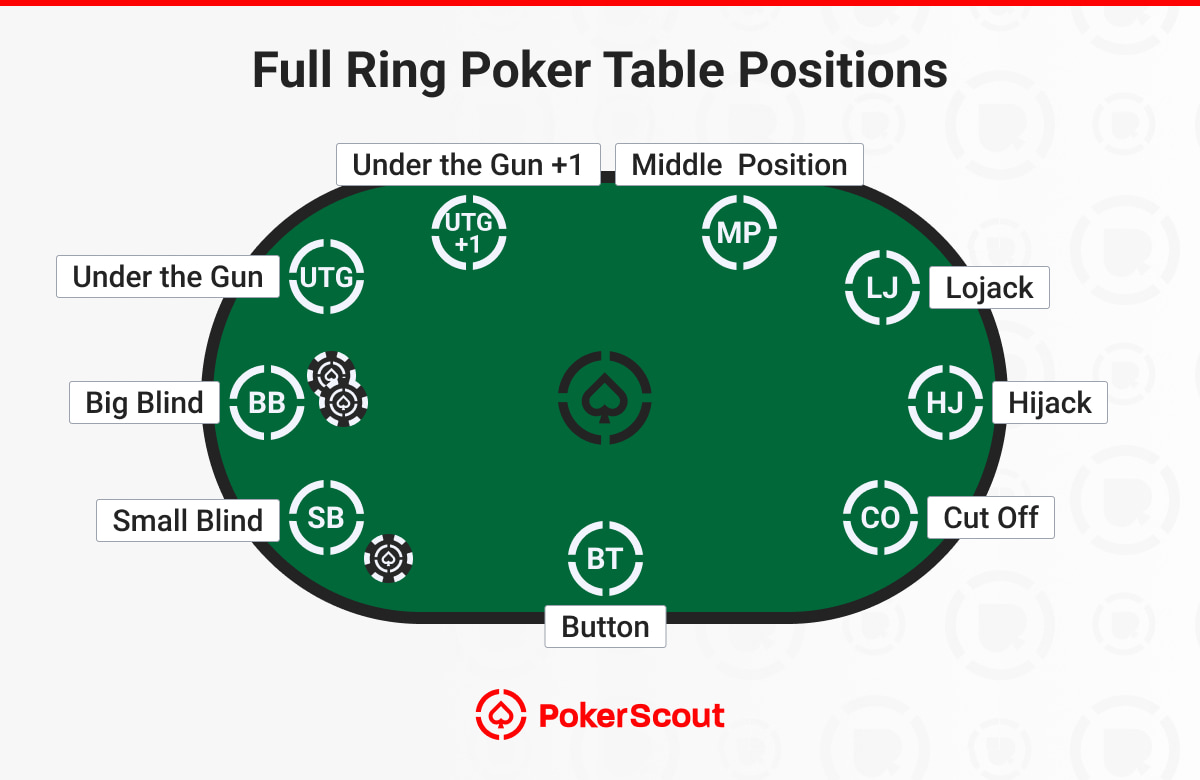
The positions at the table can be broken down into broad categories:
- Early position: Under the gun and UTG+1 are known as early positions.
- Middle position: Middle position and the lojack fall under this category.
- Late position: The hijack, cutoff, and button are late positions.
- Blinds: The small and big blind pay a compulsory bet and will nearly always be out of position postflop.
How Position Affects Your Starting Hands
The positions at the poker table also have strategic significance.
Basically, you’ll play a tighter range from early position, gradually widening the range of starting hands you play as you move towards later positions.
Here’s a quick poker cheat sheet with tips on position:
- From early position, play a very tight range. Stick to mostly premium starting hands and include a small selection of strong bluffs for balance.
- From middle position, start to widen up by including other Broadway and strong suited hands.
- From late position, you can play a very wide range to steal blinds and win pots using your positional advantage postflop.
- The small and big blind are terrible positions. However, you’ll often have the pot odds to defend with playable hands from the big blind.
Texas Hold’em Cheat Sheet for Starting Hands
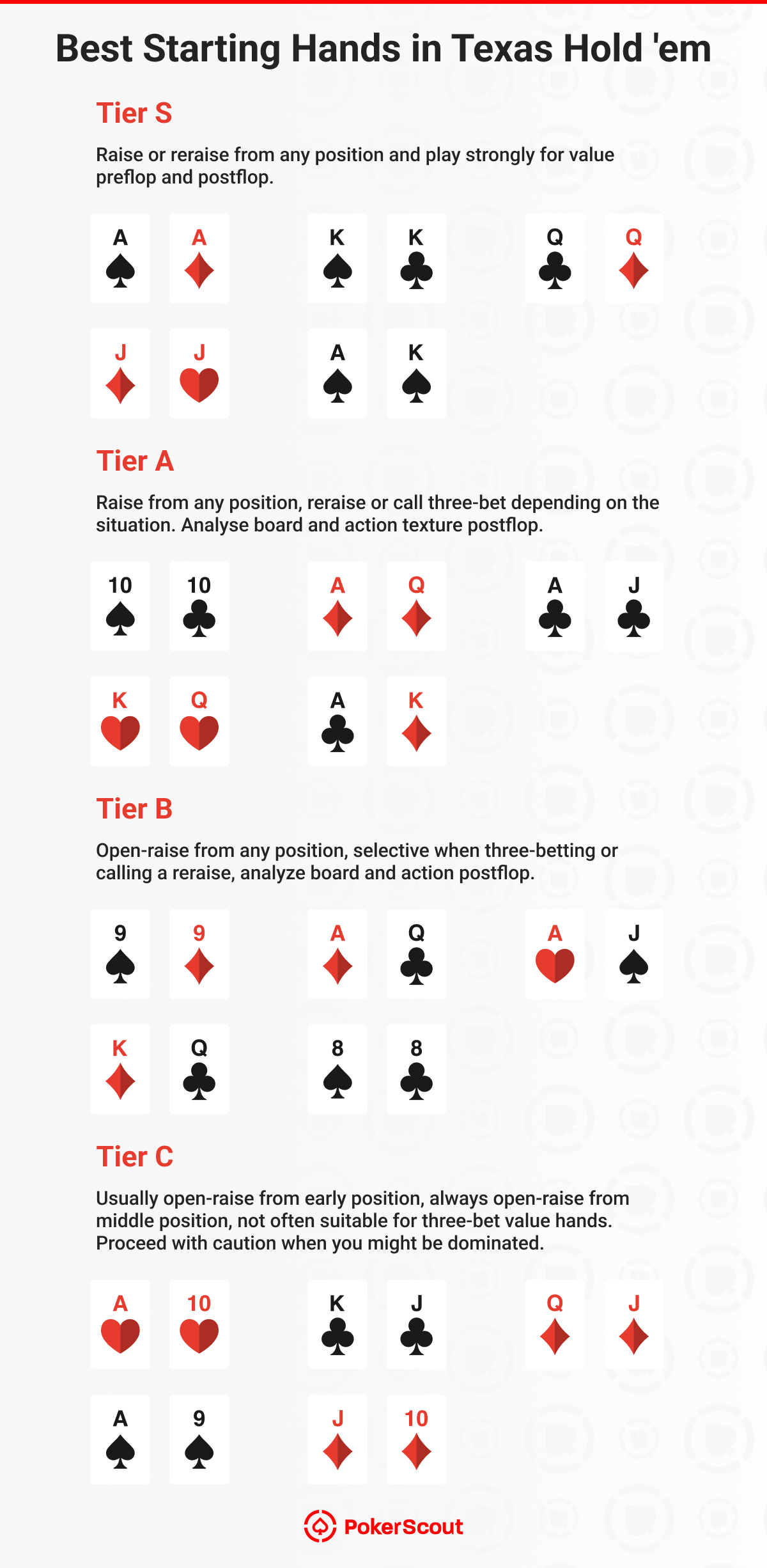
Your first decision in any poker game is which starting hands to play. These Texas Hold’em cheat sheets will guide you through the basics of hand selection, starting with premium hands that can be played from any position.
Premium Hands
Premium hands are the foundation of your starting hand selection. The top twenty starting hands shown on this poker hand cheat sheet are solver-approved, based on expected value in 100 big blinds (bb) cash games. They stand true in tournaments when stacks are deep.
Generally speaking, you can profitably enter the pot from any position with the top fifteen starting hands shown here, Tier S down to Tier B, whereas some caution may be required with Tier C hands from early position.
Suited combinations gain an equity boost and additional playability over their offsuit counterparts, which is why they appear higher on the list.
Playable Hands by Position
Hand ranges in poker strategy are determined by position.
Here’s a Texas Hold’em cheat sheet that takes you through hand ranges according to position.
These are conservative ranges so that you can’t go far wrong:
UTG opening range
Tightest range, all premium hands from Tier S to B, some Tier C hands if stacks are deep and opponents are weak.MP opening range
All premium hands, plus small to medium pocket pairs and some strong suited connectors, such as T9 suited and 98 suited.BTN opening range
All premiums, any pair, all suited aces and lots most offsuit aces, all broadways, small to medium suited connectors, suited one-gappers, lots of suited kings and queens, totally around 50 percent of hands.Blind defense ranges
From the big blind, defend with any pair, most aces, broadways, suited connectors and strong one-gappers, suited kings and queens, and medium to strong offsuit hands. Defend more tighter from the small blind, mostly premiums.
Hands to Fold (Common Beginner Mistakes)
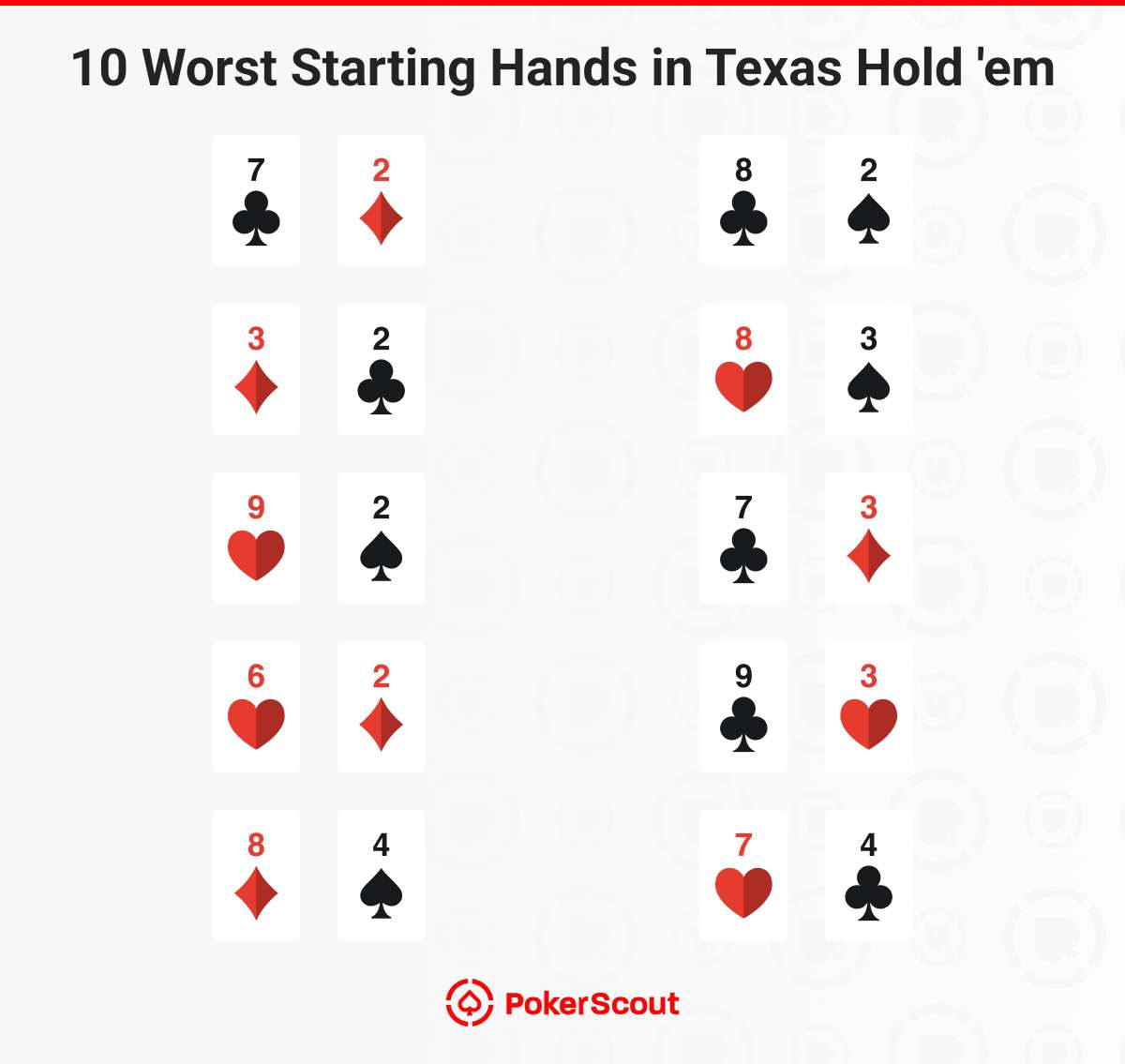
Some hands are too weak to play from any position. These hand combinations have a very low chance of winning the pot, are easily dominated, and will rarely make it to showdown.
This is your poker cheat sheet for when to fold. You should fold trash hands pretty much every time, with very few exceptions.
The ten worst hands in poker are 7-2, 8-2, 3-2, 8-3, 9-2, 7-3, 6-2, 9-3, 8-4, 7-4, all offsuit. Other low card, unconnected, unsuited hands are also worthless, while the suited versions of these hands are not much better.
Beginners should also be cautious not to overvalue speculative starting hands, such as suited connectors, one-gappers, and small pairs. They can flop well, but are easily dominated and often miss their draws. Play them as mid-to-late position semi-bluff hands, rather than as premiums.
Poker Betting Strategy: Street by Street
Each betting round has its own rhythm, and it pays to know what to look for. Use these quick cheat sheets for poker betting to sharpen your thinking from preflop to river.
- Play tight from the earlier positions, loosen up from late positions.
- Open-raise rather than limping.
- 3-bet for value or to add pressure, depending on stacks and opponent.
- Avoid calling large raises with speculative hands.
- Have a plan for later streets when heading into the hand.
- Continuation bet often in position on dry boards, with strong hands, or against weak opponents.
- Coordinated boards require stronger hands or draws to continue.
- Conversely, tighten up continuation betting from out of position, or in multi-way pots.
- Use position to bet marginal hands for protection or semi-bluff draws to gain equity.
- Start building the pot if you have a strong or nutted hand.
- Use pot control by checking or flat calling with medium hands.
- Bet consecutive streets (barrel) if your hand improves or the turn is a blank.
- Consider checking back medium hands for pot control.
- Leverage scare cards that can be used to bluff your opponent off their hand.
- Plan for the river.
- Value bet when you are ahead and can target specific ranges.
- Carefully consider showdown value and whether it’s worth betting or raising.
- Bluff only with a credible backstory or blockers that strengthen the bluff.
- Avoid hero calls unless your opponent bluffs often enough.
- Bets and calls are expensive, so discipline is crucial on the river. Folding when you are beat is crucial.
Poker Math Cheat Sheets: Essential Calculations
The most intimidating aspect of poker strategy for new or aspiring players is the mathematics that underlies decision-making. Our maths cheat sheets for poker players will give you a simple outline of the main concepts and calculations that you need to know.
Pot Odds Made Simple
Pot odds are the ratio of the size of the total pot compared to the size of the current bet. It tells you the risk-reward of calling a bet. Here’s the formula for pot odds:
- Pot Odds = Total Pot (Pot + Bet): Size Bet
- For example, the pot is $20, and the bet is $10.
- Pot Odds = 20:10, simplified to 2:1.
- You can divide the amount to call by the total pot to get a pot odds percentage:
- Pot Odds as a Percentage = Size of Bet / Total Pot = 1 / 2 = 50%.
This poker cheat sheet shows you the conversions of common pot odds ratios into percentages. The equity you need to break even when you call a bet is always the same as the pot odds percentage. When your equity, or chance of winning, is higher, the call is profitable.
| Pot Odds Ratio | Pot Odds Percentage | Equity Needed to Call |
|---|---|---|
| 1:1 | 50% | 50% |
| 2:1 | 33% | 33% |
| 3:1 | 25% | 25% |
| 4:1 | 20% | 20% |
| 5:1 | 17% | 17% |
For a much deeper dive and some examples, check out our pot odds calculator to get some practice under your belt.
Counting Outs & The Rule of 4/2 in Poker
When you have a drawing hand, you need to hit certain cards to improve and complete your draw. The cards you can hit are known as outs.
To count your outs, figure out which cards give you the winning hand, count how many of those cards are in the deck, then subtract any dead or repeat outs, such as those that are already visible.
You can then use the Rule of 4 and 2 to calculate your equity in a drawing hand based on your number of hands, in other words, your chance of hitting the draw.
- On the flop, multiply your number of outs by 4 to get your equity from flop to river.
- On the turn, multiply your number of outs by 2 to get your equity from turn to river.
For example, you have a flush draw with nine outs to complete the flush. Your rough equity on the flop is 36% (9×4), and your equity on the turn is around 18% (9×2).
Next, compare your equity to the pot odds. If your equity is greater than the pot odds, you can profitably call.
Below is a poker hands cheat sheet for common draws, showing the number of outs and equity for each type of hand.
| Draw Type | Number of Outs | Equity (Flop → River) |
|---|---|---|
| Flush draw (any suit) | 9 outs | 36% |
| Open-ended straight draw | 8 outs | 32% |
| Inside straight draw | 4 outs | 16% |
| Pair to set (flop to turn) | 2 outs | 8% |
| Straight flush draw | 15 outs | 60% |
| Straight + flush draw combo | 15 outs | 60% |
| Flush draw + two overcards combo | 11 outs | 44% |
*Outs can vary depending on the exact board. Equities are based on the Rule of 4 and 2, which provides a rough approximation using a simple formula.
Implied Odds vs Pot Odds Cheat Sheet
Implied odds factor in future bets that you could win if you hit your hand.
Simplified, the formula would be:
Implied odds = (Current pot + future expected winnings) / Cost to call
For example, the total pot before you call is $10, and the price to call is $5. If you complete your straight, you expect to win an additional $20 from your opponent. This happens around one-third of the time, so you add around $7 of value for implied odds.
Implied odds = ($10 + $7) = $17 / $5 = 3.4:1 or 22.7%.
In this situation, your pot odds are 2:1 (33%), but implied odds give you a boost: The only problem is that implied odds make a lot of assumptions. You don’t actually know for sure what future winnings will be in a hand. Your opponent could just fold at the first sign of trouble.
Implied odds, therefore, are not really used on their own, but as a minor adjustment to pot odds. The concept becomes more relevant when:
- Stacks are deep in relation to the pot, potentially allowing you to win a lot of chips when you hit.
- Opponents are aggressive or calling stations (not overly tight), making it more likely they will pay you off.
- You have position, which generally enables more opportunities to get paid.
Expected Value (EV) Quick Guide
Expected value (EV) is the amount you can reasonably expect to gain or lose in a given situation. It’s a measure of whether a particular hand or play is profitable.
EV = (Probability of Winning×Amount You Can Win) − (Probability of Losing × Amount You Could Lose)
Bankroll Management Cheat Sheet
For any player who is looking to make a sustained run at their chosen stakes, bankroll management is an absolute must. Set aside funds that are exclusively for playing poker, separate from the rest of your finances.
Recommended Buy-In Levels
Because of the element of chance in poker, known to pros as variance, you can’t rely on one or even a handful of games. You need to be able to cushion against a bad run of results so that your long-term win rate can shine through. Here’s a cheat sheet for buy-ins according to game type:
- Cash games – 40-100 full buy-ins
- Tournaments – 100 to 300 buy-ins, depending on factors like field size
- Sit & Gos – 40 -100 buy-ins
Moving Up & Down in Stakes
You should only move up in stakes when you have the skills to compete and when you are crushing your current stakes, as proven by your growing bankroll. Your bankroll should always be able to support you at the new buy-in level using your usual strategy. Don’t move up until you can afford it.
Nobody likes moving down in stakes, but doing so can stop you from losing too much of your bankroll or going broke. If your bankroll falls significantly below your buy-in strategy, adjust to a suitable level that again provides the recommended number of buy-ins.
Mental Game & Table Selection
- Table selection: Choose games that you have an edge in, such as loose cash game tables or low stakes tournaments. Only move up in stakes once your own skill level improves.
- Tilt control: Take breaks, be honest with yourself about your mental state, and don’t play when tired or buzzed. If you’re spiraling or the game is just frustrating you, get up!
- Review: Use process metrics to review play when completed, so that you’re not as concerned with the short term and can focus on long-term results.
For softer games and Sunday-style action, we use Poker Scout’s Game Finder.
Practice and Tools
If you want to further improve your poker strategy, we recommend using poker tools like solvers to analyze tougher spots or take advantage of affordable poker coaching from online sites.
Check out Poker Scout’s best poker coaching sites for top recommendations.
Most importantly, stay curious, because poker is an almost limitless rabbit hole. The poker cheat sheets we’ve taken you through today are really just the beginning. Once you start learning, the journey never stops.