Poker Expert


Texas Hold’em is the world’s most popular version of poker. At first glance, the game seems simple, but learning how to play Texas Hold’em requires a thorough understanding of the rules, timing, and strategy.
Scratch beneath the surface, and you’ll discover that Texas Hold’em is an exciting game that involves bold moves and intricate strategy.
Read on for our complete guide to Texas Hold ’em rules, hands, and essential tips for beginners.
All You Need to Know
- Texas Hold’em is the most popular type of poker in the world. It can be played at home, at the casino, or online.
- Players are dealt two hole cards with up to five community cards on the board. The goal is to make the strongest five-card combination based on the hand rankings.
- Texas Hold’em is most often played with no limit betting rules, but there are also other variations.
- Texas Hold’em rules are easy to learn and understand, but the game’s strategy is very difficult to master and involves skills like position, maths, and hand reading.
What is Texas Hold’em?
Texas Hold’em is a well-known community-card poker variant in which players use any combination of their two hole cards and five community cards to make the best possible five-card hand.
Texas Hold’em originated in Robstown, Texas, and gained popularity throughout the state before being introduced to the gambling capital of Las Vegas in the 1960s.
After the World Series of Poker’s creation and later its rise on televised broadcasts, the game became cemented as the world’s number one poker variant. If you’re learning how to play poker, Texas Hold’em is probably one of the easiest variants to understand.
How to Play Texas Hold’em: Step by Step Guide
Here’s a step-by-step guide on how to play Texas Hold’em. You can use this quick poker cheat sheet when you jump into games:
- Set up or join your chosen game, either at home, at the casino, or online.
- Before any cards are dealt, the two players to the left of the dealer place the small and big blind.
- Two hole cards are dealt to each player, followed by a round of betting.
- Players can choose to check, bet, call, raise, or fold during a betting round.
- Once the preflop betting round is over, the first three community cards – known as the flop are dealt. This is followed by the second betting round.
- The fourth community card, known as the turn, is revealed. This is followed by another betting round.
- The fifth and final community card, known as the river, is dealt. This is followed by the final betting round.
- If two or more players remain in the hand after the final betting round, the hand goes to showdown. The player with the strongest five-card combination, according to poker hand rankings, wins the pot.
- If at any point during the hand all other players fold and only one remains, they win the pot before the showdown.
- Once the hand is complete, the cards are shuffled, blinds are placed, and hole cards are dealt again.
While this step-by-step overview covers the basic flow of play, understanding the specific rules that govern each stage – from blinds and betting structures to hand rankings – is essential for playing correctly and confidently.
Texas Hold’em Basic Rules
Poker is a card game for two to ten players at each table. Chips are used for betting and keeping track of the score. Here’s a rundown of Texas Hold’em rules for beginners.
Blinds & Antes
All Texas Hold’em poker hands, whether in tournaments, cash games, online, or in-person, start the same way: the player to the immediate left of the dealer pays a compulsory bet called the small blind, the player to his direct left posts the big blind, which is typically twice double in amount.
Blinds exist in poker tournaments to ensure that there is a cost for players to take part in the game and a pot that is worth playing for. Without blinds, everyone could sit around all day waiting for A♣A♠.
Some Texas Hold’em games will also have antes, an additional compulsory amount paid by all players at the table before seeing their cards. The ante is usually a small portion of a big blind, such as 10%.
Cards
Once the blinds are posted, each player receives two cards that only they can see, known as hole cards.
The dealer distributes cards from a standard 52-card deck, face down, one at a time, starting with the player in the small blind position and moving clockwise. Once everyone has received at least one card, the dealer repeats the process.
Throughout the hand, the dealer places up to five community cards face up in the middle, which can be used by any player who is still in the hand.
Texas Hold’em Poker: Objective
The objective in Texas Hold’em is to win chips. Broadly speaking, there are two ways that you can do this:
- By holding the best five-card hand when the time comes to show your cards.
- By forcing your opponents to fold before the time comes to show your cards.
As simple as it sounds, there are many ways to do this using different Texas Hold’em strategy options, with more advanced players dedicating hours to studying at the poker training sites.
Betting Structure
To learn how to play Texas Hold’em poker, you need to understand the betting limits for that game or tournament.
Below, you’ll find the Texas Hold’em rules explained for the most common betting structures:
- Hold’em ‘no limit’: Bets are uncapped – players can bet any amount.
- Hold’em ‘pot limit’: The bet limit is the total of the pot.
- Hold’em ‘limit’: Bets are capped in each round.
- Hold’em ‘mixed’: Limit and no-limit rounds alternate.
No limit is by far the most widely used version of Texas Hold’em rules, but you will also encounter plenty of limit options available at online poker sites in the US.
One site which has plenty of Hold’em games is CoinPoker, where you can grab an extra $10 bonus using the bonus code POKERSCOUT.

Texas Hold’em Hand Rankings
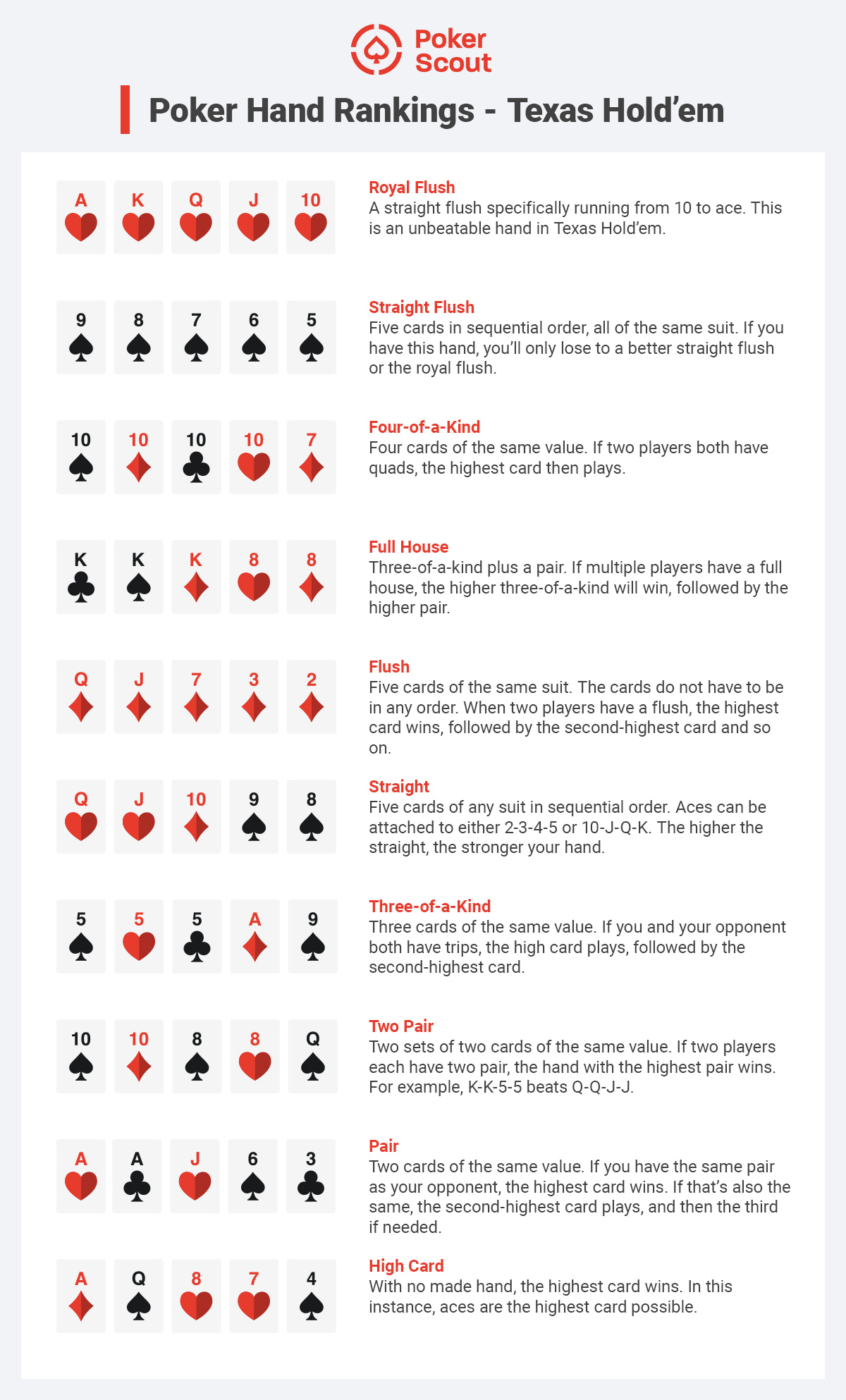
When you’re learning the basics of how to play Texas Hold’em, your starting point should be hand rankings, so that you’re confident you know which hands beat others. Here’s a Texas Hold’em cheat sheet showing hand rankings from the strongest to the weakest:
- Royal Flush: Five cards of the same suit, ranked from ace to ten; e.g. A♥K♥Q♥J♥10♥
- Straight Flush: Five cards of the same suit and ranked consecutively; e.g. 9♣8♣7♣6♣5♣
- Four of a Kind: Four cards of the same rank; e.g. J♥J♦J♣J♠7♦
- Full House: three cards of the same rank and two more cards of a different rank; e.g. 6♠6♦6♣3♠3♣
- Flush: Any five cards of the same suit; e.g. K♠10♠8♠5♠2♠
- Straight: Any five cards ranked consecutively, but not of the same suit; e.g. 7♥6♥5♣4♠3♣
- Three of a Kind: Three cards of the same rank; e.g. 8♣8♦8♠A♣4♥
- Two Pair: Two cards of one rank and two cards of another rank; e.g. K♥K♦5♥5♣2♠
- Pair: Two cards of the same rank; e.g. Q♣Q♦7♥3♣2♥
- High Card: Five unmatched cards; e.g. A♣10♦8♦5♦2♠ – this would be called “ace-high”
You shouldn’t really expect to see the highest-ranked hand in poker too often. The odds of a Royal Flush in Texas Hold’em over all seven cards are an astonishingly low 0.00323%, or once every 30,939 hands that are played to the river.
At the lower end of the Texas Hold’em cheat sheet, you’ll make a pair by the river an average of once every 2.3 hands and make a full house around 2.6% of the time, or once every 38 hands.
Understanding Position in Texas Hold’em
Position is one of the most important concepts in poker, and it is one of the first lessons you’ll encounter when learning how to play Texas Hold’em poker.
Position determines the order of play during a hand and also has significant implications for strategy.
Position is denoted by the dealer button, which moves around the table in a clockwise direction one seat per hand, and ensures that players take turns in each position.
Table Positions Explained
The image below shows all of the positions at a full-ring poker table:
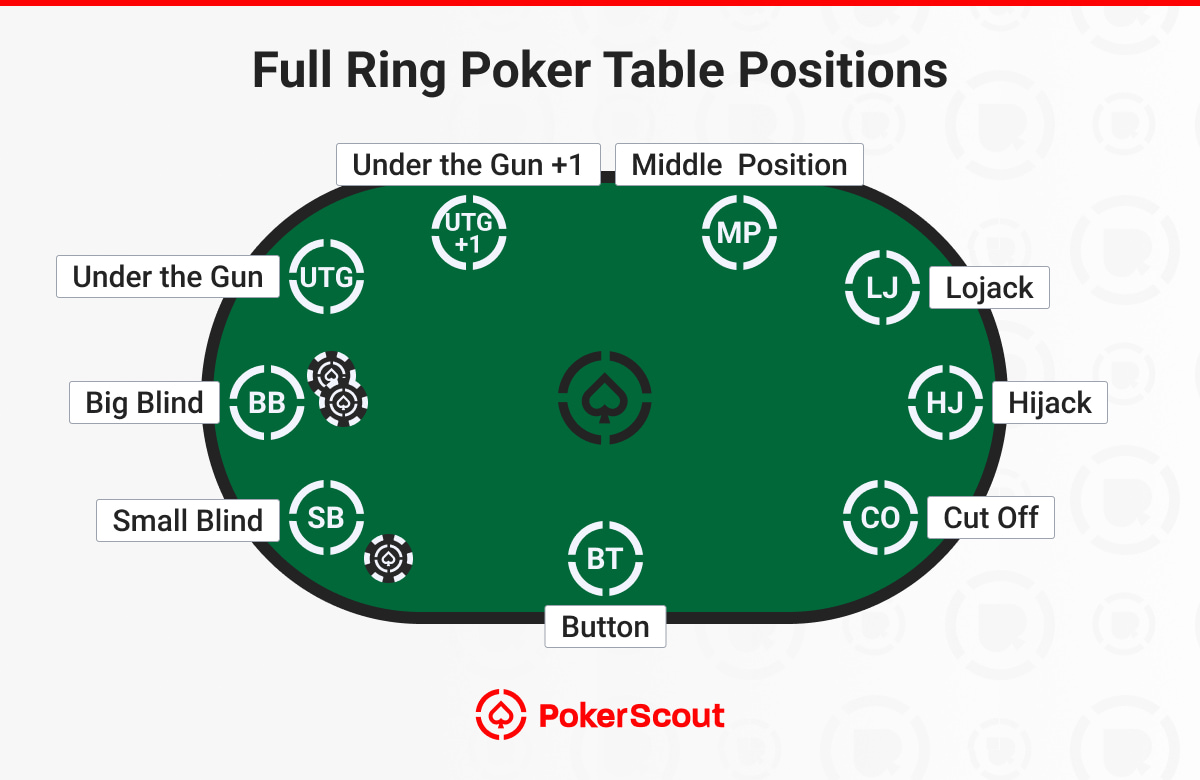
Preflop, the small and big blind post their compulsory bets, and then action is on the under the gun (UTG) player, who is first to voluntarily act. Betting then proceeds in a clockwise direction around to the button, then to the blinds, who are last to act preflop.
Postflop, betting always starts with the first active player to the left of the dealer button and once more proceeds clockwise. The last player to act during the postflop betting round has a huge advantage in Texas Hold’em strategy.
Texas Hold’em Betting
Now that we know the hand rankings and basics of how to play Texas Hold’em, it’s time to get down to another crucial aspect of gameplay, the betting. We’ll start with the different betting rounds in Texas Hold’em.
Texas Hold’em Player Betting Rounds
There are four betting rounds in Texas Hold’em: pre-flop, flop, turn, and river. This is a key part of the game and something you learn when you either play or know how to deal poker.
Texas Hold’em Bet Types
Next, we’ll take a look at the different bet types in Texas Hold’em:
In Texas Hold’em hands, we sometimes have the option to check when it’s our turn. This simply means to pass the action on to the next player in the hand, without having to raise the pot or fold.
Texas Hold’em rules state that you can only check if no bets have yet been made during the current betting round.
The first player to put chips in the middle during a round is making a bet. Bets can be made with strong hands when you want to increase the amount of chips in the pot, or with weak hands to make a bluff and encourage others to fold.
If other players want to stay in the pot, they will at least have to match your bet. Otherwise, they will have to fold.
A raise is when you increase the size of the wager so that it is more than the current bet. For example, your opponent bets $5, and you raise it up to $15. In no limit games, you can bet or raise any amount of chips up to your entire stack.
If you know how to play Texas Hold’em, you know that raising is one of the most important aspects of the game. Raising for both value and as a bluff is an essential part of a balanced, aggressive Texas Hold’em strategy.
In Texas Hold’em hands, if another player has already bet or raised before us, we can choose to call. This means to match the current bet with our own chips. If we don’t have enough chips, calling the bet would put us all-in.
If a bet has been made and you don’t wish to either call or raise, you have the option to fold. This means that you throw away or ‘muck’ your cards and sit out the remainder of the hand. You can no longer win the pot after folding.
All-In
Going all-in is a bold move where a player bets all of their remaining chips in a single hand. In Texas Hold’em, it can be a strong play when you have a great hand or even as a bluff as part of a balanced poker tournament strategy.
All-ins are much more common in no-limit games, as players can and often do move their chips in the middle as early as the preflop stage. It’s also a big part of Texas Hold’em strategy for short-stack play.
Players with a lower chip count than us only have the option to either call or fold. Players with a higher chip count can also reraise or shove over the top when we move all-in. Either way, it’s a high-risk, but powerful move that should be part of your Texas Hold’em strategy.
How Payouts Work in Texas Hold’em
Understanding how payouts work in Texas Hold’em is crucial for managing your expectations and bankroll, whether you’re playing in tournaments or cash games.
Tournament Payouts
In a Texas Hold’em tournament, the prize pool is known once registration ends. The total pool is divided among the top 10-20% of finishers, with payouts increasing the deeper you go.
Payouts in tournaments are heavily weighted towards the final table and the top few spots. The outright champion usually walks away with around 10-25% of the total prize pool.
Cash Game Payouts
Cash games are different, as the amount of chips you have in the game directly represents real money. For example, a $50 chip in a cash game represents $50 in real life. Your chips can be cashed out at any point during the game, so your payout is whatever amount you leave the table with.
Texas Hold’em Game Variants
There are variations of poker games available that suit different players and styles of play. If you know how to play Texas Hold’em, your skills are easily transferable between one game type and the next. Here are some popular types of Texas Hold’em tournaments.
Turbo
A turbo is a tournament where the levels are shorter, and the blinds increase more rapidly than in a regular game. Not for the faint-hearted, turbos offer players fast-paced action where every move can lead to dramatically increasing your stack or potentially losing everything. Expect short-stack action and exciting preflop all-ins.
Deep Stack
A deep stack game is one where players begin with a relatively high starting stack compared to the blinds. Players can see more hands and build their stack over a long period of time. Deep stack games suit patient players, as there’s no pressure to make big moves early on.
Satellites
Satellite tournaments award prizes not as cash, but as entries to larger and more lucrative poker events. They are popular because they give players a chance to participate in high-stakes games for a relatively small buy-in. These can be online poker tournaments that serve as qualifiers for major live events.
KO/PKO/Mystery Bounty
Knockouts and Progressive Knockouts (PKOs) are very popular formats of Texas Hold’em, especially online. The prize pool is split between the main payouts and bounties, which are awarded when you knock other players out of the tournament. KOs have a set bounty, while PKOs have a bounty that grows as you eliminate others. Mystery Bounties are the new kid on the block. They award randomized prizes for knockouts.
Bonus: Short Deck Poker
Once you master Texas Hold’em, you can learn how to play Short Deck poker. It’s a variant where the 2s, 3s, 4s, and 5s are removed from the deck, creating a 36-card game that plays like Hold’em. The major differences are that flushes beat full houses, and most games are played with antes rather than blinds. A novel and action-packed poker format.
Texas Hold’em vs Omaha
Two very popular variations of the game differ in one fundamental aspect: in Texas Hold’em rules, players can use any combination of their two hole cards and the five community cards to form their best five card combination.
In Omaha, players are dealt four hole cards, which creates a potential for many more combinations of starting hands. You must use exactly two hole cards and three board cards to make the strongest hand.
Texas Hold’em Strategy & Tips
Now you know how to play Texas Hold’em, it’s time to learn some strategy to give you the best chance of success at the tables.
Below are some Texas Hold’em poker tips to get you started:
- Get familiar with the language and phrases: Start by learning the poker jargon and slang that is commonly used in games to avoid feeling out of your depth at the tables. Understanding these terms will also provide a framework for describing hands and grasping basic Texas Hold’em strategy.
- Concentrate on your decision-making: Once you know the Texas Hold’em rules and hand rankings, you’ll be ready to compete at the tables. But don’t expect to win immediately. Instead, focus on studying, playing basic strategy well, and gaining experience on and off the felt. Results will follow.
- Use Texas Hold’em cheat sheets: When you are first starting out on your poker journey, it can help to use Texas Hold’em cheat sheets, which are visual guides to basic strategy and common situations. Later on, when you can make decisions confidently, you won’t need them.
- Learn about positions: You shouldn’t just play the same hands no matter where you sit at the table. Poker positions impact starting hand selection and strategy. This is one of the most important Texas Hold’em strategy concepts to learn.
- Don’t go on ‘tilt’: Being on tilt is a poker term for making careless decisions because of emotions, usually after losing a hand or two. It’s inevitable that you’ll lose some hands – don’t let this derail your game.
- Gain experience: Although Texas Hold’em rules are simple enough, the game is incredibly hard to master, and competition is tough. Aim to gain experience by watching poker content, reading, studying and integrating that into practice at the micro or low stakes before moving up.
Preflop Texas Hold’em Strategy: Starting Hand Selection
Texas Hold’em strategy begins from the moment you decide whether or not to play a hand. Starting hand selection is incredibly important because it sets the foundation for all betting on future streets.
Picking the right hands to play is half of the battle.
Here’s some general advice:
- Play premium hands from any position, such as strong pairs and top broadways.
- Play tight from early positions and widen your range in late positions.
- By the button, you can profitably raise around 50% of starting hands.
- Defend liberally in the big blind with playable suited hands.
- Always fold trash hands with low, unsuited, unconnected cards.
For example, a starting hand like K♣ T♣ plays terribly from under the gun. It’s too likely someone will wake up behind with a better hand, and you’ll nearly always have to play out of position postflop. From the button, though, the same combo solid hand to raise.
When you are the first to enter the pot, you should nearly always start off with a raise. Limping, i.e., flat calling the blind, is too weak.
Postflop Texas Hold’em Strategy: Hand Reading & Odds
Once the hand goes postflop, decisions become a lot more complicated.
Here’s a quick guide to postflop Texas Hold’em strategy and decision making:
- Assess the board texture and how it interacts with both your own hand and your opponent’s range of hands. Identify possible draws and likely made hands.
- Analyze your hand strength: Do you have a strong made hand, a weak hand, draw, or nothing at all?
- Plan your betting: Decide whether you are looking to extract value, bluff, or attempt to make it to showdown for cheap based on relative hand strength.
- If your opponent bets, calculate your pot odds and compare this with your chances of winning the hand to see if it’s worth making a call.
- As the hand progresses, narrow down your opponent’s possible range of hands based on the board cards and betting action so that you have a clearer idea of how to respond on later streets.
The above is a simplified guide to postflop decision-making. Check out further reading on Texas Hold’em strategy to delve deeper into the concepts that will make you a winning player.
5 Common Beginner Mistakes in Texas Hold’em
Here are the most common mistakes that beginners make when playing Texas Hold’em:
- Playing too many hands: Whether out of impatience or simply not knowing any better, playing too many hands is a sure way to lose a lot of chips quickly.
- Ignoring position: Starting hand selection should be based on position. Without this knowledge, you’ll overplay early positions and underplay later ones.
- Chasing draws: Beginners tend to chase draws without the correct price, paying well over the odds to see the next card.
- Overvaluing hands postflop: It’s very common for beginners to overvalue certain hands, especially when they hit postflop. Classic examples include middle pair hands, or a pair of aces with a weak kicker.
- Not adjusting to opponents: At first, you’ll learn how to play Texas Hold’em poker in a kind of set, rigid way. After a while, you’ll need to learn to adjust your hand ranges and betting to each individual opponent to maximize winnings.
How to Set Up a Texas Hold’em Home Game
One of the most fun and accessible ways to get started learning how to play Texas Hold’em is to set up your own home game. This takes the pressure off and lets you enjoy the game at your own pace in a casual environment.
To set up your own poker home game, you’ll need some basic equipment:
- Cards: Bring at least one deck, but consider bringing a spare just in case.
- Chips: You can purchase a basic poker chip set online for a few dollars; no need for anything fancy.
- Table: Any table will do, even better if you have a dedicated poker table. If not, you can purchase green felt to slide over a standard table, preventing the cards from sliding.
- Dealer button: The dealer button shows positions and play order. If you don’t have one, you can use any counter or item to mark the dealer.
- Timer: If you’re playing a home game tournament, you’ll need a timer to keep blind levels consistent. A smartphone will do.
Always establish the Texas Hold’em rules, structure, and payouts before you start playing. Even though home games are casual, all of this still needs to be outlined to avoid disputes and so everyone enjoys the evening.
Texas Hold’em Dealing
If you are setting up your own home game, it’s essential that you know both how to play Texas Hold’em and how to deal the hands.
Start by distributing a card to each player from a standard 52-card deck, face down, in a clockwise direction, starting from the dealer’s left. Once everyone has received a card, a second card is distributed in the same way as the first until all players have two hole cards.
This is followed by the first betting round. As the dealer, you are responsible for keeping the action flowing, counting bets, and giving change.
After the preflop round of betting concludes, three cards are dealt face up for the flop. After a round of betting, one more is dealt for the turn, and following that round, a final card is dealt for the river.
At the end of the hand, the dealer announces the winner at showdown and pushes the chips over towards the winning player. In the event of a tie, the dealer should split the pot.
If you’re playing at a casino, online casino, or offshore poker site such as CoinPoker, the dealing process is automatic.
How to Play Texas Hold’em Poker at a Casino
When playing poker at the casino, you may come across a game known as Ultimate Texas Hold’em. This is actually a casino table game that is played against the house using Texas Hold’em poker rules and set payout tables.
Texas Hold’em poker is also played at casinos and card rooms, which may host both scheduled tournaments and cash games that run around the clock. This is the face-to-face version of poker, played against others.
Playing poker at the casino can be intimidating, as you’ll be expected to keep up with the Texas Hold’em poker rules and flow of the game, post blinds on time, act when it is your turn, physically handle chips and cards, as well as follow a loose bunch of poker etiquette rules that can seem confusing at first.
We recommend gaining a little experience at home or playing online so that you are familiar with the basics of how to play Texas Hold’em card games before trying your hand at the casino.
Poker Etiquette
Although some poker etiquette applies when playing online, there’s a lot more to think about when it comes to live games. Even players who are familiar with the basics of Texas Hold’em can unintentionally break etiquette or overlook certain rules.
These Texas Hold’em tips ensure that your sportsmanship is never questioned:
- Always act when it is your turn. Never before or after. Acting out of turn can reveal information to other players and may even be seen as a subtle form of cheating known as angle shooting.
- When you do bet, your chips should be moved across the line in a single, smooth motion. Never splash the pot by throwing chips into the middle, or make a string bet by gradually betting more chips. Both are confusing for players and dealers alike, and could be seen as cheating.
- Always respect other players and staff. Avoid deliberately aggravating players by slowrolling, which is taking a long time to call on purpose when you clearly have the best hand. You can talk at the table, but don’t berate players and staff.
How to Play Texas Hold’em Online
In many ways, online poker platforms are a great place to get to grips with Texas Hold’em rules for beginners. You’ll find real money games online at much lower stakes than you would typically find in a casino, such as a few cents or dollars per game. There’s also less social pressure, allowing you to focus on learning the basics.
Here’s a step-by-step guide on how to play Texas Hold’em poker online:
- Select a poker site: Choose a poker site that offers games in your country.
- Register an account: Sign up for the site with your personal details.
- Make a deposit: Make your first deposit. Remember to claim any first deposit bonuses, which are a common feature at online poker sites.
- Choose your game: Scan through the lobby of your chosen poker room. Filter games by type, such as cash games or tournaments, and by stakes.
- Start low: Start with micro or low stakes games until you gain experience and build up your bankroll.
Whether you’re playing online or at a casino, remember that poker involves financial risk and can be addictive. Play responsibly, set clear limits, and never stake more than you can afford to lose. With consistent practice and disciplined bankroll management, online poker offers an accessible way to develop your skills and enjoy the game.