Poker Expert


Poker tournaments offer the prospect of winning substantial prize money while allowing players to enter for a relatively low buy-in. This is why you need to know how poker tournaments work.
We’ll guide you through the basics of poker tournament rules and share key tips to boost your profitability.
All You Need to Know
- To enter a poker tournament, players pay a set fee known as the buy-in for a starting stack of chips.
- Tournaments typically pay the top 10-20% of players, with the biggest prizes reserved for the top spots.
- There are many types of poker tournaments and various ways each game can be structured, ranging from low-stakes freezeouts to high-stakes bounties.
- Poker tournament strategy can be used to improve your win rate, from making better decisions to keeping your emotions in check.
What Are Poker Tournaments?
Poker tournaments are games with anywhere from two to thousands of players competing for a single prize pool. In a multi-table tournament (MTT), there are at least two tables of players.
As people get knocked out, the number of tables and players is gradually reduced.
The winner will take the biggest prize, but players who finish in the top 10-20% of the field also tend to earn some cash. When played at the lower stakes, a poker tournament format can be a great fit for beginners.
How Do Poker Tournaments Work?
Before joining an event, it’s important to understand how poker tournaments work and how they differ from cash games. While tournament poker rules can vary, we’ll give you a general overview of what to expect as you get started.
Buy-Ins
To enter a poker tournament, you must pay an entrance fee, known as a buy-in. In return, you’ll receive a predetermined number of chips. Every player pays the same fee and starts with the same number of chips.
Poker tournament chips have no cash value, meaning that 10,000 chips in a poker tournament are not transferable for real-life money and don’t represent $10,000 in cash.
Starting Stacks
Once you’ve paid the buy-in and the tournament begins, you’ll receive your starting stack – the number of chips you begin with.
Every player receives the same set starting stack in exchange for their buy-in.
Once the tournament begins, these chips cannot be traded in for money. They are used as part of your poker tournament strategy to gain more chips, survive, and hopefully make the payouts. As the game progresses, chip stacks will fluctuate depending on the pots won or lost.
Blinds
A key part of understanding poker tournament structure is knowing how blinds work.
Blinds are compulsory bets that players in the small and big blind positions are forced to pay before any cards are even dealt. The big blind is typically twice the size of the small blind.
These positions rotate clockwise around the table after each hand, so everyone takes turns paying the blinds.
Blinds exist in poker tournaments to ensure that there is a cost for players to take part and a pot that is worth fighting for. Without this cost, players could choose to literally play nothing except the best hands in Texas Hold’em, such as pocket aces, which would make for a very dull and pointless game.
Another point to note is that the blinds indicate the minimum bet that can be made in a round (equal to the big blind’s value). As a tournament progresses, the blind level increases, so the amount paid by the small and big blind goes up incrementally, and so do bet sizes.
The ever-increasing blinds are a huge part of how poker tournaments work that you won’t find in cash games, where the blind levels remain consistent.
Payouts
So, by now you’re probably wondering: How do poker tournament payouts work? What do you need to actually win?
No matter the type of poker tournament, you’ll always know the prize money available in advance by the time late registration closes. At this point, all entries have been made, and the prize pool has been collected based on the number of players in the tournament. Typically, the top 10-15% of the players finish “in the money”, meaning they win a cash prize, while some tourneys will pay the top 20%. The biggest prizes are reserved for the top spots.
Depending on the poker tournament structure, the outright winner will typically take 20-30% of all prize money.
Types of Poker Tournaments
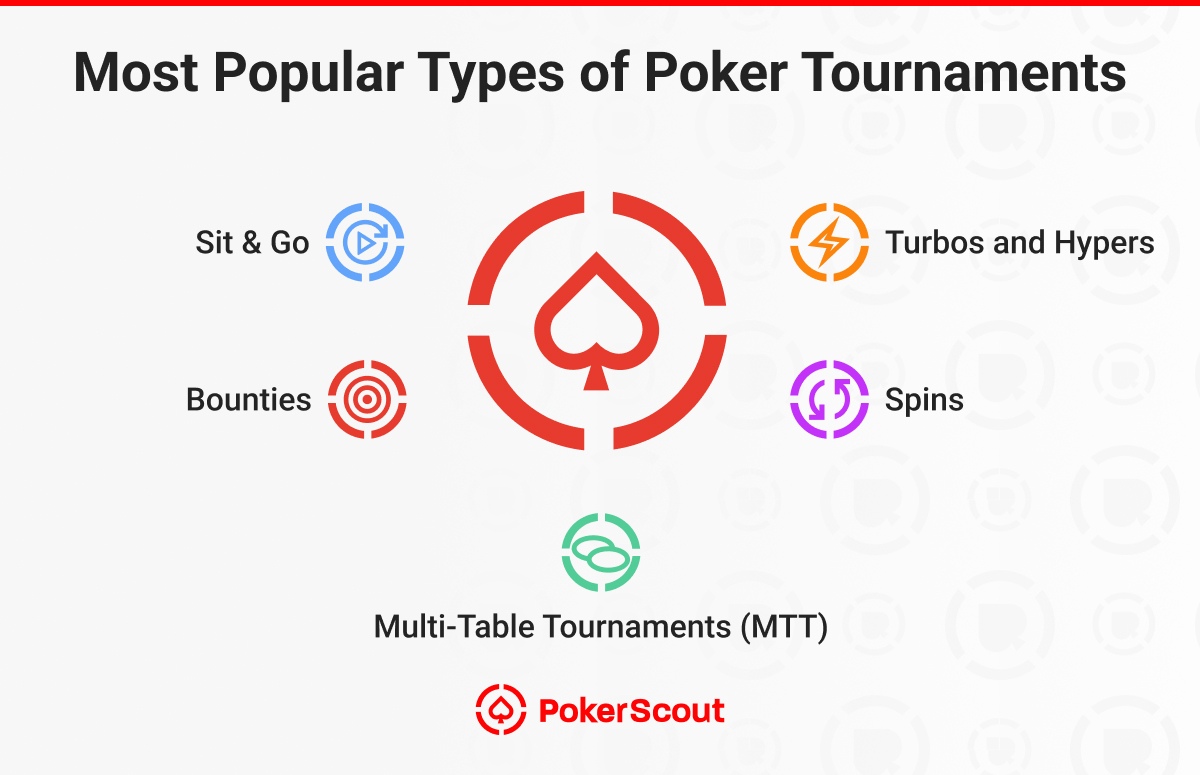
One of the most appealing aspects of poker tournaments is the many formats. There are many types of poker tournaments – Texas Hold ‘Em, Omaha, Stud, and Razz being the most popular – but also many ways in which each one is played.
Below, we outline the types of poker tournaments and their differences. Once you’ve decided on the game you play, you’ll find all of these options at popular offshore poker sites.
One of the most popular poker tournaments is the Sit & Go, also known as the SNG. These tournaments don’t start at a scheduled time – they begin as soon as enough players have registered. This can vary from as few as one table with six or nine players, all the way up to 180 or even more players.
Starting stacks are typically modest, and blinds tend to increase rapidly, so SNGs often complete quickly. This fast-paced game is popular amongst the online poker community. Because you can choose a low buy-in and a small pool of players, SNGs are a great way to learn how to play tournament poker.
If you are new to tournament poker, your first image is probably of a multi-table tournament, or MTT. These are scheduled tournaments that have a set start time and well well-defined poker tournament structure.
By definition, MTTs have at least two tables worth of players, often a lot more. MTTs are especially popular because they tend to draw larger fields, which means bigger prize pools. Players are eliminated until the money is reached, then the final table, and eventually, just one player is left standing.
Bounty games are a poker tournament format in which each player who enters has a bounty placed on their head. Whoever eliminates them from that tournament will immediately win that bounty.
The prize pool is divided into two parts: the main payouts and the prizes for eliminations. Nothing is stopping the overall winner of the tournament from not winning any bounty (barring the final heads-up hand). In contrast, players can receive bounties for eliminating others but still not cash in the tournament.
Recently, Progressive Knockouts (PKO) and Mystery Bounties have become popular, which are variations on the bounty poker tournament format.
In the turbo poker tournament structure, blinds increase quickly than in normal speed games.
In hyper turbo tournaments, the blinds increase even quicker, and players often start with a smaller stack, meaning that the action comes thick and fast. Hypers offer players the opportunity to play fast-paced poker, where every move can lead to either building a big stack or potentially losing it all.
Spins refers to an ultra-fast poker tournament format with three or four players competing for a randomly generated prize pool. These are popular with amateurs and players who love to gamble, as they only last a few minutes, and the top prize can be huge multiples of the buy-in. Most of the time, though, you’ll only play for a small prize.
How to Choose the Right Poker Tournament
Now that you know the basics of how a poker tournament works, it’s time to choose the game, format, and stakes that suit you best.
With hundreds of games running at any given time, it’s important to consider a few key factors before getting started. Some players may be drawn to tournaments with large guaranteed prize pools, while others may prefer low buy-ins or a short time limit.
Here are the top factors to consider when selecting a poker tournament.
Buy-In Level
Before paying a buy-in, you need to decide how much you’re willing to stake. The golden rule is not to play with money that you can’t afford to lose.
Tournaments with low buy-ins are attractive as they involve less pressure and generally weaker competition. This will allow you to develop your poker tournament strategy without risking too much, although be aware that opponents may be playing with a carefree style.
At the opposite end of the scale, a tournament with a high buy-in usually attracts more skilled and experienced players, as they are putting more at stake. The higher stakes are not a good place for beginners to start, both in terms of bankroll and skill.
The more you know how to play poker and the more successful you’ve been, generally, the higher buy-in you’ll play.
If you’re just starting out, you can sign up to CoinPoker. They have freerolls and MTTs with buy-ins of under $1. Plus, you can get an extra $10 bonus using the sign-up code POKERSCOUT.

Blind Speed
How long does a poker game last? The answer largely depends on the speed of the blinds.
A higher blind speed will mean that relative stack sizes will shrink more quickly, as you’ll be forced to put in more and more chips each round as the blinds rapidly increase. This is great for active players who enjoy being involved in pots, and is also the ideal poker tournament structure for players with time constraints.
However, players who prefer to bide their time and not be forced into making a move due to their stack diminishing might prefer a tournament with slower blinds.
Freezeout vs Rebuy
In a freezeout poker tournament rules, each player begins with a specified amount of chips.
When a player loses all of their chips, they are eliminated from the tournament. Rebuy or re-entry poker tournament rules differ in that when players lose all their chips, they can pay the buy-in again to re-enter the tournament. This costs the same as the original buy-in and grants the player the same starting stack.
There are benefits to both types of tournament: a freezeout means that once a player is out, they are out, and you are closer to the main prize.
But a rebuy in which they can re-enter means that a tournament can last longer. More rebuys mean a bigger prize pool, though.
Guarantee
A tournament with a guarantee is one where the prize pool is always set at a minimum amount, regardless of the number of players who enter.
For example, a tournament might offer a $100,000 guaranteed prize pool with a $1,000 buy-in, but only 80 players enter. The amount collected is $80,000, so the organizer covers $20,000, a situation known as “overlay”.
Guarantees are used to attract players to the tournament. Keep an eye out for tournaments with an overlay, as they offer great value with fewer players competing for a relatively large prize pool.
The payout structure for poker tournaments varies by event, but typically, the top 15-20% of players receive a payout. Some online poker sites in the US even offer tournaments with seven- or eight-figure guarantees.
Choosing the Right Poker Variant
Before entering a tournament, make sure you are comfortable with the game you will be playing. For example, if you don’t know how to play Razz poker, you probably shouldn’t jump straight into a Razz tournament. It’s best to stick to what you know, or at least learn the basics, before playing for real money.
So, if you know how to play Omaha poker, start with Omaha tournaments. For most players, though, Texas Hold’em is the place to start. It provides a great mix between chance and complex poker tournament strategy.
Once you are comfortable with one or two poker tournament types, you can start playing other variants or even mixed games.
Live Poker vs Online Poker Tournaments
Although tournament poker rules and strategies are the same for both online and live play, there are some vital differences that are important to know. It would be a stretch to say that they’re completely different experiences, but online players trying out a live game – and vice versa – could be in for a surprise.
Let’s take a look at how online poker tournaments work compared to live games.
Time
One significant difference between how online poker tournaments work and how poker tournaments work at casinos is that live games are significantly slower compared to their online counterparts. This is due to the amount of time it takes to shuffle and deal the cards, collect and distribute the pots, and the time spent by players thinking over a move.
Live poker is a more social affair: many players enjoy talking, laughing, and having fun, which is quite different from the fast-paced nature of online gaming.
Live Reads & Tells
Another major difference is the ability to pick up on body language and physical ‘tells’ in the live version of the game.
Most players give away information about the strength of their hand, whether by slamming the chips down when bluffing, or being more chatty when having a good hand – these can be picked up on when studying an opponent closely.
Reading an opponent’s signals, often around big, high-pressure moments, is a skill that can provide a significant advantage – something that can’t be done against online players.
Poker Software & Calculators
Poker is a game of skill that can be studied and improved over time. If you like, you can use poker software and calculator tools. These applications help you to analyze hands and suggest moves to ensure optimal play.
Using poker software like solvers during a tournament is against the rules. However, there’s no harm in using poker tools to go back and study your previous hands. It’s something nearly all top pros do.
Live poker tournament rules can be even stricter. Software use is completely banned, and sometimes even having a laptop at the table is not permitted.
Buy-ins and Game Selection
The online poker world has a vast number of games available at any time of day.
These include games with low buy-ins. In live poker, it’s much more difficult to find tournaments that offer low buy-ins, while game selection is generally limited to the few tournaments a casino has on the schedule.
Poker Tournament Strategy
To give you the best chance at the tables, you need a solid poker tournament strategy. Below are three tips to get you started:
- Learn the rules: To avoid feeling lost and confused, begin by learning the poker tournament rules, familiarise yourself with the betting rounds, and get to know poker tournament structures for different types of games.
- Make sensible decisions: Don’t make the mistake of expecting to win every time you play. Focus on studying the basics, playing good hands, and learning from mistakes. The results will follow.
- Avoid being on ‘tilt’: Being on ‘tilt’ is a poker term for making rash decisions based on emotion. Inexperienced players often lose hands, which then negatively impacts the rest of their play. Don’t let this happen – take a break if necessary.
Remember that poker combines skill and chance. Improvement comes through consistent practice, studying your hands, and staying disciplined. Play responsibly and within your limits.