Poker Expert


Figuring out how to play poker might seem daunting, but the basics are straightforward.
This beginner’s guide will cover poker rules, hand rankings, position and betting rounds, as well as a few strategy tips to get you started. By the time you’ve read this poker tutorial, you’ll be ready to hit the tables.
All You Need to Know
- In poker, the goal is to win chips by making the strongest five-card combination or by forcing other players to fold their hands.
- Poker can be played at casinos, online poker rooms, and at home. For a home game, you’ll need a deck of cards, chips, a table, and players.
- When learning how to play poker, start by understanding the rules, hand rankings, betting rounds, and player positions.
- We recommend that you first learn Texas Hold’em, and then you can try other variations if you want to.
What is Poker?
Poker is a card game with multiple variations that all share commonalities.
Players aim to make the strongest five-card combination according to the poker rules of the game they are playing. All poker games also involve multiple rounds of betting.
The most popular format, and your likely starting point if you’re looking to learn how to play poker, is Texas Hold’em, which will be the main focus of this poker guide.
A great starting point is to sign up at CoinPoker, where you can play all the most popular formats and even bag an extra $10 bonus using the sign-up code POKERSCOUT.

Game Objective
The primary objective of the game in poker is to accumulate chips. In Texas Hold’em, there are two ways to accomplish this goal:
- Make the strongest possible five-card hand using any combination of two hole cards and five community cards.
- Win the pot by making others fold to your bets or raises.
In other poker games, the objective is the same: to win chips.
The main difference is how the hand is formed. For example, in Omaha poker, players are dealt four hole cards and must use exactly two of them, along with three community cards, to make their hand.
Poker as Skill vs Luck
Poker is a game of part skill and part chance.
There are several elements that are beyond your control. You have no influence over the cards that you or other players are dealt, or how the community cards run out. You do, however, have a great deal of influence over which hands you play and how you play them. All betting decisions are up to you, and this is where the skill comes in.
In the short term, anything can happen. In the long term, players with an edge win more often.
What You Need to Play
If you’re playing online poker, all you need is a laptop or mobile device, along with a stable internet connection.
If you’re playing at a casino or looking for how to play poker at home, you’ll need the following equipment:
- A standard 52-card deck of playing cards.
- A chip set with enough to give all players what they need.
- A poker table or any playing surface. (Consider covering a normal table with green felt.)
- A minimum of two and a maximum of ten players per table.
Understanding Playing Cards
Let’s start with the very basics of how to play poker for beginners.
Every poker game is played with a 52-card deck, with no jokers or wild cards. The number of cards you’re dealt depends on the poker variant. In Texas Hold’em, you’re dealt two private hole cards. There are also five face-up cards, called community cards, which are dealt in the middle of the table.
These can be used by any player when making their hand.
Poker Hand Rankings
There are a lot of poker game rules you need to learn to get started, but it’s also important to have a proper understanding of poker hands, which you can find in our poker cheat sheet guide.
You can also check out our poker guide sheet below, which shows you the hand rankings for the most common version of poker, Texas Hold’em.
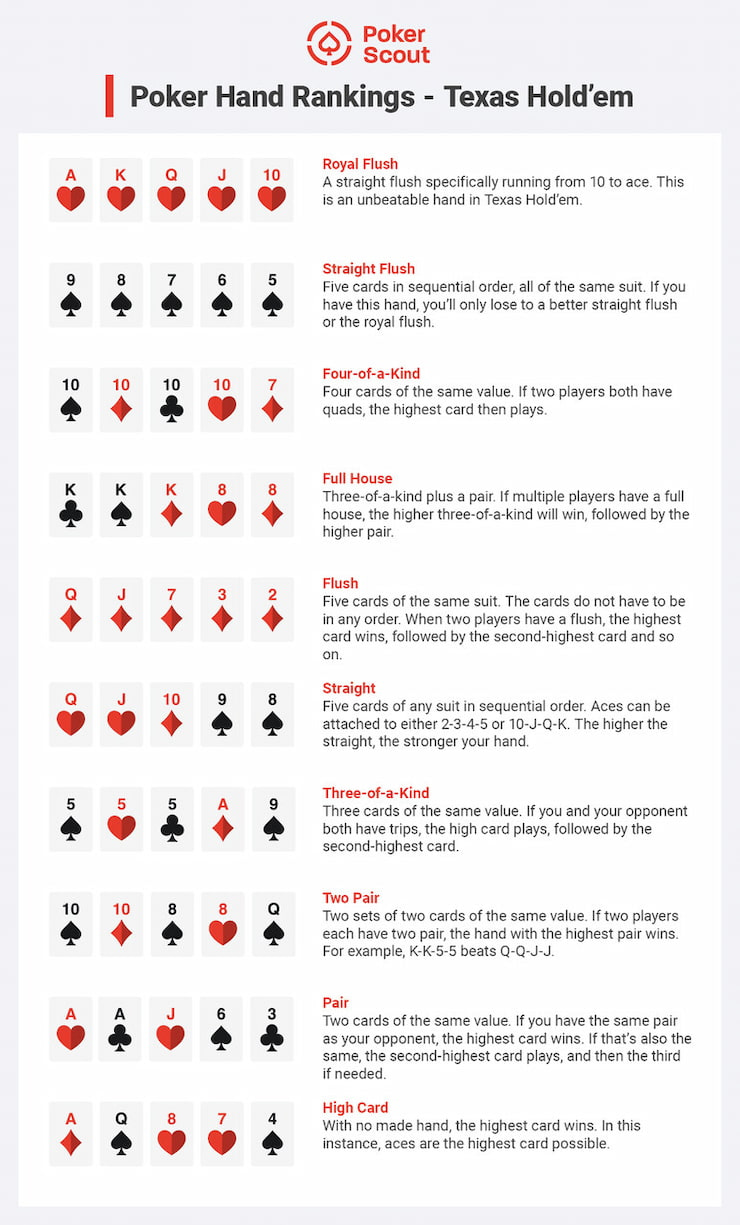
Most other poker games also follow these hand rankings.
High Card Through Royal Flush
The weakest hand in poker is a High Card, which is the absence of any other made hand.
One pair hands are common, and strong ones can win the pot. You’ll make a pair pretty often in poker, around 33 percent of the time on the flop. At the other end of the spectrum, a Straight Flush is the best hand you can make in poker, and a Royal Flush is the absolute top Straight Flush, made up of A-K-Q-J-T all of the same suit.
You’ll make a Royal Flush by the river only once every 30,940 hands on average. Fingers crossed!
Hand Ranking Memorization Tips
When you learn how to play poker as a beginner, one of the first steps is memorizing the hand rankings so that you know what hands beat others. Here are some tips to help:
- Some hand rankings are intuitive. It’s clear, for example, that One Pair beats a High Card, and that Two Pair beats a pair.
- Remember that three of a kind always beats two pair.
- Beginners often find the middle to top of the table more confusing. Memorize the order of Straight → Flush → Full House → Four of a Kind.
- Most players also know that the best hand in poker is the Royal Flush and that it is a type of Straight flush.
Betting Actions & Terminology
No online poker tutorial for beginners would be complete without clear explanations of the different types of bets you can make. During each betting round, depending on the action so far, you’ll have a choice out of the following:
Fold
If you don’t want to match the current bet or raise by putting in the required amount of chips, you can forfeit your hand by placing your cards out of play, known as mucking or folding.
There’s no shame in folding. Whether you’re just learning how to play poker or you’re a seasoned veteran, you’ll fold most of the hands you play. That includes most of the weak hands you are dealt preflop, as well as when you think your opponent has a stronger holding.
Check
A check in poker means that you are passing your turn to the next player without putting more chips into the pot. It’s only possible if no bet has yet been made on the current round. If you check when you are last to act, the hand goes to the next street or to showdown.
Bet
A bet is the first action made during the round where chips are added to the pot. In Texas Hold’em poker rules, the minimum bet is one big blind, and the maximum is your entire stack. When you bet, other players must at least match your bet to stay in the pot.
Raise
Raising involves putting more than the required amount of chips in the middle when an opponent has already bet or raised. For example, Player A bets $10, and Player B raises it to $30. Other players must then at least match your raise to stay in the pot.
Call
If your opponent makes a bet or raises and you want to stay in the hand, you’re required to at least match the required amount of chips. This is referred to as a “call.”
All-in
Going all-in means calling, betting, or raising for all of your chips. If you’re learning how to play poker, going all-in may seem scary. But it’s an essential move which you’ll need to use repeatedly in a tournament if you have any chance of winning.
Betting Rounds Explained
If you’re following our poker guide, you now know all the different actions you can make during a betting round. Next, it’s time to learn when you can make them.
There are some variations based on which poker game you’re playing. For now, we’ll stick with the four betting rounds and streets of community card games like Texas Hold’em and Omaha.
Preflop
Before the cards are dealt, the two players to the left of the dealer place compulsory bets, known as the small and big blind. This ensures there’s always some chips in the middle to play for.
Each player receives their two face-down cards, known as hole cards, and views them in private. The action then moves in a clockwise direction based on poker positions, which we’ll cover in more detail soon. This is the first round of betting in a hand.
Players can choose to fold, call the blind (known as limping), or raise.
Flop
Once the pre-flop action concludes, three community cards are dealt, known as the flop.
All players can use these cards in combination with their hole cards to make their best hand. Again, the betting moves clockwise, starting with the first active player to the left of the dealer. If no bets have been made yet, players can check or place a bet.
If a bet has already been made, players can fold, call, or raise.
Turn
If two or more players are active after the flop betting round is completed, the next card is dealt, known as the turn. Action again begins from the left of the dealer, and betting takes place in exactly the same way as on the flop.
River
A final card is dealt, and then the final betting opportunity starts. If you’re bluffing, this is your last chance to push your opponent off their hand before you get found out. If you have a strong hand, it’s your last chance to win some extra chips.
Showdown
During any betting round, if all players fold except for one, the hand ends, and that player wins the pot. If two or more players remain after the final betting round on the river, the hand goes to showdown. Players flip their cards, and the best hand wins. This happens automatically online.
At a casino, the dealer will announce the winning hand and push the chips to the winner.
Betting Limits
There are three main types of betting limits in poker, which determine the amount of chips players can bet.
- No limit: This is the most common form of poker, in which you can bet as much as you want at any stage, up to the value of your entire stack.
- Pot limit: Another popular structure is pot limit, in which you can’t bet more than the number of chips in the pot.
- Fixed limit: An even more restrictive format, which is usually limited to the small bet and big bet, with a fixed maximum number of bets and raises each round.
If you’re beginning your journey of how to play poker online, it’s easy to see the betting limits before you take your seat. All of the information will be in the lobby. At a casino, betting limits are always clearly outlined.
Poker Positions Explained
Position is one of the most important aspects of learning how to play poker. Here’s a breakdown of each position and why it matters:
Why Position Matters
For beginners who are learning how to play poker, it may seem like the only role of position is to determine the order of play. However, position also has implications for poker strategy.
- Preflop, players in early position have many opponents still to act behind them.
- Players in late position have fewer opponents still to act preflop.
- The player who acts first postflop, known as the out-of-position player, has a disadvantage.
- The player who acts last preflop, known as the in position player, gains more information and has greater control over the pot.
Essentially, early positions are weak, while late positions are advantageous.
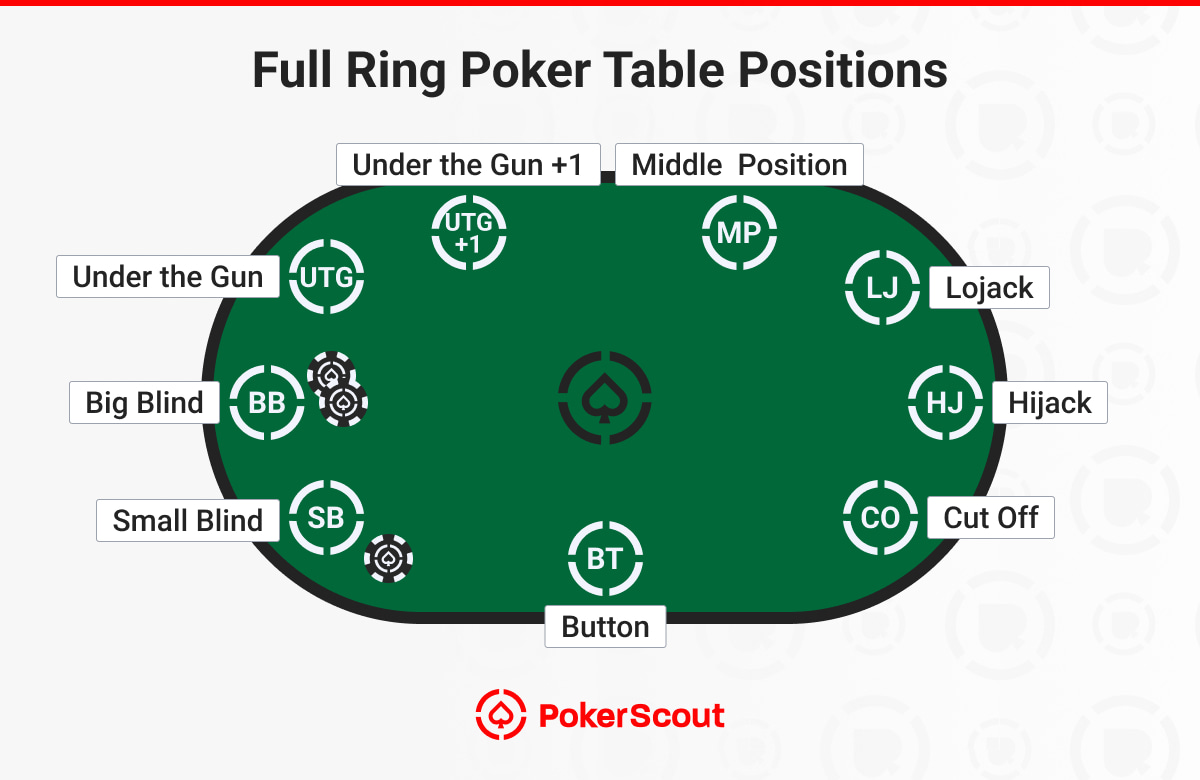
Early, Middle, & Late Position
Early positions, such as under the gun (UTG) and UTG+1, are the weakest at the table.
Preflop, you still have lots of other players left to act behind who could wake up with a big hand. Postflop, you’ll nearly always be out of position. As you move around towards the middle positions, you can start to widen your starting hand selection a little, but must still proceed with caution.
In late positions, such as the button, cutoff, and hijack, you have a chance to get aggressive, raising a wide range of hands to steal pots and outplay opponents postflop.
Dealer Button
The dealer position is the absolute strongest seat at the table.
Preflop, there’s only the blinds left to act. Postflop, you’ll always act last, which gives you more information and more control over the size of the pot. The dealer button moves around the table in a clockwise direction after every hand, so that players take turns in each position.
Blinds
The two players to the immediate left of the button are the small and big blind.
They pay compulsory bets preflop before the cards are dealt. The small blind is usually half the big blind. These positions are undesirable, although you’ll often have the right odds to play from the big blind given the bet you’ve already placed.
Common Beginner Mistakes
Here are the most common mistakes for beginners learning how to play poker:
- Not understanding the rules: Before even playing, you’ll need to know the rules of poker for the game that you want to play. Not knowing them will ruin the game flow.
- Misunderstanding hand strength: Not knowing the hand rankings or values can lead to misreading and misplaying hands.
- Betting mistakes: Placing chips wrong in a live game, betting out of turn, or betting the wrong amount.
- Disregarding position: Playing too many hands from early position or playing too recklessly from out of position postflop.
Poker Variants for Beginners
You’ll see lots of different versions of poker, especially at online sites, each with its own poker game rules. It might be tricky knowing where to start.
When you’re new to poker, learning how to play Texas Hold’em poker is definitely the safest starting point. You can learn it quickly and then develop your skills at poker training sites. The accessibility of Texas Hold ’em, in terms of both strategy information and game availability, makes it the perfect choice for beginners.
As you become more experienced, you can add other poker variants. The skills you learn in one game are often transferable to other types of poker.
Here’s a brief explanation of the different types of poker you can play.
Texas Hold’em (Most Popular)
Many players want to learn to play Texas Hold’em, as it is by far the most popular version of poker.
In this game, you’re dealt two hole cards followed by three community cards (the flop), a fourth (the turn), and a fifth (the river). Your goal is to make the best five-card hand using whichever cards work best.
Omaha (Intermediate)
There are significant similarities and differences in how to play Omaha versus Hold’em.
In Omaha, you’ll receive four hole cards instead of two. However, you must use precisely two hole cards and three community cards. Betting rounds work the same way as Hold’em. However, it’s more common to find Omaha in a pot limit format.
This helps limit too many all-ins, which is needed because Omaha hands are often packed with potential for future streets.
These are three common variants of Omaha:
- Pot Limit Omaha (PLO): The standard and most popular version of Omaha.
- Omaha Hi/Lo (PLO8): The Hi Lo split pot version of Omaha.
- Five-Card Omaha (PLO5): Players are dealt five hole cards but must still use exactly two.
5-Card Draw (Simplest)
In Five Card Draw poker, you’re dealt five starting cards and have the opportunity to discard and redraw as many or as few cards as you choose in between the two betting rounds.
In many ways, Draw is the simplest type of poker to learn. With only one draw and two betting rounds, you’ll be able to get a hang of basics like hand rankings and betting. Learning how to play 5 Card Poker is a good starting point for beginners.
There are also tons of draw poker formats if you take to the game, including:
- A-5 Lowball Draw: Draw to the lowest possible hand, which is A-2-3-4-5.
- Deuce to Seven Lowball: Similar. Draw to the lowest possible hand, but aces are high, and flushes and straights count against you.
- Badugi: A fun draw poker variation that you’ll often learn how to play at home.
Stud Variants (Advanced)
Seven-Card Stud used to be the go-to game in poker, but has been overtaken by Hold’em.
It’s now much harder to find stud events with huge guarantees, although you’ll still find Stud online or as part of mixed games. Unlike Hold’em and Omaha, there are no community cards in Stud. Instead, you receive a mixture of face-up and face-down cards.
Your opponents will be able to see some of your cards, adding an interesting nuance to hand strengths and bluffs.
As an entirely different format of poker, and one that has some tricky elements, we recommend you learn Stud later, after learning how to play Texas Hold’em poker and other games.
Tournaments vs Cash Games
Poker is split into two categories: cash games and tournaments.
Both follow the same basic set of poker game rules, but the two formats are structured very differently. Most players tend to prefer one over the other, although there’s nothing stopping you from trying both.
Tournaments
Even though there are all different types of tourneys, you can still quickly learn how poker tournaments work on a basic level.
In a tournament, every player pays a fixed fee, known as a buy-in, and receives the same number of chips. These chips have no direct monetary value. You then play until you’re eliminated. A standard poker tournament payout structure typically awards prizes to the top 10-20% of players, and online poker tournaments often have substantial guarantees.
There are two main reasons tourneys are better when you’re learning how to play poker:
- Limited losses: You know exactly how much you stand to lose as soon as you sit down. If it’s a $5.50 tournament, you can go all in and lose that exact amount.
- Fair fight: Every player starts with the same number of chips. This differs from cash games, where one player typically has more money than the other.
- Strategy: There are some elements of tournament strategy that don’t apply to cash games. Arguably, you’ll get a well-rounded education when learning how to play poker tournaments.
Cash Games
When you play cash games, each chip has a dollar value.
When you win, you’re winning straight cash that you can take to the bank. But when you lose, that’s actual money draining from your wallet. The directness of cash games can feel intimidating for a beginner, although in reality, there’s less variance involved.
- Direct money: This can be a pro or a con depending on how you look at it, but it’s certainly risky if you’re only just figuring out how to play poker.
- No time limits: In cash games, you don’t have to wait until you’re eliminated. You can come and go as you please – even after a single hand, if you like.
How to Play Poker at a Casino
If you want to join a live poker event at a casino, start by heading to the venue and checking in at the poker desk. If there’s a tournament starting, you can register and pay the buy-in there. You’ll be given your starting stack and allotted a random seat and table number.
For cash games, you can either take a free seat or be added to a waiting list, depending on how busy the room is. You’ll also see casino poker. This is played against the house and, despite the name and similar rules, it’s a totally different game.
Alternatively, you can enjoy all types of poker online at offshore poker sites.
Poker Etiquette & Table Rules
If you’re looking at how to play poker in a casino, it’s crucial that you’re already familiar with the poker rules for the game that you want to play. When playing live, you’ll also need to keep up with the flow of the game, which means placing blinds and betting in turn.
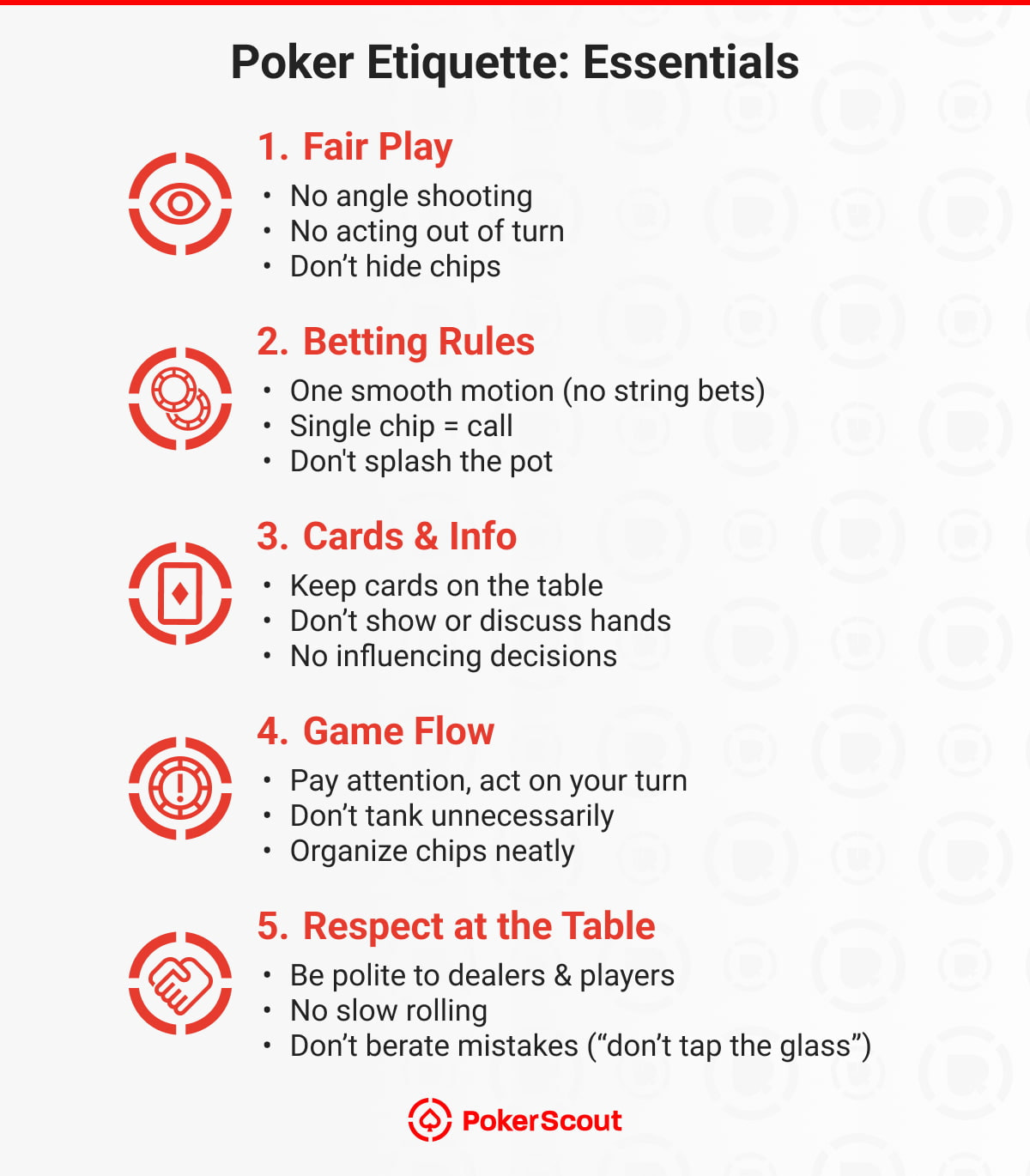
There’s quite a bit of poker etiquette when playing in a casino environment. These are the unwritten rules of the poker game designed to promote fair gaming in an enjoyable setting.
Basic Table Etiquette
- Don’t try to gain an unfair advantage by peeking at cards or bending the rules of poker.
- Place your chips in the middle in one smooth motion when making a bet or raise.
- Always pay attention, post blinds, and act swiftly when it is your turn.
- Respect players, dealers, and floor staff.
Setting Up Your First Home Game
One of the most enjoyable ways for beginners to learn how to play poker is by setting up a home game. This allows you to play casually between friends, while learning the rules and basic strategy as you go along.
Here’s a quick guide to setting up your own home game:
Gather materials
Gather everything you need to play poker: a deck of cards, chips, a table, a dealer button, and some players.Table setup
Give all players the correct amount of chips. Draw cards for who starts with the dealer button.Establishing house rules
Before the game begins, it’s important to establish all of the poker rules and structure you’ll be using, such as the format of the game, blind levels, and how long players can rebuy.
How to Deal Poker
Part of learning how to play poker at home is knowing how to deal.
It’s the dealer’s job to shuffle and distribute the cards, keep the game moving, check all bets are accurate, and push the pot to the winning player.
Step-by-Step Dealing Procedure
- Make sure the small and big blind have placed their compulsory bets, and shuffle the deck to randomize the cards.
- Deal out hole cards to players, one at a time, starting with the small blind and moving clockwise around the table until every player has two cards.
- After the first betting round, burn one card and then place three community cards face-up in the middle of the table, known as the flop.
- After the second betting round, burn one card and place one community card face-up, known as the turn.
- After the third betting round, burn one card and place a final community card face-up, known as the river.
- Following the final betting round, if two or more players are left in the pot, the hand goes to showdown. The winner is the player with the strongest five-card combination.
Poker Tips for Beginners
Your journey from learning how to play poker to becoming a winning player is a long and challenging road. It takes a lot of time and effort to go from basic poker rules to advanced poker strategy.
For now, here are some top poker tips for beginners to get you started:
- Play positionally: As we’ve touched on, poker strategy is very much about position. Stick to premium hands from early positions and loosen up from later positions.
- Aggression is key: Beginners may struggle to understand that playing passively is not a winning style. You’ll need to bet and raise, applying pressure with both strong hands and bluffs.
- Pot odds and equity: Poker is fundamentally a game of maths and probability. When learning how to play poker, focus on key concepts such as equity and pot odds.
- Read opponents: As poker is played against others, you can gain an edge by taking note of how opponents play. You can then use this info to adjust your own strategy.
- Bankroll management: Always set aside funds that you can afford to lose. Then, play stakes that are well within your limits.
Start by playing low-stakes games to practise these fundamentals without risking significant money, and gradually move up as your skills improve. Remember that poker involves financial risk and can be addictive.
Play responsibly, set clear limits, and never stake more than you can afford to lose.