Poker Expert


Learning how to deal poker takes practice. You might not notice a great dealer, but you’ll definitely spot a bad one. If you’re planning to host home games, knowing how to deal properly is a must. We’ll take you step-by-step through the basics so you can get started with confidence.
All You Need to Know
- Dealing in poker involves shuffling the deck, distributing the cards, and keeping control of the betting action throughout the hand.
- To deal poker correctly, you’ll need to know the rules of the game you are playing as well as any poker dealer rules.
- Dealing poker requires an understanding of concepts such as blinds, antes, bet sizing, burn procedures, and poker hand rankings.
- Each poker variation requires a different approach to dealing.
What Is Dealing in Poker?
Dealing in poker involves shuffling and distributing the cards to players at the table. There are specific poker dealer rules that must be followed to ensure randomness, fairness, and smooth game flow. The cards should be shuffled properly and dealt in a clockwise direction. Dealers also need to be familiar with key mechanics, such as blinds and antes, burning cards, and counting bets.
In casinos, professional dealers will take care of every poker deal. At online poker sites, shuffling and dealing happen automatically using random number generators (RNGs). At smaller venues or home games, the players themselves may share the duty. This is where it helps to know how to shuffle and how to deal a poker game.
What Does a Poker Dealer Do?
A live poker game cannot be played without a dealer: someone who distributes the cards in the correct order, at the correct times, and who manages the betting in each round. Knowing how to deal in poker is vital to ensuring that the game runs smoothly and fairly from one hand to the next.
The role of a poker dealer includes shuffling and then circulating the hole cards, then dealing the community cards in stages. You will also need to know the small and big blind amounts and oversee the pot during each stage of the action.
Use our Texas Hold’em guide to help you get up to speed on the rules so that you know how to deal poker, too.
How to Deal Poker: A Step-by-Step Guide
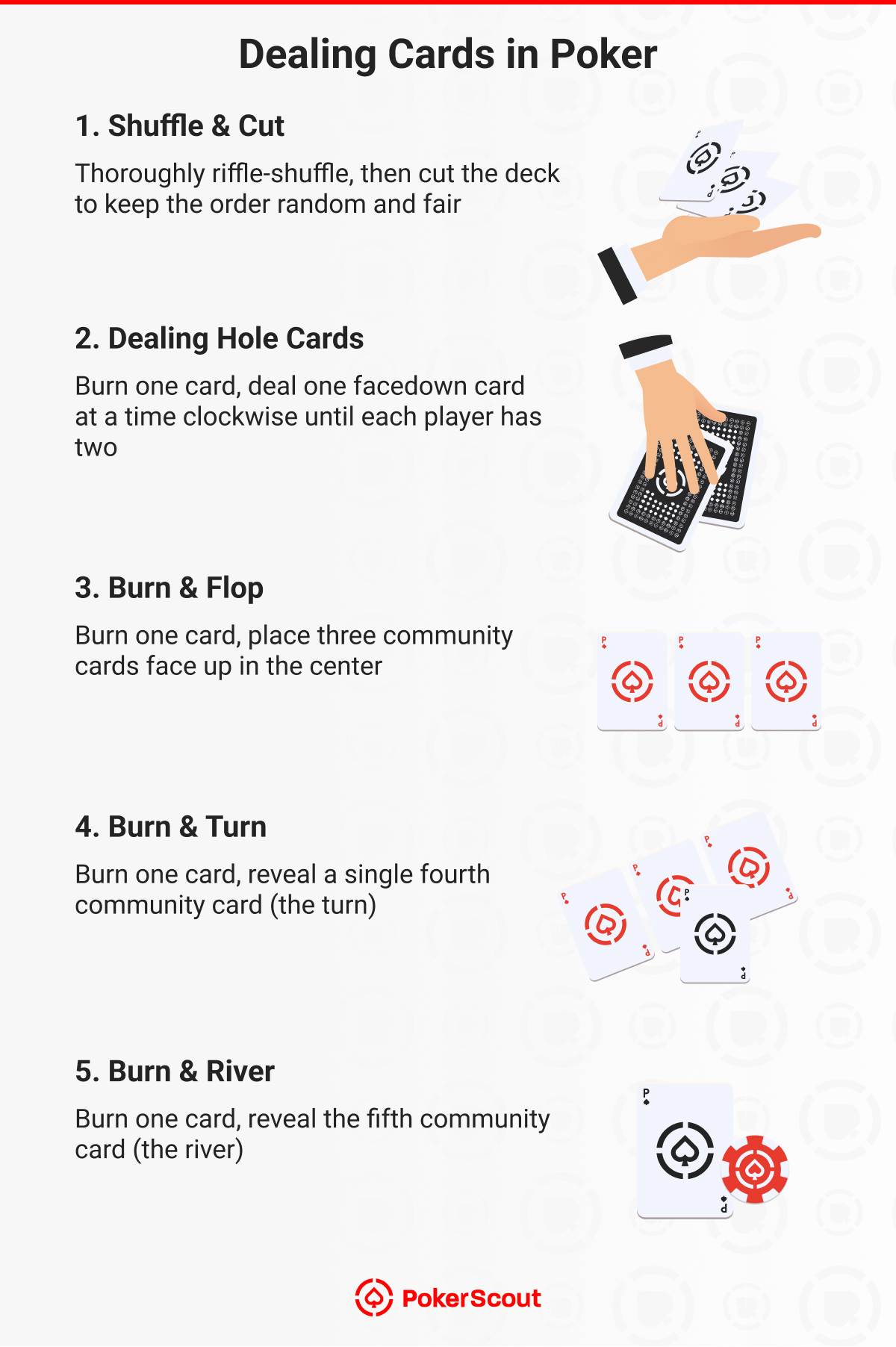
Let’s take a closer look at how to deal poker cards for each stage of the hand. All types of poker games are played with a standard deck of 52 cards, with all jokers removed. This is important to remember if you’re arranging a live game among friends.
Here’s how to achieve the perfect poker deal. We’ll cover Texas Hold’em before moving on to other variations.
Deciding on the Poker Dealer
As mentioned, if you’re playing a professionally run poker game, you won’t have to worry about dealing. Just leave it to the pros. If you’re at a home game, however, there are a few ways to decide who will take on the duty of dealing in poker.
First, the host or other players might volunteer to deal, particularly those who are already competent at shuffling and keeping up with the game flow. In this case, the problem is solved. If several players volunteer, simply take turns.
In most cases, though, you can decide who will deal first by giving each deal player a single card. The player with the highest card receives the dealer button and handles the first poker deal. After the first hand, the button moves clockwise around the table. Whoever is on the button deals the poker hand.
Shuffle and Cut
You will usually see the poker dealer fanning the cards out across the table before a game begins. This is a good way of checking that the deck contains all 52 cards.
It is imperative that the deck is shuffled thoroughly before each hand, as this randomizes the order of the cards and stops players from knowing where any of the cards are. This is a real skill when it comes to dealing poker.
Although there are different techniques for shuffling, such as the riffle or the overhand, do whatever comes naturally to you. Technically, the riffle is best for randomizing the deck. For the sake of a home game, though, the key is to make sure players can’t see or predict any of the cards, so that everyone knows the game is fair for every poker deal.
Cutting the deck is another way to ensure fairness and is obligatory as part of the poker dealer rules. This is done by splitting the deck into two roughly equal piles and placing the lower half on top of the higher so that the order is always unknown to the dealer and players. Once the deck is shuffled and cut, it’s ready to be dealt.
Blinds and Antes
There are two blinds in poker – small blind and big blind. These are mandatory bets by two players that ensure that there is always a stake in the pot. In tournament poker, the blinds increase throughout the game.
The player to the left of the dealer places the small blind, and the player to the left of the small blind places the big blind. The small blind is usually half of the big blind. The game may also feature an ante, a small, obligatory bet paid by all players before the action begins in each round.
When dealing in poker, it is your responsibility to make sure the blinds are in the middle and the correct amounts have been placed before the cards are dealt.
Dealing Hole Cards
Once the blinds have been posted, the poker deal can begin. Each player is dealt one card at a time, starting with the player sitting to the left of the dealer and continuing in a clockwise direction. This cycle continues until all players have two cards.
Those who know how to deal poker cards will already be aware that all hole cards must be dealt face down, so that none of the other players can see each other’s cards. When all players have two cards, the first betting stage begins.
Burn and Flop
In community card games like Texas Hold’em and Omaha, the next stage of the poker deal is called the flop.
Here is how to deal a poker flop:
- First, take the top card of the deck, not showing it to anyone, and place it face down on the table in a separate pile. This is the “burn” card and is not part of the board.
- The top three cards of the deck are then placed face up in the middle of the table. They are the first three community cards, which are shared by all players who are in the pot.
- Players who are still in the hand can then choose their actions, starting with the first player to the left of the dealer.
Burn and Turn
The next stage when you deal poker is called the turn. It happens in almost the same way as the flop. You’ll burn one card and place it in the burn pile. However, at this point, as the dealer, you’ll place just one community card in the middle: the turn. As before, betting then commences amongst the surviving players.
Burn and River
The final betting round of a poker hand is called the river. The poker dealer rules once again state that you should burn the top card, then, just like at the turn stage, you will place one card in the middle of the table, face-up. This is the fifth and final community card. The final betting round then takes place between the players.
Betting Rounds
Knowing how to deal in poker also means mastering how to facilitate the betting action. Remember, betting occurs before the flop and after each community card is revealed.
At each stage of the hand, there is a chance that players will get involved by betting. It is your role as the dealer to ensure that players post the correct amounts and use the right chips for bets and raises.
There are a lot of poker dealer rules to remember when it comes to handling the betting action. For example, players should only act on their turn and clearly state or place multiple chips when they are raising. Home games are a little more relaxed, so you don’t have to enforce every rule strictly.
For example:
If a player calls a raise of 250, as the dealer, you need to check and ensure that the player has actually pushed 250 chips into the pot. Likewise, anyone calling this bet needs to match the amount. If anyone needs to get change after calling, you’ll need to facilitate this as well.
Showdown
Once all the rounds have been completed and the final bets have been called, if two or more players remain in the pot, the hand goes to showdown. This is where the players reveal their cards, and the winner is decided.
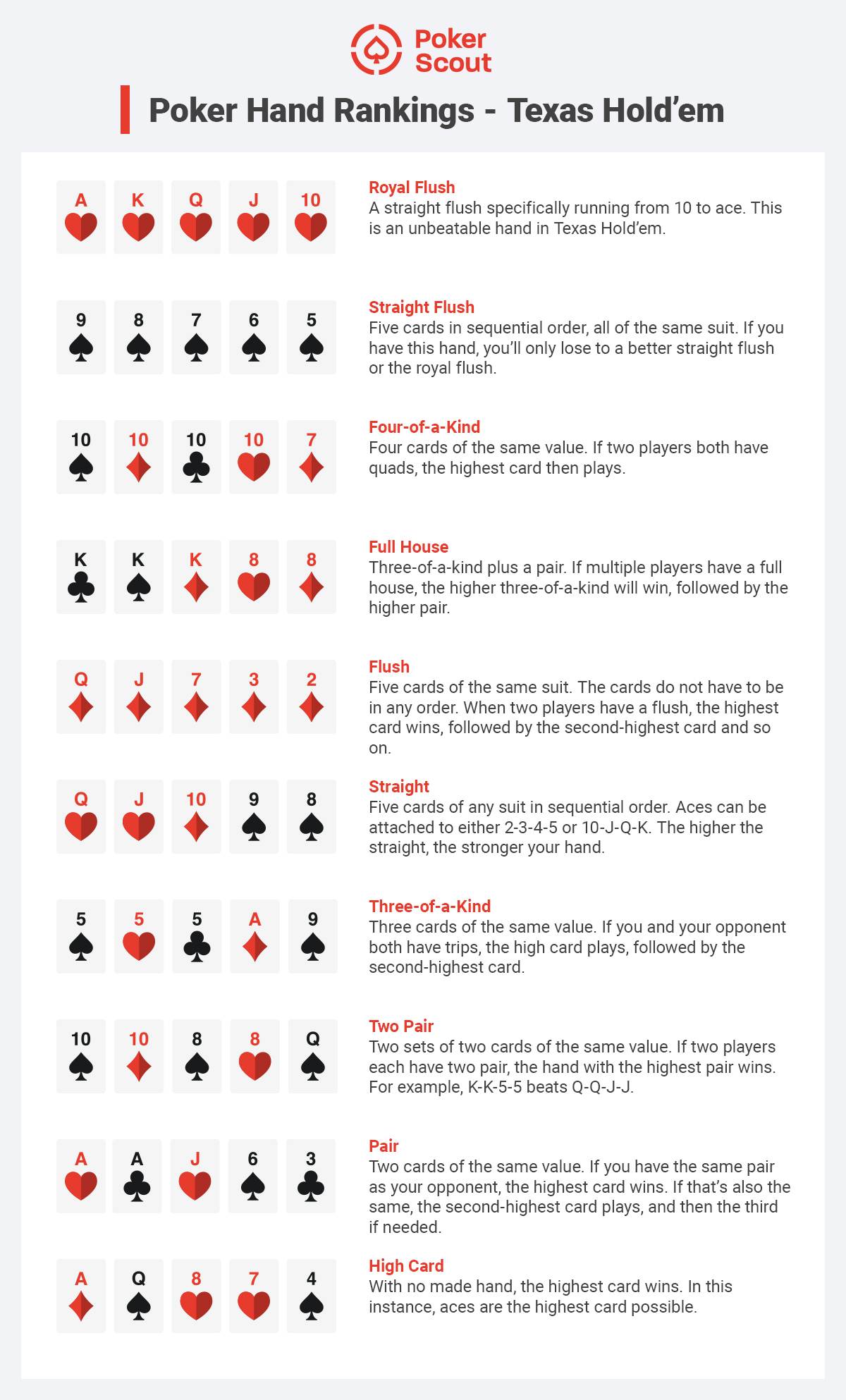
As the dealer, you must determine who has the winning hand. This is a very important moment, so you need to know hand rankings, found in our poker cheat sheet.
Meanwhile, at the online poker tournaments, there will be no second-guessing. The software automatically declares the winner, and your winnings are paid.
Here are the poker hand rankings for Texas Hold’em:
Pushing the Pot
To complete the poker deal, you’ll gather up all of the chips and push them over to the winner. Be sure to collect the blinds, any antes, and all of the players’ bets. That’s pretty much all there is to know about how to deal a poker game, at least when it comes to Texas Hold’em.
Once you have pushed the pot, pass the dealer button to the player to your left. Then, it’s on to the next hand.
Poker Dealing Rules for Different Variations
Though Texas Hold’em is by far the most popular version of poker, there are quite a few variants of the game. Here, we outline the key differences to be aware of and show you how to deal poker cards for other formats.
How to Deal Omaha Poker
Knowing how to deal Omaha poker is very similar to Texas Hold’em, but with one key difference: players are dealt four hole cards instead of two. If you occasionally watch the action unfold on Omaha poker sites, you probably already know this. Unlike Hold’em, players must use exactly two of their hole cards combined with three of the community cards to make the strongest hand they can.
How to Deal Five-Card Draw
Five-Card Draw is a popular variation of poker where, at the beginning of the hand, players are dealt five cards face down. This is followed by the first betting round. If players remain in the pot, they can discard and redraw during the drawing round. After this comes the final betting round. If two or more players remain, they go to the showdown, where the player with the best five-card hand wins
How to Deal Three-Card Poker
When it comes to knowing how to deal three-card poker, players are dealt three hole cards face down. There are no community cards. Betting takes place once the cards are dealt. After the betting round ends, there’s a draw, and players can choose how many cards to discard and redraw. This is followed by the final betting round, then showdown, at which point the best three-card hand wins.
Now that you have gone through these key steps, you’ll know how to deal poker across its most popular variants. Follow these essential rules and your games will run smoothly.
Some key things to always keep in mind:
 Shuffle thoroughly before dealing in poker – it’s not a good look if a player receives the same cards two hands in a row.
- Always deal hole cards face down – you don’t want to be accused of giving anyone an unfair advantage.
- When dealing poker, keep an eye on the blinds and bets to manage the pots as the action progresses. This means watching the action closely and not waiting until the final showdown to attempt to total up all the stakes.
- Know poker hand rankings so you know who has won.
 Shuffle thoroughly before dealing in poker – it’s not a good look if a player receives the same cards two hands in a row.
And that’s it – you’re pretty much an expert on poker dealing now. Of course, if you’d prefer to skip all of this and have it done automatically, you can join an online poker site such as CoinPoker. New members can currently claim $10 for free using the code POKERSCOUT.