Poker Expert


Understanding poker odds and probabilities is a necessary foundation for success at the tables. While the thought of calculating poker hand probability can be daunting at first, we aim to provide a simple overview of all key concepts and situations.
We’ll start by explaining each concept and outlining how to make the calculations for yourself. Then, we’ll provide a useful selection of tables outlining the most important poker odds that you can learn to immediately elevate your game.
All You Need to Know
- Poker probabilities and odds tell us the likelihood of particular outcomes happening.
- Equity in poker refers to the chance your hand will win, or your statistical share in the pot.
- Pot odds show you the risk-reward of making a call by comparing the size of the pot to the size of the bet.
- You can make well-informed decisions at the tables by comparing poker hand odds to pot odds.
What Are Odds and Probabilities in Poker?
Odds and probabilities are two concepts that express the same information in different ways:
- Poker probability tells us the percentage chance of something occurring out of all possible outcomes. For example, there’s a little under a 35% probability that a flopped flush draw completes by the river.
- Poker odds compare two outcomes as a ratio to tell us how often something happens versus how often it doesn’t happen. This is usually expressed as odds against, making it easier to compare directly to pot odds (more on this later).
For example, the odds of making your flush by the river are approximately 2:1 against, meaning you miss an average of two out of three times and hit an average of one out of three times.
Poker odds can be converted to probabilities and vice versa using the formulas below:
Converting Poker Probability into Odds
Odds against = (100 – P) / P
Flush Draw Example: 100 – 35 = 65/35 = 1.857:1, which we round up to 2:1 pot odds.
*P = Probability
Converting Poker Odds into Probability
Probability = 1/ (X + 1)
Flush draw Example: 1/ (2+1) = ⅓ = 0.333 or 33%.
* (X+1) = pot odds
Essential Poker Probability Concepts
Before we move on to calculating poker hand odds and applying maths at the tables, it’s important to understand a few essential poker probability concepts, which apply to both live and online poker games.
What Are Outs?
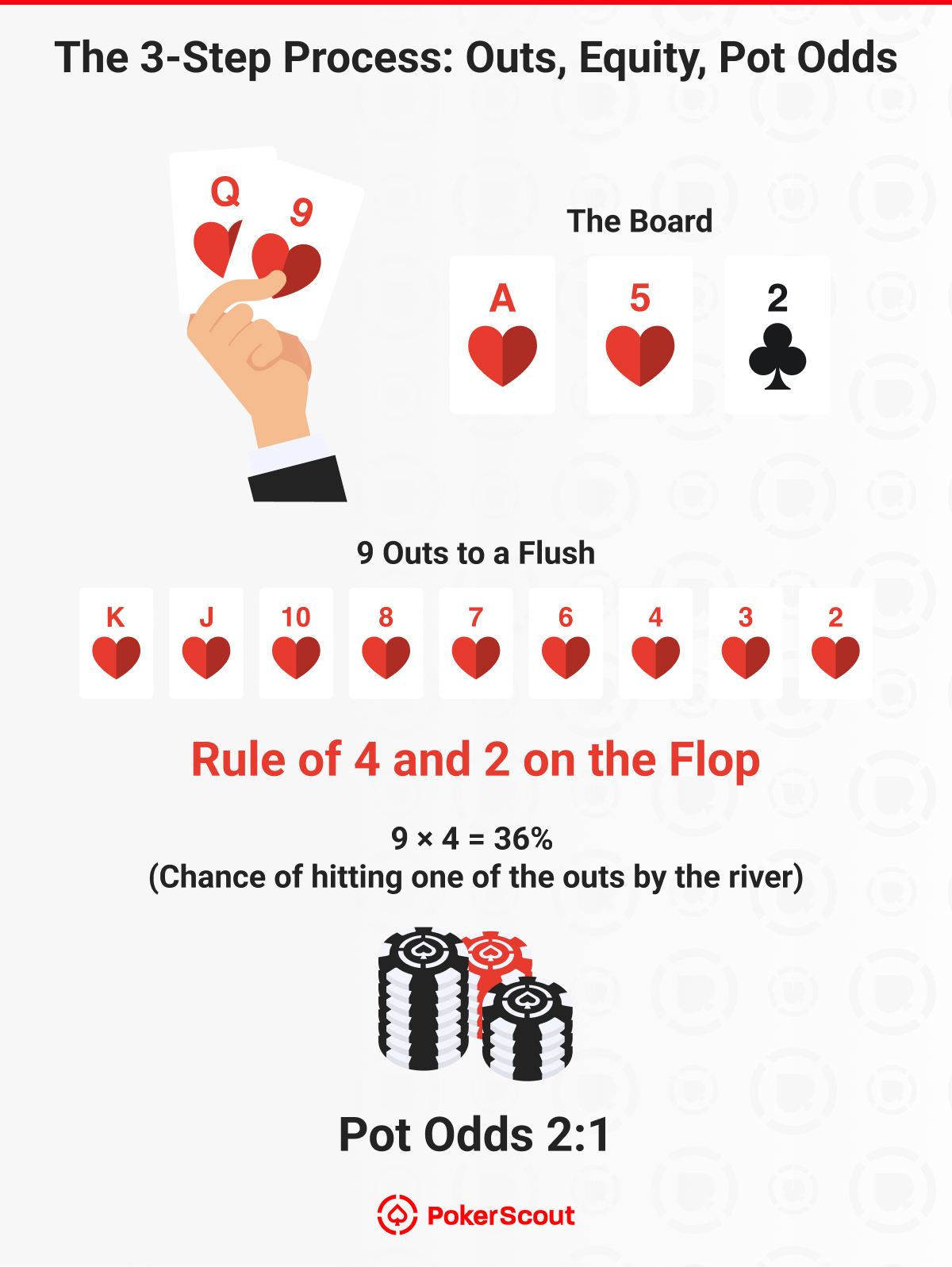
Outs in poker refer to the number of cards that remain in the deck that can improve your hand. This is a particularly useful concept if you have a draw, such as a flush draw or straight draw. For example, if you have a flush draw with four spades, there are nine spades left in the deck, so you have nine outs to make your flush.
By calculating how many outs you have with a draw, you can work out the probability of making the hand and your approximate equity against your opponent’s range.
What Is Equity in Poker?
Equity is a little different from poker probability, although the two are related.
Poker probability is the chance of a particular outcome occurring. Equity is the overall chance of winning the hand, or the share of the pot you are statistically expected to win in the long run.
For example:
AK suited has around 45% equity against 88 preflop. If the remaining cards are dealt all the way to the river, AK wins an average of 45% of the time.
If you know the total amount of chips in the pot, equity can also be converted to a chip or cash amount. For example, if the pot size is $100 and you have 45% equity, your share of the pot in the long run is $45.
What Are Pot Odds in Poker?
Pot odds in poker are the ratio between the size of the total pot (with the current bet added) and the size of the current bet.
For example:
There is $100 in the pot before any bet is made, and a player bets $50. The total pot size is now $150, and the cost to make the call is $50. The pot odds are 150:50, which can be simplified to 3:1.
By converting your pot odds to a percentage, you can then compare the odds you are getting to with your equity in the hand. If your equity is greater than your pot odds, you can make a profitable call.
Bringing Together Outs, Equity & Pot Odds
Now that you have a basic understanding of poker probability and odds, it’s time to learn how to make poker hand odds calculations.
In short, your number of outs can be converted into equity, which can then be compared to pot odds to make the right decision about whether to continue in a hand.
Here’s a step-by-step guide.
Step 1: Calculating Your Poker Outs
If you have a drawing hand, your first step when deciding whether or not to call a bet is to count your outs. To do this, calculate how many cards you need to improve your hand to secure the win.
Here are some drawings of hands and their corresponding number of outs:
- Flush draw: Nine cards to give you a flush = nine outs.
- Open-ended straight draw: Four cards at each end of the straight = 8 outs.
- Straight and flush draw combo: Nine cards to a flush and eight cards to make a straight, minus two cards that overlap (the flush cards that also complete a straight) = 15 outs.
- Pocket pair to set: Two cards of that rank remaining in the deck (four in total, minus the two already in your hand) = two outs.
We’ll cover more of these drawing situations soon in our poker hands probability tables.
For now, take note of how outs are counted, and remember to discount any outs that are no longer in the deck or that could help your opponent.
Step 2: Converting Outs to Equity: The Rule of 4 and 2
Now that you know your number of outs, it’s time to figure out your poker hand odds and equity. To do this, you can use the Rule of 4-and-2 to work out a poker hand’s probability of completing a draw.
Here’s how it works:
- On the flop, with two cards to come, multiply your number of outs by 4 to give you an approximate chance of the poker hand hitting by the river.
- On the turn, with one card to come, multiply your number of outs by 2 to give you an approximate chance of hitting on the river.
So, if you have a flush draw with nine outs on the flop, you have around a 36% chance of completing the flush by the river. On the turn, you have around an 18% chance of hitting.
The Rule of 4-and-2 only gives an approximate poker probability, but in practical terms, it is accurate enough to be useful.
Remember, the probability of hitting isn’t always the same as your equity.
Your flush will sometimes lose to a better hand, such as a higher flush or a full house. Your actual equity in this situation is likely to be a little less than your chances of hitting. If you want to figure out the exact odds or figure out the equity of your hand against a particular range, you can use a poker equity calculator.
Step 3: Comparing Equity to Pot Odds
Once you know your equity in the pot, you can now figure out the mathematical solution to the question of whether or not you should call a bet.
To do this, compare your equity in the hand to the pot odds you are getting.
For example:
You have a flush draw against top pair on the flop, giving you around 35% equity. Your opponent bets $50 into a pot of $100, which gives you pot odds of 2:1, or 33 percent. Your equity is slightly higher, allowing you to profitably make the call purely based on pot odds.
If this same bet was made on the turn, your equity in the hand would be drastically reduced to around 12-13 percent, and you would no longer have the pot odds required to profitably call.
You can make this same comparison with any hand, drawing, or made, against an opponent’s assumed range. Again, a poker hand calculator is handy here, as these calculations are complex. The PokerScout odds charts lower down the page to guide you in the right direction.
Poker Hand Rankings & Probability
We’re now at the part where you can kick back and let us do the maths for you. Here, you’ll find an epic compilation of poker probability charts that show you the odds for all manner of situations.
Five-Card Poker Hand Probabilities
There are 2,598,960 distinct five-card combinations we can make from a standard 52-card deck. The table below shows the number of combinations for each hand rank in poker, along with the odds and probabilities of making it when dealt five cards, such as in Five-Card Draw or Five-Card Stud.
| Hand Rank | Combinations | Odds | Probability |
|---|---|---|---|
| Royal Flush | 4 | 1 in 649,740 | 0.000154% |
| Straight Flush | 36 | 1 in 72,193 | 0.00139% |
| Four-of-a-Kind | 624 | 1 in 4,165 | 0.0240% |
| Full House | 3,744 | 1 in 694 | 0.1441% |
| Flush | 5,108 | 1 in 509 | 0.1965% |
| Straight | 10,200 | 1 in 255 | 0.3925% |
| Three-of-a-Kind | 54,912 | 1 in 47 | 2.1128% |
| Two Pair | 123,552 | 1 in 21 | 4.7539% |
| One Pair | 1,098,240 | 1 in 2.4 | 42.2568% |
| High Card | 1,302,540 | 1 in 2 | 50.1177% |
Odds and Probabilities in Texas Hold’em (Made Hand By the River)
In Texas Hold’em, a five-card hand is formed by the river, using a total of seven available cards – two hole cards and five community cards. This significantly improves the odds of making strong hands.
Interestingly, if we make it to the river in Texas Hold’em, we’ll end up with at least a pair more often than not – and we’re actually more likely to make two pair than to finish with no pair at all. Here are the poker hand odds in No Limit Hold’em.
| Hand Rank | Combinations | Odds | Probability |
|---|---|---|---|
| Royal Flush | 4,324 | 1 in 30,939 | 0.00323% |
| Straight Flush | 37,260 | 1 in 3,590 | 0.0278% |
| Four-of-a-Kind | 224,848 | 1 in 594 | 0.168% |
| Full House | 3,473,184 | 1 in 37.5 | 2.60% |
| Flush | 4,047,644 | 1 in 33.05 | 3.025% |
| Straight | 6,180,020 | 1 in 21.65 | 4.62% |
| Three-of-a-Kind | 6,461,620 | 1 in 20.7 | 4.83% |
| Two Pair | 31,433,400 | 1 in 4.26 | 23.50% |
| One Pair | 58,627,800 | 1 in 2.23 | 43.83% |
| High Card | 23,294,460 | 1 in 5.75 | 17.41% |
Hole Cards: How Often Is a Hand Dealt in Texas Hold’em?
There are 1,326 total combinations of hole cards that can be dealt, though they can be sorted into just a few common categories. Here are the combinations, odds, and poker probabilities for starting hands in Texas Hold’em:
| Starting Hand | Combinations | Odds | Probability |
|---|---|---|---|
| Any Hand | 1,326 | 1 in 1 | 100% |
| AA (or any specific pocket pair) | 6 | 1 in 221 | 0.45% |
| Any pocket pair | 78 | 1 in 17 | 5.88% |
| Pair KK+ | 12 | 1 in 110.5 | 0.90% |
| Pair QQ+ | 18 | 1 in 73.7 | 1.4% |
| Pair JJ+ | 24 | 1 in 55.3 | 1.8% |
| AKs (or any specific suited hand) | 4 | 1 in 331.5 | 0.30% |
| AKo (or any specific offsuit hand) | 12 | 1 in 110.5 | 0.90% |
| AK (or any specific unpaired hand) | 16 | 1 in 82.8 | 1.21% |
| Pair TT+ or AK | 46 | 1 in 28.8 | 3.4% |
| Suited cards (any) | 312 | 1 in 4.3 | 23.53% |
| Connected cards | 208 | 1 in 6.4 | 15.7% |
| Suited connectors | 52 | 1 in 25.5 | 3.92% |
| Suited broadways (T or better) | 40 | 1 in 33 | 3.02% |
Pre-Flop Hand Matchups: Odds of Two Hands Against Each Other
Now, let’s take a look at how various hands perform against each other preflop. Each row in the chart below represents a common heads-up scenario where two players are all-in preflop:
| Hero Hand | Villain Hand | Hero Win Probability | Villain Win Probability | Odds to Win |
|---|---|---|---|---|
| KK | 77 | 80% | 20% | 4:1 |
| KK | 82.2% | 17.8% | 4.6:1 | |
| AKo | 57% | 43% | 1.32:1 | |
| 88 | AJo | 55.5% | 44.4% | 1.25:1 |
| 88 | AJs | 52.5% | 47.5% | 1.16:1 |
| KK | AJo | 72% | 28-29% | 2.4:1 |
| KK | AJs | 67.3% | 32.3% | 2.09:1 |
| AKo | JTo | 63% | 36% | 1.75:1 |
| AKo | J2o | 68% | 32% | 2.1:1 |
| AKo | 87s | 58-59% | 41-43% | 1.4:1 |
| AQo | QTo | 72% | 26.5% | 2.7:1 |
| A7o | QTo | 56% | 43.7% | 1.28:1 |
| ATo | J9o | 62% | 37.6% | 1.65:1 |
| AA | 87s | 77% | 22% | 3.4:1 |
| AA | AKo | 93% | 6% | 15.5:1 |
Factors That Impact Poker Hand Odds: Connectivity and Suits
The odds and poker probabilities shown above for various scenarios are averages and approximations. Poker hand odds are affected by factors such as shared suits, connectedness, proximity of the cards, and suitedness.
It’s helpful to understand these concepts to see why certain hands perform better or worse against others:
- Suited: Suited hands typically have between 2-4% additional equity when compared to the same value offsuit hand.
- Connectivity: When a hand is connected, equity is boosted by around 5-6% compared to a similarly ranked gapped hand.
- Shared suits: Subtly, equities change when players share the same suit. In this case, the player with the higher cards of shared suits gains a small equity boost of around two percent.
- Proximity of cards: Heads-up odds are affected by the proximity of cards. When two hands are close together in ranks, the hand that is ahead blocks straight possibilities for the hand that is behind, so the leading hand gains a small amount of equity.
If this all feels a bit overwhelming, don’t worry – a lot of this becomes quite intuitive with practice. If you want to try a few hands or tourneys for free, you can use the code POKERSCOUT to get $10 free when you sign up at CoinPoker.

Postflop: Common Texas Hold’em Poker Hands Odds
When learning how to play poker, players are often most interested in the specific poker probabilities of how hands are likely to develop across the flop, turn, and river.
Odds of Flopping a Made Hand
Below are the poker odds of flopping hands, based on your hole cards. As you can see, an unpaired hand will improve to a pair 29% of the time on the flop. If we add in the chance of poker hands like two pairs, trips, and straight draws, there’s around a 32% chance you’ll hit the flop.
| Hole Cards | Flopped Made Hand | Odds | Probability |
|---|---|---|---|
| Unpaired Hand | Pair | 1:3.5 | 29% |
| Unpaired Hand | Two Pair | 1 in 49.5 | 2.02% |
| Unpaired Hand | Trips | 1 in 73 | 1.35% |
| Pocket Pair | Set | 1 in 8.5 | 11.8% |
| Connected Cards | Straight | 1 in 77 | 1.3% |
| Suited Cards | Flush | 1 in 119 | 0.8% |
Pocket Pairs vs Higher Pairs & Overcards
Pocket pairs are strong hands against lower pairs or undercards. However, the lower the pair, the more likely it is that our opponents have an overpair, which puts us in a very unfavorable position with 4:1 odds of winning, or around 20% equity.
Here are the odds in poker that at least one of our opponents will be dealt an overpair in the three most common scenarios: heads-up, six-handed, and full ring (9 players):
| Pair | Opponent's overpair probability (heads-up) | Opponent's overpair probability (6-max) | Opponent's overpair probability (full ring) |
|---|---|---|---|
| KK | 0.5% | 2.5% | 4% |
| 1% | 4.9% | 7.6% | |
| JJ | 1.5% | 7.1% | 11.2% |
| TT | 1.9% | 9.4% | 14.7% |
| 99 | 2.4% | 11.7% | 18.3% |
| 88 | 2.9% | 13.9% | 21.4% |
| 77 | 3.4% | 16.1% | 24.6% |
| 66 | 3.9% | 18% | 27.4% |
| 55 | 4.4% | 20% | 30.3% |
| 44 | 4.9% | 22.4% | 33.1% |
| 33 | 5.4% | 24.1% | 35.8% |
| 22 | 5.9% | 26% | 38.3% |
When our opponents hold two overcards to our pair, they typically have a 45-50% chance of winning. Additionally, overcards on the board make it difficult to navigate the postflop betting stage with your pocket pair.
The table below shows how often you will see at least one overcard to your pair on the flop.
| Pocket Pair | Probability of 1+ overcards on the flop |
|---|---|
| KK | 22.6% |
| 41.4% | |
| JJ | 57% |
| TT | 69.5% |
| 99 | 79.3% |
| 88 | 86.7% |
| 77 | 92.1% |
| 66 | 95.8% |
| 55 | 98.1% |
| 44 | 99.4% |
| 33 | 99.9% |
| 22 | 100% |
Odds of Making a Set With a Pocket Pair
With small pairs, you’ll almost always encounter overcards, so your best chance of winning the pot is seeing a cheap flop and attempting to hit a set. A pocket pair will flop a set around 11.8% of the time.
That’s not too often, but when you do hit a set, you’ll often be paid off by top pair hands. A set can even improve to a full house or four of a kind on later streets. Once we have flopped a set, this happens around 33.4% of the time.
Poker Hand Odds of Making a Flush
Offsuit hands only make flushes once every 650 hands, which is approximately 0.15%. Suited hole cards are 40 times more likely to make a flush by the river, which happens an average of 6.5% of the time.
You won’t flop a flush very often, with only a 0.8% chance of this poker hand hitting straight away. However, with two suited hole cards, you’ll pick up a flush draw on around 10.9% of flops.
Once you have a flush draw, the probability of completing the flush on the turn is 19.2% and the same odds on the river. So, with a flopped flush draw, the probability of making our flush by the river is 3%.
Open-Ended Straight Draw (OESD)
Similarly to the flush, we rarely flop a straight. When we are holding fully connected cards (like T9), it only happens 1.3% of the time.
However, with a connected hand, we have a 9.6% chance of flopping an open-ended straight draw, meaning it occurs just under one in ten times. Double gutshots, which have the same number of outs, have the same poker probability.
With one-gappers (i.e., T8 or 75), the OESD will only come 7.26% of the time, and with two-gappers, this drops to 4.47%.
Once we hold an OESD, we will hit the straight on the turn 17% and on the river 17.4% of the time, for a total of 31.45% from flop to river.
Odds of Flopping a Draw
To summarize, let’s take another look at the poker odds of flopping the most common draws with our suited and connected hands:
| Hole Cards | Flopped Hand | Odds | Probability |
|---|---|---|---|
| Suited Cards | Flush Draw | 1 in 9 | 10.94% |
| Connected Cards (JT to 54) | OESD | 1 in 10.4 | 9.6% |
| Connected Cards (JT to 54) | Gutshot | 1 in 6.25 | 16% |
| Suited Hand | Pair or Better or Flush Draw | 1 in 2.37 | 41.6% |
| Suited Connectors (JTs to 54s) | Straight Draw and/or Flush Draw | 1 in 3.4 | 29.05% |
| One-Gappers (QT to 53) | OESD | 1 in 13.8 | 7.26% |
| Two-Gappers (Q9 to 63) | OESD | 1 in 22.4 | 4.47% |
Odds of Improving on the Turn or by the River
And here is an overview of how often the most frequently played hands will improve on the turn and/or the river:
| Hand on Flop | Improved Hand | # of Outs on Turn | Made Hand on Turn % | # of Outs on River | Made Hand on River % | Made Hand Turn/River % |
|---|---|---|---|---|---|---|
| One Pair | Two Pair or Trips (hole cards only) | 5 | 10.6% | 5 | 10.9% | 21.35% |
| Trips | Full House or Quads | 7 | 14.9% | 7 | 15.2% | 27.8% |
| Set | Full House or Quads | 7 | 14.9% | 10 | 21.7% | 33.4% |
| Two Overcards | Pair (hole cards only) | 6 | 12.7% | 6 | 13% | 24.1% |
| Flush Draw | Flush | 9 | 19.1% | 9 | 19.6% | 35% |
| OESD | Straight | 8 | 17% | 8 | 17.4% | 31.5% |
| Gutshot | Straight | 4 | 8.5% | 4 | 8.7% | 16.5% |
| Two Overs + Flush Draw | Pair (hole cards only) or Flush | 15 | 31.9% | 15 | 32.6% | 54.1% |
| Flush + OESD | Straight or Flush | 15 | 31.9% | 15 | 32.6% | 54.1% |
| Flush Draw + Gutshot | Straight or Flush | 12 | 25.5% | 12 | 26.1% | 45% |
| Pair + Flush Draw | Two Pair (hole cards only), trips, or flush | 14 | 29.8% | 14 | 30.4% | 51.2% |
| Two Overs + Gutshot | Pair or Straight | 14 | 29.8% | 14 | 30.4% | 51.2% |
Implied Odds vs Pot Odds
Pot odds tell you whether the cost of making a call is profitable based on your equity in the pot. However, it’s also useful to know about implied odds and how they can impact your decisions.
Implied odds is the theoretical amount that you stand to win on future streets if your hand improves. Hands like sets have incredible implied odds because they are well hidden, as do straight and flush draws.
The implied odds are significant when:
- Your hand is likely to be the winner, especially when you are drawing to the nuts.
- You are likely to get paid off by other strong but losing hands, such as top pair or weaker flushes.
- Stacks are deep, allowing you to extract a lot of value when you hit.
Even if the pot odds are not quite favourable compared to your equity, you can sometimes justify calling on the basis of implied odds.
Best Poker Odds Calculator & Tools
Poker is a game of small edges, and over the long run, these percentages can add up to a significant advantage.
Remembering and understanding just a few of these key scenarios and matchups goes a long way. Looking at these hand characteristics more closely will deepen your understanding of the game. You can do this by using poker odds calculators and other tools to analyze specific hand matchups on any street.
By using a simple poker probability calculator, studying poker ranges, and training with GTO solver tools, we can learn to recognize specific scenarios and refine our strategy to become more profitable.
Learning poker probability and odds allows you to make mathematically sound decisions that, if implemented correctly, will instantly improve your win rate. Until this information becomes second nature, we recommend printing out guides, poker probability charts, or using poker odds calculators to develop your skills.