Poker Expert


Knowledge and understanding of poker ranges are essential skills for players.
Poker is a game in which we can never have complete information. The best we can hope to do is to use strategy and heading reading skills to narrow down our opponent’s possible range of hands. The more accurately you can do this, the better chance you have of gaining an edge.
Here we explain poker ranges, show you how to build your own poker ranges by position, and how to put other players on a range.
All You Need to Know
- We can never know our opponent’s cards for sure, so poker ranges are essential for outlining and narrowing down likely card combinations.
- You can use poker range calculators and charts to build your ranges as well as predict other players’ ranges.
- Your opponent’s range in poker will be determined based on factors such as position, stack sizes, and opponent type.
- As the hand develops, you should further narrow down players’ possible holdings on the board cards and their betting action.
What Is a Poker Range?
A poker range is all of the possible combinations of hands that a player is likely to have in any given situation.
Poker is a game of incomplete information, as you can never know the cards other players are holding with 100 percent certainty. Trying to guess the exact holdings of your opponents would be an extremely difficult way to play the game. To create a sustainable strategy, you need to think in terms of poker ranges rather than individual hands.
For example, your opponent raises from under the gun (UTG). What possible hands could they be holding? We can’t know for sure, but with the information that we already have, we can start to narrow down their poker range by position, stack size, preflop action, and opponent type.
In this situation, we would typically put our opponent on a range of 22-AA, KJs+, KQo+, ATs+, and possibly a few bluffs, accounting for around 10 percent of hands. However, the actual range you would use depends on the specific circumstances.
We’ll mainly be discussing the most popular type of poker. So, before diving in, you’ll need to know how to play Texas Hold’em.
Why Use Poker Hand Ranges?
Considering hand ranges in poker helps players make informed decisions over time, rather than becoming fixated on specific cards and situations. Poker hand ranges give us a useful way to narrow down the possibilities of what our opponents’ cards could be.
Once you become skilled at analyzing players’ poker hand ranges, you can compare this to the strength of your own hand. This allows you to make informed decisions about whether to check, bet, call, raise, or fold.
Once you know this, as well as how poker tournaments work, you will be ready to try your hand at the tables.
Understanding Poker Ranges
Poker hand ranges can be presented in a number of different formats, such as matrix, strand, or percentage. Here’s a quick guide that explains poker ranges and how to define them:
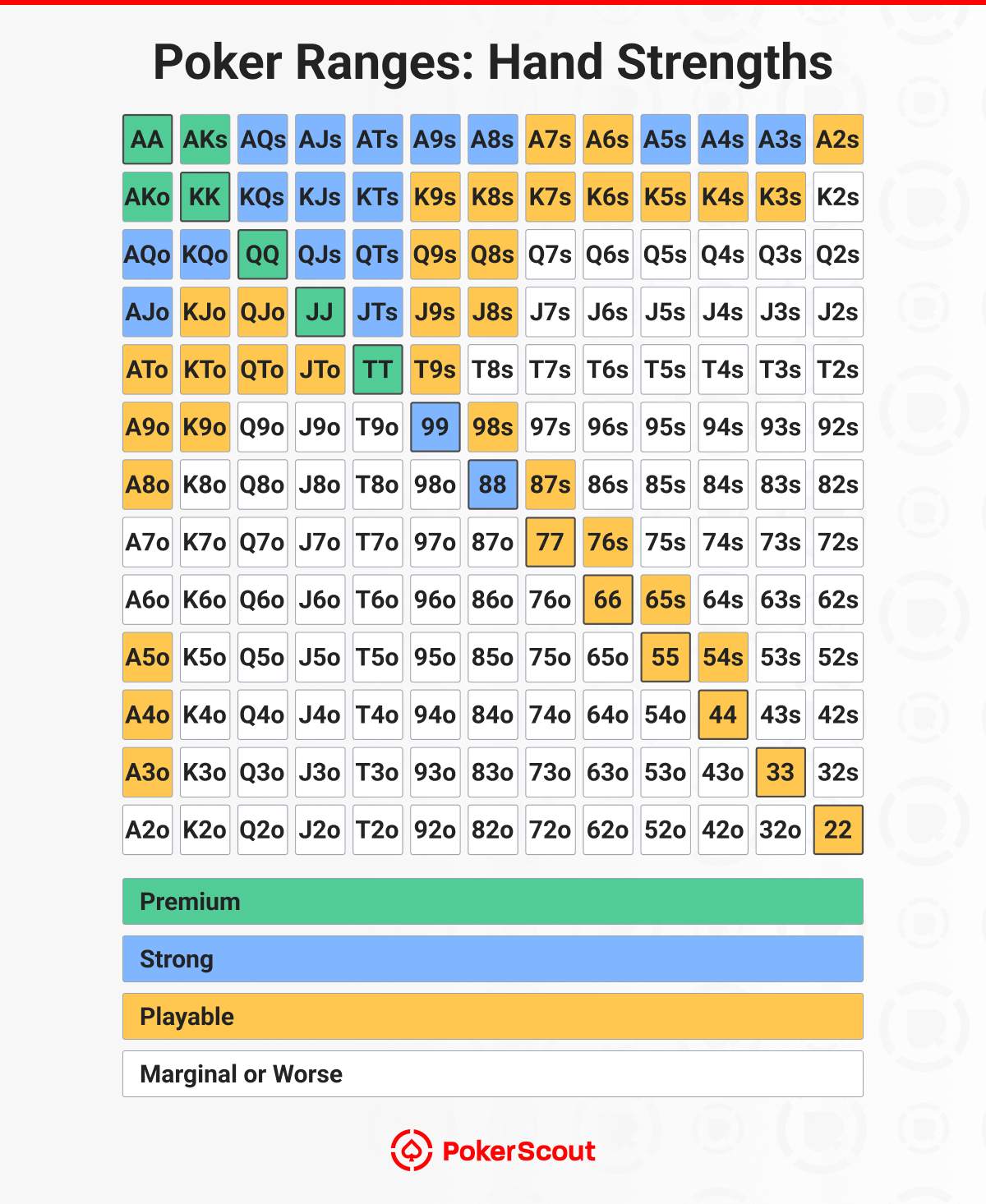
The poker hand matrix is one of the most employed tools when working with poker ranges. It comprises the 169 starting hands in poker. Poker range charts are displayed in a 13×13 grid format, making them easy to read, interpret, and utilize effectively.
For example:
 22+: This means the player has all pocket pairs in their range.
- A9s – AJs: This indicates that the player has A9, A10, and AJs suited in their range.
- 98s+: This indicates that the player has all suited connectors over 98s+ in their range.
- A3s/A4s: This indicates that the player has both A3s and A4s in their range.
 22+: This means the player has all pocket pairs in their range.
Preflop and Postflop Poker Hand Ranges
Determining poker ranges of players at different stages of the game, such as preflop and postflop, is a crucial skill to develop. The process should begin preflop and follow on from there.
At the preflop stage, the starting point is to consider poker ranges by position.
Players should open with a very tight range from the early position and loosen up in the late position. For example, a typical UTG range in poker usually includes around 10 percent of hands, whereas it’s profitable to raise with over 50 percent of possible starting hands from the button.
Preflop poker ranges vary based on other factors, such as stack sizes, opponent type, and any clues you can gather from bet sizes. The more you play against someone, the more information you can gain about how they play that you can use to more accurately assess their poker hand ranges.
Once you move to the postflop stages, you should already have the preflop poker ranges that you’ve assigned to your opponents.
That is your baseline. You can then remove hands from their range based on the board texture and their actions on each street.
The further a hand progresses towards the turn and river, the more information you will have based on your opponent’s actions. By the river, it should be possible to narrow down poker ranges to just a few likely combinations, or even to polarize ranges between nutted hands and bluffs.
Heads up poker ranges require special consideration, as they differ significantly from full-ring and 6-max games. In heads-up poker, ranges are much wider since you’re only playing against one opponent.
A typical heads-up poker range from the button might include 70-80% of starting hands, while defending ranges from the big blind should be equally wide to prevent exploitation.
Using Poker Range Charts and Training Tools
A poker range chart is a visual tool that displays poker hand ranges for various situations within the game. They can be used to help you build your own ranges and to give you visual guidance about likely ranges in certain spots.
There are various poker range tools and charts that you can utilize to gain an advantage. The best starting point for beginners is to study poker preflop ranges. You can do this by looking at GTO poker range charts, which will show you poker ranges by position and stack size.
As hands move postflop, the game tree becomes more complex, and each situation is unique. However, you can still use poker range builders and GTO solvers to study each hand in detail.
Leveraging Training Resources
Poker training sites are a sure-fire way to up your game and ensure that you’re ready to be successful at the tables. You’ll find an array of different poker range tools that are suitable, whether you’re a novice or more experienced. These include courses designed to teach you the basics, from beginner to advanced, in GTO simulations that outline poker ranges for challenging spots.
You can then put that knowledge into action at a site like CoinPoker. And, if you sign up using the bonus code POKERSCOUT, you can claim an extra $10 bonus on top of the standard welcome offer.

Poker Range Examples
Now that we’re up to speed with the basics of ranges in poker, let’s take a look at a couple of examples of how they are used to determine the course of action in a hand.
Poker Range Example 1
Your opponent raises from the button with a big stack. You have no prior information about how they play, but their position and stack size suggest that they should be raising very wide here to steal blinds and win pots postflop.
You put them on a poker range of around 50 percent of starting hands.
The small blind folds, and you’re in the big blind looking down at JTs. You could call to see a flop, but your 20 big blind stack size is perfect for gaining fold equity by reshoving, and your hand has decent equity when called. Given how wide your opponent’s poker range is by their position, you decide to reshove. They are forced to fold.
Poker Range Example 2
You’re sitting at the table and have been studying the poker hand ranges of other players. A loose player raises UTG roughly 14% of the time. Written as a range strand, this would be something like: 22+, ATs+, AJo+, KQo+, JTs+, with a few strong bluffs such as A4s/A5s/98s.
You decide to flat call on the button with 88, and the flop comes T-6-4 rainbow. Your opponent makes a continuation bet on the flop. Given that they are generally aggressive, you expect them to bet most of their range, which includes made hands and missed hands.
Your pocket eights are behind all pairs of tens, as well as any overpair to the board. They are ahead of all underpairs, missed broadways, and bottom pair hands like A4. You deduce that your pocket eights are ahead of your opponent’s overall range. You call the flop bet.
Best Poker Range Tips
Poker ranges are a vital tool for any developing or competent poker player. To guarantee your best chance at success, keep in mind these essential poker hand range tips:
- Always think in ranges: Don’t make the mistake of fixating on working out an opponent’s specific cards. This will likely lead to false assumptions and mistakes. See the broader picture, develop your own ranges in poker, and read your opponents based on likely hand combinations.
- Study poker range charts: Familiarize yourself with how different poker ranges are presented and the forms they take, particularly poker range charts that outline typical preflop ranges based on position and stack sizes.
- Narrow down ranges: As the hand progresses, ranges in poker should start to shrink via a process of elimination. With each betting round, you’ll be able to gather more information based on the betting action for each street. Use this to narrow down poker ranges to just a few likely combos.
- Pay close attention to the size of bets: Analyzing an adversary’s betting can narrow down their range, as some players will adjust their bets based on the strength of their hand. Pay attention to these deviations and what they mean in terms of your opponent’s hand range.
- Adjust to opponents: Playing styles vary widely in poker, so you’ll need to constantly adapt to other players’ ranges. For example, a tight player might raise 30 percent of hands from the button and only c-bet the flop with top pair or better. A loose opponent, on the other hand, might raise 60 percent of hands from the button and bet every flop. Each player’s poker ranges are somewhere between marginally and completely different, so you’ll need to adjust your own ranges to compensate.
Conclusion
A poker range represents the possible hands an opponent might have based on their play and poker hand probability, which you can then use to refine your actions and strategy. Mastering poker ranges is crucial for making winning decisions at the table.
Tools like the poker range chart simplify this, showcasing hand ranges visually for different positions and scenarios, particularly preflop.
Understanding preflop poker ranges is vital, as it sets the foundation for narrowing down hands through postflop play. Practicing regularly on trusted online poker sites is one of the most effective ways to strengthen these skills and apply theory in real-time scenarios.
By thinking in ranges and analyzing betting patterns, players can gain an edge and outplay their opponents.