Managing Editor


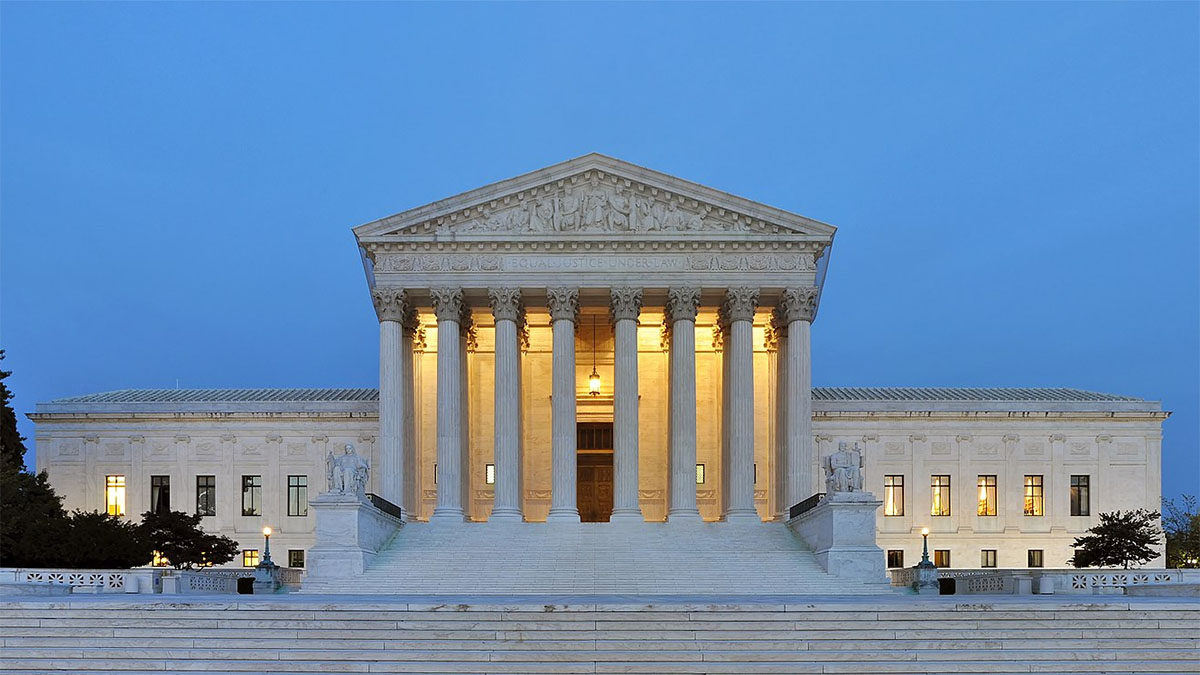
Yesterday’s announcement by the U.S. Supreme Court that it would fast-track Trump’s tariff case led to a brief but intense bout of volatility for a Kalshi market related to the case. When the dust had settled, the odds ended up roughly where they began, so users who held their position emerged unscathed. However, some day-traders likely took big profits or losses as the spot price of the contracts yo-yoed.
In particular, an arbitrage opportunity presented itself as Kalshi’s line diverged from Polymarket. The latter also experienced a rapid back-and-forth price swing on the news, although much smaller in both duration and magnitude than Kalshi’s.
Both sites offer contracts on the question: Will the Supreme Court rule in favor of Trump’s tariffs?
The current line is the same for both, at 46%, which is within one percentage point of where it was 24 hours ago.
However, Kalshi traders sent the price surging to 61 cents — corresponding to a 61% chance — before selling off at prices as low as 35 cents a few hours later. On Polymarket, the blip lasted barely an hour, with prices dipping below 44 cents, then jumping to nearly 52 cents before returning to the baseline.
Technically, the Supreme Court agreeing to fast-track the case is good for the Yes side of the market. That’s because it could have declined to hear the case at all, which would have been a victory for No under the market rules. However, given the magnitude of the issue and the President’s involvement, it would be unthinkable for the Supreme Court to find it unworthy of appeal.
The Court will now hear the case in early November. That rapid timeline is probably neutral for the outcome of the markets. However, it may have prompted some traders to get their bets down quickly, leading to the volatility.
Massive Arbitrage Opportunity Existed for Several Hours
The lack of a lasting reaction on Polymarket may have been what caused the belated crash in Kalshi prices late Tuesday night. The terms for the two markets are nearly identical, including resolving to No if the court dismisses the case without ruling on the legality of the tariffs. As such, their prices should also remain quite close.
However, what happened is that the Kalshi price remained north of 50 cents(and often above 55 cents) for five hours, while Polymarket flatlined at 48 cents. Just before the correction on Kalshi, the price had gone over 60 cents.
At that point, it’s likely that one or more users noticed the disparity and chose to take opposing positions on the two sites. That’s what’s known as arbitrage, an opportunity for guaranteed profit that occasionally exists on traditional stock markets as well as in sports betting and predictions markets. However, when it comes to stocks and sports bets, the margins are typically much smaller and shorter-lived. For a spread of up to 15 percentage points to exist between identical markets for several hours before someone capitalizes on it is almost unthinkable in those spaces.
Part of the reason may be that technically, the two markets aren’t available to the same user base. Kalshi is U.S.-regulated and only available domestically. By contrast, Polymarket is a crypto-based product not available in the U.S., although it is in the process of making its return. Taking advantage of the opportunity would have required collaboration between two parties, international travel, or for someone to illegally circumvent one of the sites’ geofencing.
What the Tariff Case is About
The imposition of taxes and tariffs typically falls to the legislative branch of government, per the U.S. Constitution. The President, as the head of the executive branch, does not generally have the power to impose them himself.
However, President Trump invoked the International Emergency Economic Powers Act. He claimed that the fentanyl crisis warranted the use of extraordinary powers and that imposing tariffs on Mexico and Canada to coerce their assistance would solve the problem. In the case of the Canadian tariffs in particular, much has been made of the fact that only about 0.1% of illegal fentanyl seized in the U.S. is found to have come through the northern border.
A lower court has already ruled against the administration on constitutional grounds. However, it declined to require an immediate halt to the tariffs, given the near-certainty that the case would go to the Supreme Court.
The Trump administration asked the Supreme Court to expedite the case because the consequences of losing it increase the longer the tariffs remain in effect. The government has already collected $210 billion through the tariffs in question, at a pace on the order of $1 billion per day. It told the court that the total could reach $1 trillion if the case took until next year to resolve, and that “unwinding [the tariffs] could cause significant disruption” if left until that point.
Image Credit: Joe Ravi via Wikimedia Commons (CC-BY-SA 3.0)