Managing Editor


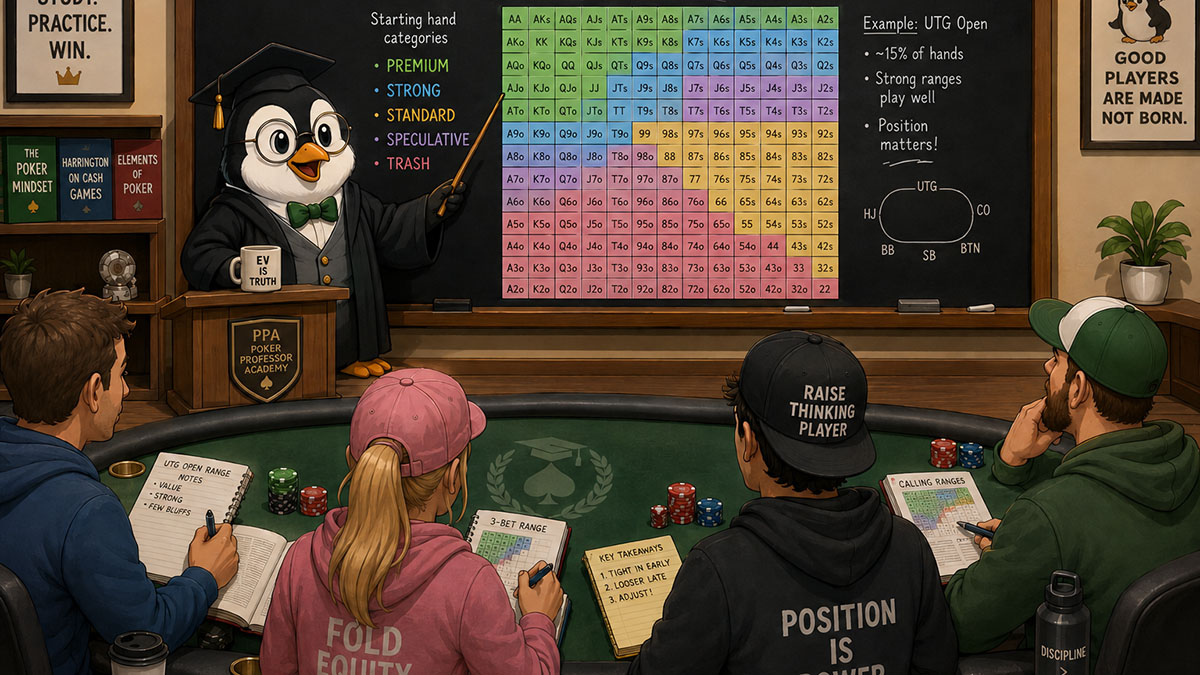
AI-driven analysis and study tools have made the gap between professional poker players and amateurs wider than it has ever been, but unfortunately, many of these solvers are difficult to approach. As the leading products compete to pack in more features and solve for more complex spots, their interfaces inevitably become more arcane.
That potentially makes room for a new generation of products that prioritize affordability and user-friendliness. This week, we’ve seen one such brand arrive on the market: GTO Strategy, which describes itself as a “gamified poker tool.”
The solver behind GTO Strategy originated as Odin Poker, launched in 2021 by high-stakes pro Rory Young. In collaboration with Patrick Leonard and Owen “PR0DIGY” Messere, the GTO Strategy team repackaged Odin’s solutions in an approachable interface that encourages users to train on their own and then test their skills against friends. It’s less like hanging out in the library and more like bar trivia night.
GTO Strategy’s interface is straightforward, with just three modes to choose from:
- Solve: Input your own spots and get an answer.
- Train: Test your poker skills in a variety of pre-solved spots.
- Compete: Similar to Train mode, but with player-versus-player leaderboards.
There are even prizes to be won in Compete mode, through a partnership with CoinPoker.
Pricing at launch is $39 for the Standard plan or $79 for “Elite.” The difference is in the degree of access to the AI solver. The Standard plan allows custom solves only for heads-up turn and river situations. Elite will let you solve from the flop and includes multi-way situations, both of which are more computationally intensive.
The Entry-Level Niche Works in Other Industries
GTO Strategy is entering a market currently dominated by GTO Wizard, but the time is probably right for the niche it’s trying to carve out.
The team behind GTO Wizard is leaning heavily into technical prowess, but in doing so, they’re exploring spaces where interface dilemmas pose as much of a challenge as finding the solutions. Last month, for instance, they added Pot-Limit Omaha functionality.
But the thing about PLO is that there are 16,432 mathematically distinct starting hands instead of 139. That means traditional grid-based interfaces are out the window and requires multiple tabs just to make sense of a single solution.
It’s easy to see how that sort of complexity can coexist alongside a minimalist alternative, as they’re not targeting the same audience.
We see the success of that business strategy in other sectors. For instance, Adobe’s graphics products now require a subscription that costs as much as your Internet, and dozens or hundreds of hours of training to get your money’s worth out of them. Although Creative Suite is still the go-to for professionals, its cost and complexity are what have allowed entry-level apps like Canva and Procreate to become as successful as they are.
It’s not the first time we’ve seen the poker industry making moves in this direction, either. One of Phil Galfond’s innovations with Run It Once Poker — before it became BetRivers — was a built-in HUD that replaced the usual bevy of numerical statistics (VPIP, CvFCB, W$SD, etc.) with visual archetypes, giving amateur players an easy way to remember at a glance whether the play they’ve seen from an opponent is more nitty, wild, or somewhere in between.