Managing Editor



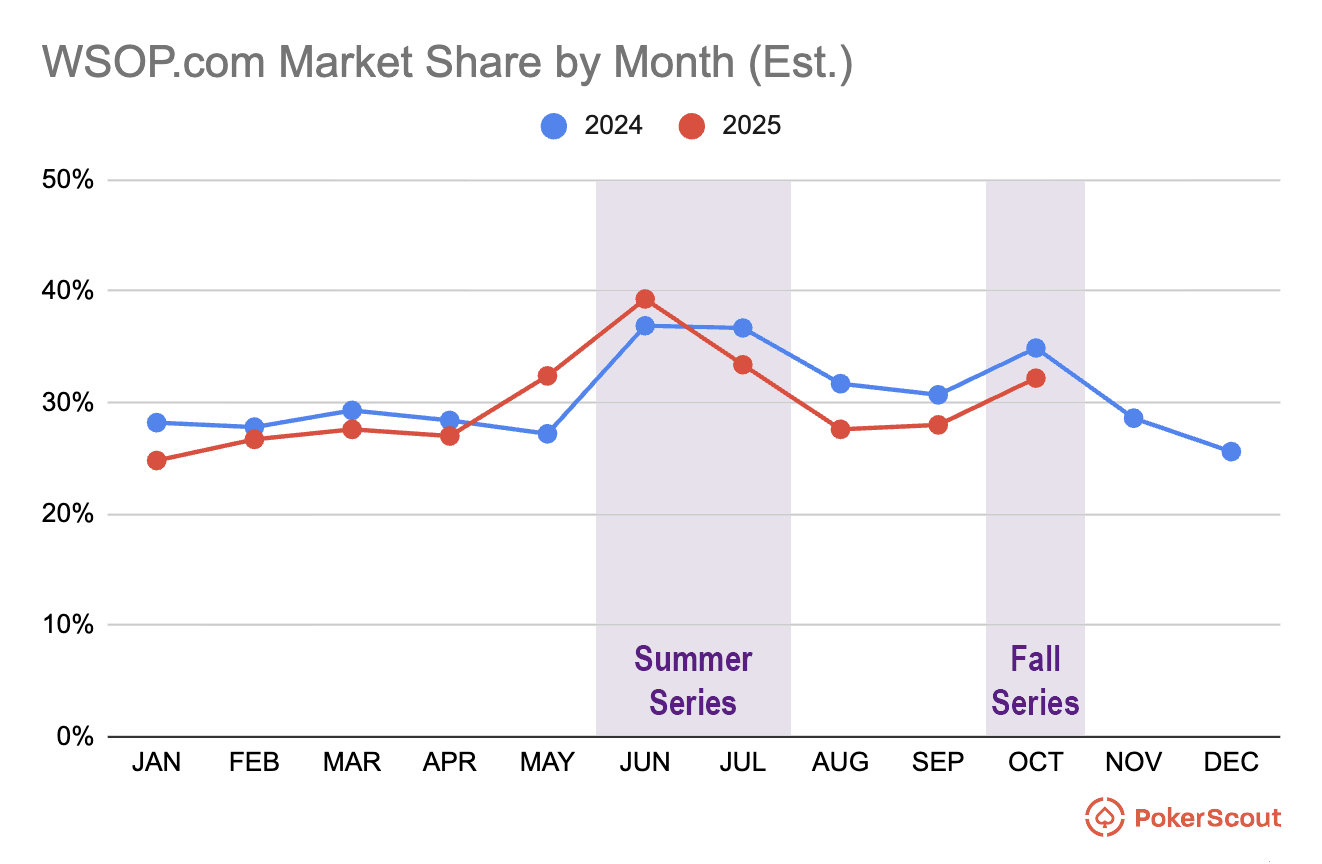
October is generally a good month for online gambling operators, but especially for WSOP.com, thanks to its annual Fall Bracelet Series. According to PokerScout estimates, the daily average aggregate revenue of domestically licensed U.S. poker operators rose 5.0% from September to October 2025, with WSOP leading the way with a 20.6% spike.
U.S. online poker sites have been having a great year thanks to the networking of Pennsylvania with other states. Only PokerStars has failed to take advantage of that and, unsurprisingly, is also the only one not enjoying year-over-year growth.
Although the initial surge in revenue brought by shared liquidity has tapered off somewhat, the growth rate remains in the double digits and bounced to 14.2% in October, up from 11.1% in September. That’s still only half the pace of growth that online casinos have been seeing for years. However, online poker had been largely stagnant for several years after its last boom during the COVID-19 casino closures, so seeing the rate remain above 10% for so many months is encouraging.
Online poker remains a niche vertical in the U.S., as it does internationally. Total revenue for the U.S. operators in October amounted to $9.1 million, of which WSOP collected $2.9 million.
Despite WSOP’s fall surge, BetMGM Poker remains the market leader, with 37.7% of October revenue. Although WSOP overtook BetMGM this summer, during its last online bracelet series, PokerScout has predicted that will turn out to have been the last time. The bounce for the fall series is typically smaller, and BetMGM’s growth puts it on course to be out of anyone’s reach by next summer.
Keep Reading
- DraftKings Poker Experiment Appears to Be a Dud—’Electric’ Variant Earning Minimal Revenue One Year In
- BetMGM Poker Takes Biggest Market Share Lead to Date in August as WSOP Comes Down to Earth Following Summer Series
- U.S. Online Poker Continues to Benefit From the ‘Pennsylvania Boom’ Even During Slow Fall Season
Seasonality for iGaming, Poker, and WSOP
All online gambling is seasonal. Part of the reason is the weather and the availability of alternative activities. Summer is slow because people are having fun in the sun, not betting on their phones.
In the U.S., that’s compounded by the seasonality of sports and the popularity of sports betting. The most popular sports for betting in the U.S. are football and basketball, both of which begin their seasons in the fall. Crossover of players from sportsbooks impacts both online casinos and online poker.
WSOP bucks the trend, however, because of its tournament schedule. Its association with the live World Series of Poker gives it the ability to offer gold bracelets to tournament winners, a privilege shared only with the brand’s new owner, GGPoker. That’s one of two competitive advantages that have allowed WSOP to remain the second-place operator in the market. The other is that it’s the only site currently serving Nevada, although a BetMGM launch there may be coming.
WSOP usually offers online gold bracelets to U.S. residents at two points during the year. The first is concurrent with the live World Series of Poker in Las Vegas. The second is in October, during the Fall Bracelet Series. This year’s schedule included 33 bracelet events, as well as 36 Circuit rings and qualifiers for next month’s WSOP Paradise in the Bahamas. It ran until November 11, so we may see some residual benefit in this month’s revenue numbers when they come in.
The summer series is a much bigger affair. Last summer’s produced a 10 percentage point market share boost for WSOP, with residual effects even after the series was over. This year’s response was quicker, beginning in May, even before the series started. It was also sharper, peaking at a 12 percentage point increase. It was shorter-lived, however, with revenue having returned to prior levels by August.
Coming into the fall series, WSOP was starting from a slightly lower baseline, having lost about 3 points of market share to BetMGM over the past year. The magnitude of the response to the tournaments was similar to last year, however, with an increase of 5 percentage points each year.