Managing Editor



Operator revenues for U.S. online poker plunged in November, but for once the former market leader PokerStars didn’t do significantly worse than its competitors. By PokerScout estimates, gross gaming revenue for all operators across all regulated states amounted to just $7.8 million for the month, the lowest total in over a year. Annual growth, which had been north of 10% since Pennsylvania joined the multi-state player pool, dipped into the negatives.
PokerStars’ U.S. revenue dropped below $1.8 million, the lowest it has been since the days when it operated only in New Jersey. At one time, PokerStars Pennsylvania made, on its own, over $2 million per month.
However, the monthly drop in its daily average revenue for November was only 11.7%, while the decline for the total market was 11.3%. In other words, its market share didn’t change much. For the past three months, it has held roughly level, between 22.5% and 22.9%. That’s good news after having been in freefall for over two years.
The only operator that didn’t suffer a significant decline in November was up-and-comer BetRivers. It managed to keep its revenue level during the slow month, and add another percentage point to its market share in the process. Now just over a year old, it has managed to quadruple its footprint over its short life, from 2% immediately after launch to 8% today.
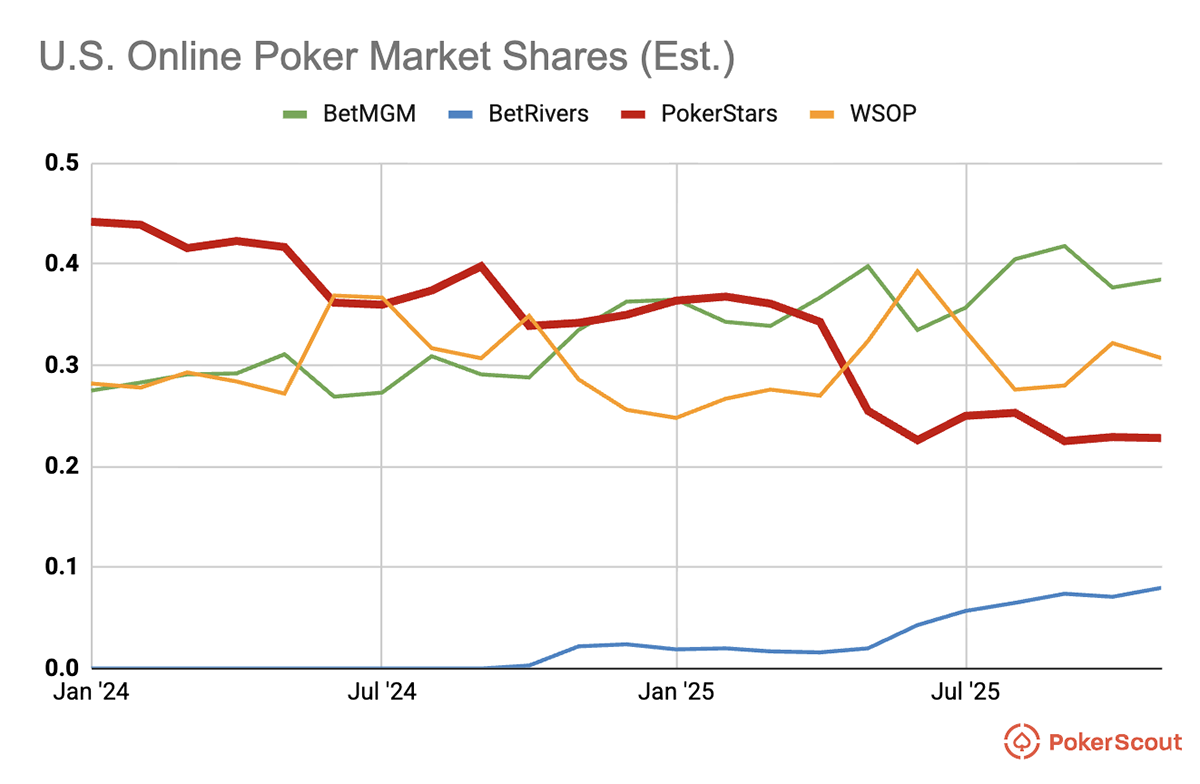
Has the Bleeding Stopped for PokerStars?
Although PokerStars’ dominance of the U.S. market was already in question coming into 2025, the loss of its throne became inevitable when it elected not to combine its Pennsylvania site with the rest of the network. All other operators went to that trouble — even BetRivers, which didn’t have a presence in other states until that point. However, PokerStars’ owner Flutter indicated that its priorities were focused on other parts of the world.
The addition of Pennsylvania to the larger U.S. player pool brought unprecedented growth for the other operators. PokerStars, on the other hand, has declined by an average of 27% year-over-year since April, when the necessary legal changes took effect.
It makes sense, then, that PokerStars’ market share would have stabilized now, just as the growth spurt for its competitors has seemingly worn off.
There is one caveat, however. WSOP’s seasonality has an influence on other operators’ market share. It could be that a temporary flow of players from WSOP back to PokerStars is masking an underlying continued erosion of PokerStars’ position.
WSOP Online Bracelets Wrap Up
WSOP, like PokerStars, could fairly be accused of resting on its laurels in the U.S. The two operators whose market share is growing — BetMGM and BetRivers — appear to be more actively engaged with their players and more diligent about software updates.
However, WSOP has an advantage that PokerStars lacks — the cachet of its gold bracelets, which still draw players to its online tournaments despite grumbling about the software.
That advantage ebbs and flows, peaking in the summer during the main series in Las Vegas, with a smaller bump in the fall for a special online-only series. Invariably, WSOP’s market share rises during these periods, though whom it pulls that share from can vary.
This summer saw a mass migration of players from PokerStars to WSOP, mostly in Pennsylvania. It was, after all, the first time Pennsylvania players could compete for gold bracelets in the national player pool, instead of only in their own, limited series.
There was no immediate reversion following the end of the summer series. However, the WSOP fall series seems to have pulled mostly from BetMGM, leaving PokerStars untouched.
If some of the players who left PokerStars for WSOP over the summer are trickling back gradually, that effect could be canceling out continued losses on other fronts. It short, it may be a few more months before we can say with confidence that PokerStars has found its new market share floor.