Managing Editor



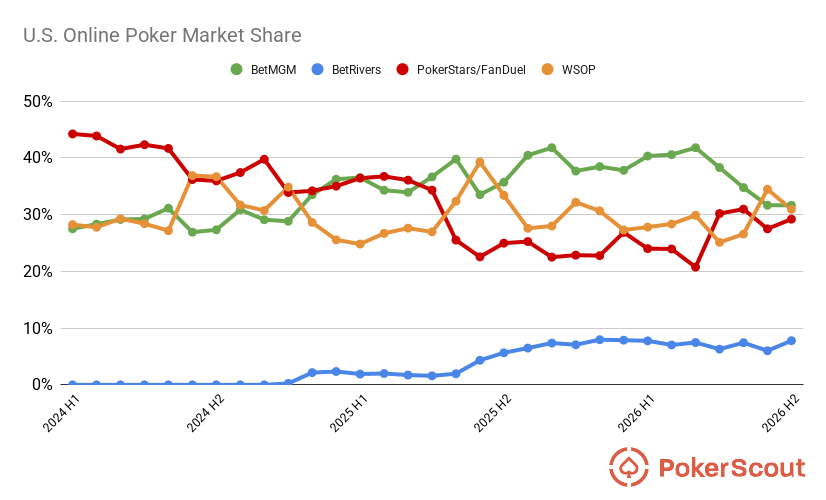
With the live World Series of Poker now over, revenue for WSOP.com is on the decline, and the primary beneficiary of that has been the new FanDuel Poker, born a few months ago from the ashes of PokerStars.
Since that rebranding, the pressing question in the U.S. poker industry has been whether FanDuel can reclaim the top spot, which had belonged to its predecessor for many years. PokerStars’ decline began shortly after its acquisition by Flutter, whose priorities for the U.S. market clearly rested with FanDuel. Meanwhile, BetMGM took its poker product much more seriously, rebuilding the struggling PartyPoker U.S. Network into the new market leader.
And yet, the tide seems to be turning yet again. It’s too early to say with certainty that FanDuel Poker will end up on top, as it still trails both BetMGM and WSOP. However, its current trajectory makes that look like the likely outcome once August’s revenue numbers come in, unless BetMGM has managed to do something to stem its losses in the meantime.
State regulators reported their July revenue figures this week. Total, market-wide revenue was down about $150,000, from $8.35 million in June to $8.21 million. Accounting for the fact that July is one day longer, that equates to a 4.9% drop in daily average revenue.
WSOP took the worst of it, which is to be expected. Even though its online bracelet series continued into July, two-thirds of the events had already taken place in June. The live Main Event, meanwhile, would have kept players away from the online tables.
Yet, not all of its rivals benefited equally from players’ migration away from WSOP. BetMGM’s revenue held roughly constant, while FanDuel, BetRivers, and even DraftKings saw an increase.
BetMGM’s Dominance May Be Coming to an End
Technically, BetMGM was back on top in July by PokerScout’s estimates, after having ceded the lead to WSOP for a month. That’s a normal back-and-forth for this time of year, however, given WSOP’s advantages during the summer series.
What’s more important is that BetMGM’s lead is the smallest it has ever been since it first claimed the title from PokerStars. Furthermore, BetMGM’s revenue holding steady in July likely conceals continued organic losses, offset temporarily by players returning from WSOP.
Upstart BetRivers has bounced back to a 7.8% share, close to its all-time high of 8.0%. For practical purposes, the remainder of the market was split evenly in July: BetMGM held 31.7%, WSOP was less than a point behind at 30.9%, and FanDuel was a close third at 29.2%, up 1.7 points from June.
Although market leadership is mostly a vanity metric when the race is so close, it means enough that operators will sometimes wage a marketing war to take it, or to hold on to it. However, the time likely isn’t right for that so soon after the World Series, when some players are likely to take a breather.
The only special event BetMGM has had going on in August is the recently-concluded Club Championship series, the guarantees on which weren’t large enough to be likely to have moved the needle.
Is DraftKings Taking Electric Poker More Seriously?
Mostly absent from this discussion is DraftKings. Its contribution to the player-versus-player online poker space is a single game: Electric Poker, which is what’s usually known in the industry as a “lottery sit-and-go” or “jackpot sit-and-go.” That is, it’s similar to FanDuel’s Spin & Go or BetMGM’s SPINS.
Because it doesn’t have a full poker room built around it, Electric Poker has mostly been a rounding error in the market. There was some excitement when it debuted in late 2024, and it briefly held 2% of the market. However, by the end of 2025, revenue from Electric Poker had dropped into four-figure territory, and it looked likely that DraftKings would discontinue it.
Instead, it has appeared to be making a second push with Electric Poker in recent months. Revenue from the game in New Jersey (the only jurisdiction in which we can see the exact number) has more than quintupled since its all-time low in February. Extrapolating that to the full market suggests its total revenue for August was still only $33,000 and change, but trending dramatically upward.
Part of that may be that DraftKings took advantage of the Multi-State Internet Gaming Agreement to allow Electric Poker players to compete against peers in other states. Although the tables only seat three players regardless, going multi-state should mean they now start more quickly, especially at less-popular stake levels. However, that’s probably only a small benefit compared to the impact of shared liquidity on other sites’ cash games and multi-table tournaments. Moreover, the rebound for Electric Poker started months earlier, in May. It’s likely that DraftKings began using targeted promotions to entice some players back to the tables around that time, as the product itself hasn’t changed.