Poker Expert


The main Omaha poker variants are Four-Card, Five-Card, and Six-Card Omaha. As extra hole cards are added, it becomes easier for everyone to make strong hands. Action heats up, but volatility soars. So, which type of Omaha should you play? That depends on your tolerance for risk and how much of an edge over the field you want to gain.
This guide covers everything you need to know before diving into the action and tackling the Omaha poker variations.
All You Need to Know
- Four Card Omaha, namely PLO, is the main and most popular Omaha poker variation. Players are dealt four hole cards instead of the two dealt in Hold’em.
- In Five and Six Card Omaha, players are dealt even more hole cards, which further heats up the action and offers more chances to make monster hands.
- In Five and Six Card Omaha, hand equities run close, and edges are slim, which makes these games extremely high variance.
- In all types of Omaha poker, players must use exactly two hole cards and three community cards to make their strongest hand.
All of these versions of Omaha are available at CoinPoker, where you can grab an extra $10 using the sign-up code POKERSCOUT.

What Is Omaha Poker?
Omaha poker is a community card game where players are dealt four hole cards (instead of two like in Hold’em) and must use exactly two of them combined with three community cards to make their best five-card hand.
If Hold’em seems too straightforward and slow for you, then Omaha is a faster and potentially more fun alternative. It could give you the frenzied action you’re looking for.
We’re also going to look at Omaha poker variations that have even more hole cards, namely Five Card and Six Card Omaha, which dramatically increase the number of strong hands and the overall intensity of the action.
Crucially, no matter how many hole cards players are dealt, you must use exactly two hole cards and three board cards to make the strongest five card combination when playing Omaha poker.
Key Omaha Poker Differences
- You must play two hole cards; you can’t use four or more cards from the board.
- Hand strength is higher; three-of-a-kind is a strong hand in Texas Hold ‘em, but weak in Omaha.
- Math margins run slimmer; in Texas Hold’em, you can regularly be a 70-80% favorite, but edges in Omaha are much smaller.
How to Play Omaha Poker?
Aside from the key Omaha poker differences around the number of hole cards players are dealt, the rules are remarkably similar to Texas Hold’em. Up to five community cards are dealt on the board, and there are four rounds of betting. Players aim to make the strongest hand based on the standard poker hand rankings.
Here’s how a hand is dealt and played across all Omaha poker variations:
- Players are dealt hole cards, followed by a round of betting.
- The first three community cards are dealt, known as the “flop”, followed by the second round of betting.
- One additional community card is dealt, known as the “turn”, followed by a third round of betting.
- The final community card is dealt, known as the “river”, followed by the final round of betting.
- If two or more players remain in the pot after the last round of betting, hands are revealed for showdown.
- The player with the strongest five card combination, made using exactly two hole cards and three community cards, wins the hand. It’s also possible to win the pot during any betting round if all other players fold.
Check out our full guide on how to play Omaha Poker, then consider trying out some variations of the game.
4-Card Omaha – The Base Game
Four Card Omaha is the classic form of the game and the one that you will find at all of the top Omaha poker sites. It is arguably the best Omaha poker variation, as it strikes the perfect balance between ramping up the action and still providing players with room to gain a strategic edge over the competition.
In Four Card Omaha, players are dealt four hole cards each, and must use exactly two in combination with three community cards to make their best five-card poker hand.
This is the second most popular poker game in the world, behind only Texas Hold’em. It is nearly always played with a pot limit structure and is better known as Pot-Limit Omaha (PLO).
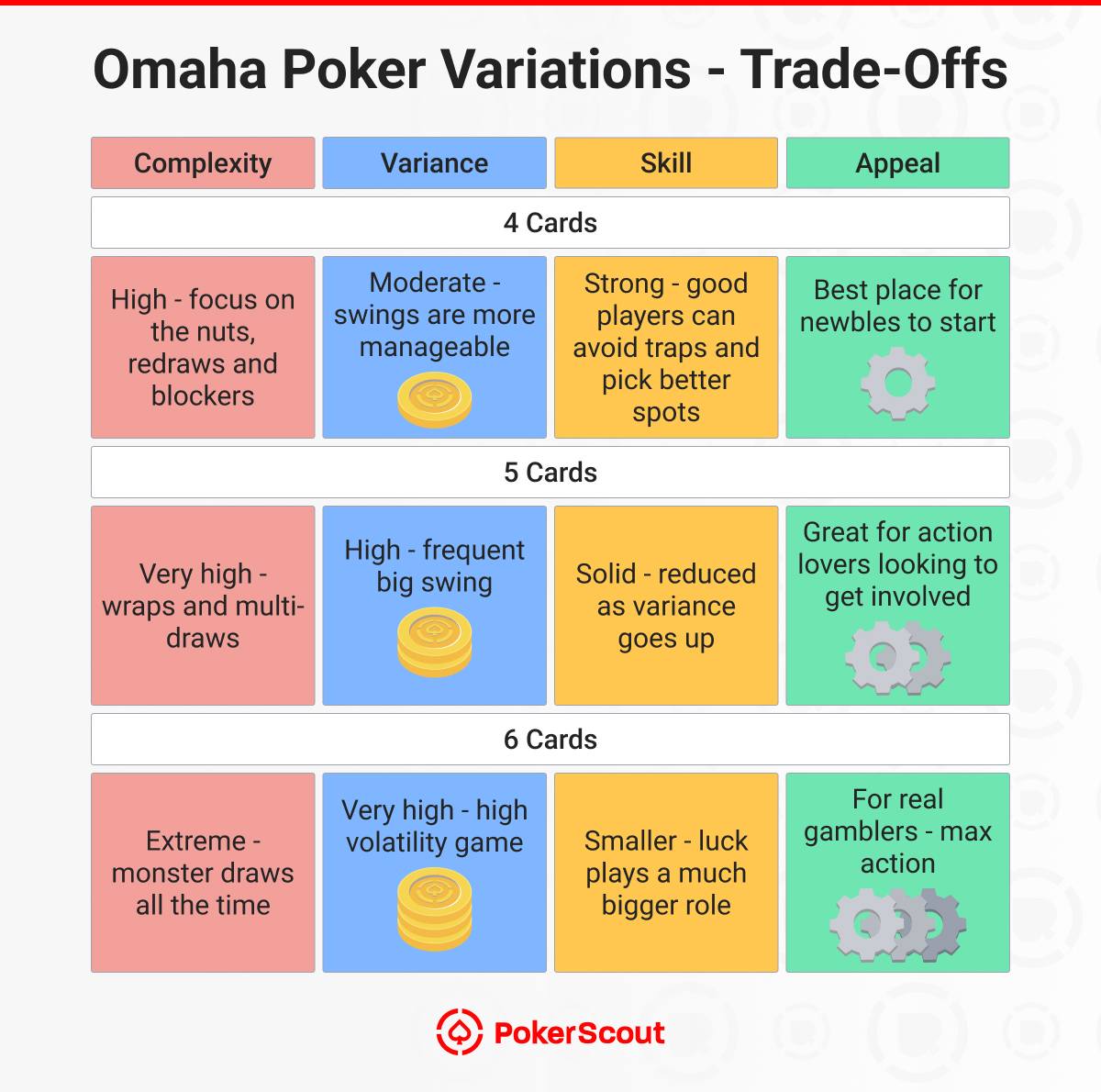
Omaha poker variations, including Four Card Omaha, are more complex than Hold’em. The extra hole cards create thousands more possible hands. It’s easier to make strong hands, so multiway pots and huge combo draws are common.
Four Card Omaha strategy typically revolves around making or drawing to the nuts, or close to it. Hands like top pair, two pair, and even trips are unlikely to win at showdown in Omaha poker variants. You’ll need to think bigger, aiming for the top end of straights, high-value flushes, and made hands with redraws.
This Omaha variant is widely available on online sites and in casinos, making it the ideal entry point for trying out this exciting poker format.
- The most popular and widely available type of Omaha poker game.
- Offers a balance between action and strategic complexity.
- Easier to make strong hands and monster draws compared to Hold’em.
5-Card Omaha (PLO5) – More Cards, More Complexity
What is the best Omaha poker variation? Well, how crazy do you want to get? The addition of extra hole cards in Four Card Omaha already boosts the action considerably. For those who are looking for even more madness, Five Card Omaha, also known as Big O, keeps the same rules while adding yet another hole card into the mix.
With five hole cards, the number of possible hand combinations goes way up, creating more frequent monster draws and unexpected showdowns. In fact, there are 134,459 unique starting hand combinations in Five Card Omaha, compared to 16,432 in the standard four-card version of the game.
The extra card makes wrap straight draws, nut flush draws, and combos much more likely. It is tough to have a hand locked down without holding the nuts, as players will often be drawing to something, and multiway battles are common.
In Five Card Omaha, hand equities run much closer together.
Often, several players will have multiple outs to different nut holdings. This leads to higher variance and deeper swings. You’ll need to have your mental game together, as Five Card Omaha tests discipline and emotional control.
The sheer number of playable-looking hands in Five Card Omaha encourages looser preflop ranges. It’s easy to get sucked into thinking every hand is worth seeing a flop, but the best players still know how to tighten up, especially out of position. Focus on hands with high nut potential.
Typically played with a pot limit structure, Five Card Omaha is not as popular as its four-card counterpart, but it is still readily available at major online poker sites and can occasionally be found at major casinos, typically as a cash game.
- Not as popular as Four Card Omaha, but still widely available at online poker sites.
- With five hole cards, the number of possible starting hand combinations shoots up to 134,459, bringing much more complexity.
- Hand equities run close together, so variance is higher, and swings can be brutal.
6-Card Omaha – The Highest-Variance
If Five Card Omaha turns the heat up, Six Card Omaha is a full-blown inferno. The rules don’t change — you still use two hole cards plus three from the board — but now you’re picking from six cards dealt at the start of the hand.
With six hole cards, there are now millions of possible starting hand combinations and almost no safe boards unless you have the stone-cold nuts. You’ll often find that you’re holding monster wraps, nut flush draws, and redraws all at the same time.
Strong starting hands in Six Card Omaha all work together to give you loads of ways to make nutted hands and draws. With six hole cards, it’s also possible to have triple-suited hands that cover three suits. Examples of monsters include A♠ A♥ K♠ K♥ Q♠ J♥ and huge rundowns like A♠ K♠ Q♥ J♥ T♦ 9♦.
This is the best Omaha poker variation for action, but the worst for gaining an edge, as hand equities run so close together. For example, a hand like double-suited aces only has around 60 percent equity against a random hand.
Bluffing rarely works. Instead, you’ll need to bet relentlessly for protection and value.
As with other Omaha poker variations, Six Card Omaha is most often played with a pot limit structure, which helps keep the action under control. The swings are sharp, so you’ll have to be prepared to deal with variance that is beyond any other poker game that you’ll play.
Of all Omaha poker formats, this is the least popular. You probably won’t find games of Six Card Omaha at your local casino. Still, for thrill-seekers who want to play, this version of Omaha is regularly available on online poker platforms.
- The least popular type of Omaha poker, but it can be found at online sites or played during home games.
- With millions of starting hand combinations, it’s essential to have huge combos and play for the nuts.
- Hand equities run even closer together, which creates extreme variance and a smaller skill edge.
Four vs Five vs Six-Card Omaha — Key Differences
As you move from four to five to six cards, the number of possible hand combinations increases dramatically, adding complexity to the game. More hole cards also means more strong hands for both you and your opponents.
In Four Card Omaha, nut potential is much more important than it is in Texas Hold’em. Hands like top pair, although ranked the same, become less valuable relative to other players’ holdings.
This trend continues as hole cards are added. In Five or Six Card Omaha, nearly every starting hand seems playable, so discipline is important. With five or six cards, it’s much more likely that someone will hit the nuts.
Postflop action gets more complex with each extra hole card. In Four Card Omaha, you’re already weighing up combos, redraws, and blockers. In Five Card Omaha and Six Card Omaha, the number of possible combos and redraws multiplies, while multiway pots become the norm.
Bankroll & Variance Considerations for Omaha Poker
The more hole cards each player is dealt, the closer together hand equities run, and the bigger the swings. That’s why bankroll management is key.
In Texas Hold’em, winning players will frequently get their chips in the middle as 70-80 percent favourites. In Four Card Omaha, this sort of edge is rare. Even a strong hand like pocket aces will typically have only a 60-70% chance.
In Five Card Omaha, equities run even closer together. Most of the time, you’ll only be a 60 percent favourite at best. By the time you are dealt six hole cards, any edge you have will be razor thin.
There’s also less room for bluffing in Five and Six Card Omaha, as it’s too likely someone else will have a hand. Instead, you’ll have to rely on value betting and semi-bluffing huge draws.
So, even as a solid player, the size of your edge over the field is slimmer in Omaha, even more so with five or six hole cards. This increases variance, leading to results that are often volatile and with huge swings.
To make up for this additional volatility, you’ll need a more conservative bankroll management strategy when playing Omaha poker variations. Here’s a rough guide for tournaments:
- Texas Hold’em – 100-300 buy-ins.
- Four Card Omaha – 150-300 buy-ins.
- Five Card Omaha – 200-400 buy-ins.
- Six Card Omaha – 250-400+ buy-ins.
Game choice matters, too. If you’re playing deep stack MTTs, you’ll experience a lot of variance and should use a conservative bankroll strategy. If you’re playing Omaha cash games, variance is reduced in comparison, and you can afford to play with fewer buy-ins.
Which Omaha Variant is Best for You?
The best Omaha poker variant for you depends on what you are looking for out of the game. For players who are new to Omaha, or perhaps those who are transitioning from Texas Hold’em, Four Card Omaha, particularly PLO, is the place to start.
Four Card Omaha is strategically balanced. It’s challenging and action-packed, yet it’s still possible to gain a decent edge over the field. The availability of both live and online games also makes it an accessible choice.
If you become proficient in Four Card Omaha and want to try something new, consider the five and six-card versions. Just be aware of the complexity, volatility, and variance that the extra hole cards bring.
Other Omaha Variants You Should Know About
Aside from Four, Five, and Six Card Omaha, there are also a couple of other popular variations of the game that you could consider playing.
The first is Omaha Hi-Lo, also known as Eights or Better. This is a split pot game in which players aim to make both the strongest five card combination and the lowest combination. The pot is divided between the winning high hand and the qualifying low hand.
Courchevel is another Omaha poker variant that has taken off somewhat for its unique twist. It’s the same as PLO, apart from the first community card, known as the door card, is dealt face up at the start of the hand.
Common Omaha Poker Mistakes
Here are the most common mistakes that players make across all Omaha poker variations:
| Mistake | Solution |
|---|---|
| Chasing non-nut draws like low flushes or the bottom end of straights. | Only draw to the nuts or very strong hands. |
| Overplaying strong Hold’em hands. | Avoid overplaying naked aces and one pair hands. |
| Thinking the best flop hand will hold through the river. | Continuously re-evaluate as new cards appear. |
| Forgetting the two-card rule. | Remember that your final hand must be made using two hole cards and three community cards. |
| Ignoring position. | Use position to your advantage when selecting hands and postflop play. |
Keep these common errors in check as you explore the different Omaha variants available.
Omaha poker variants each bring something different to the table. Four Card Omaha is the classic game, best for learning the ropes and playing strong, nut-heavy hands. Five Card Omaha adds more action and bigger swings, while Six Card is action-packed and extremely volatile, with monster draws on almost every flop.
How should you navigate these various types of Omaha poker? Beginners should start with Four Card Omaha. Then, if you’re ready to take on the variance, try five or six. Pick the version that fits your bankroll and appetite for risk. Whatever you choose, remember to play responsibly.