Managing Editor



Colorado is considering the possibility of an online lottery, although the legislative process is working in reverse — the Colorado Lottery Commission has already announced its intent to begin offering online games in 2027, but a bicameral group of legislators is working to pass a law nixing the idea.
Poker players in the state may want to keep an eye on how this political battle plays out, even if they don’t play the lottery. The games that the Colorado Lottery wants to begin offering offer an experience not too different from slots. The most likely path for online poker to become legal in Colorado — or any state — would be as part of a package deal with online casinos, and the availability of e-Instants in a market has the effect of diminshing the urgency of any potential iGaming legislation.
On December 1, 2025, the Colorado Lottery Commission announced that it had voted in favor of authorizing online sales and credit card purchases. Although the announcement doesn’t specify the nature of the online products, the phrase “buy Lottery games online” suggests that more than just draw tickets would be included.
Sen. Jeff Bridges, one of the lawmakers leading the counter-push, also understands the phase this way, telling the Denver Post:
If you look at what these online scratch ticket companies do, it is iGaming. This is iGaming sponsored by the state to the benefit of the state at a time when Coloradans can’t afford to live here.
Bill SB26-117, Permissible Methods of Selling Lottery Tickets, would shut down both portions of the Lottery’s plans if passed. It stipulates that tickets can only be purchased in cash or equivalents (e.g. debit cards) and prohibits online transactions. It has 12 sponsors in the Senate, including Bridges as one of the primaries, and 13 in the House.
Competition Between Online Lotteries and iGaming
The first online lotteries in the U.S. began appearing at roughly the same time as the first legal online casinos, a little over a decade ago. Recently, however, more states have been willing and able to bring their lotteries online than to allow private sector iGaming.
In part, that’s because legalizing an online lottery doesn’t require much work. In some cases, like Colorado, a lottery commission can do so independently, if not prevented. When legislative assistance is required, it is often only a matter of inserting the words “including over the Internet” into the language detailing the commission’s powers.
Whereas iGaming requires lawmakers to iron out things like licensing requirements and tax rate up front, an online lottery authorization can leave the nitty-gritty to the commission.
Once a state has one or the other, though, there’s relatively less reason to pursue the other. Although there is significant overlap between online lottery and online casino states, this is usually because both were authorized simultaneously or in rapid succession.
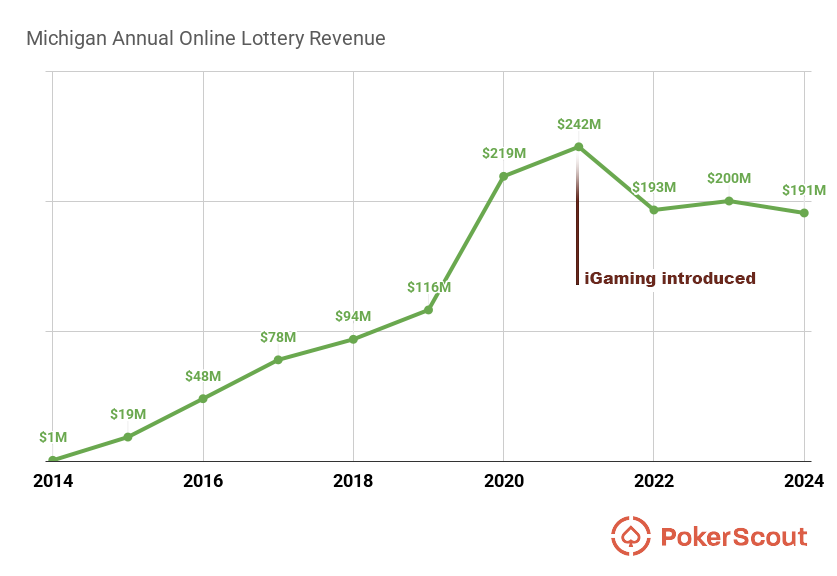
The main counterexample is Michigan, which was an early adopter of online lottery in 2014, but only launched its regulated online casino market in 2021. However, it’s also an illustration of why this order of doing things is uncommon. Its online lottery sales had been growing exponentially year-over-year until 2021, but declined sharply the year after online casinos arrived and have been stagnant ever since.
The reason is that eInstants look and play a lot like slots, but with scratch-off math under the hood. That puts them in direct competition with online slots, but when both are available, the lottery products compare unfavorably due to lower RTP and more limited features.
Colorado Already Has Enough Obstacles to iGaming
If the Colorado Lottery is allowed to proceed with online sales, it will inevitably become an opponent of iGaming because of Michigan’s example. State lawmakers may likewise be reluctant to cannibalize a state-owned revenue stream with one from which they can only collect a percentage in taxes, even if the potential market for online casinos is much larger.
Future hopes for Colorado online poker would be collateral damage in that case, as the complexity of legalizing it on its own far exceeds what it’s worth to a state economically.
Even absent an online lottery, iGaming faces an uphill battle in the mountainous state.
One reason for that is the makeup of the state’s retail gaming sector, which consists of numerous small casinos in three designated towns. While some larger casino operators like MGM and Caesars welcome the opportunity that iGaming provides, small-scale brands cannot afford that investment and tend to lobby to keep casino gaming restricted to brick-and-mortar properties.
The other reason is that the state legislature has tied its own hands. Colorado is one of many states that requires a referendum to expand gambling, albeit not for the usual reason. Many states have longstanding constitutional prohibitions that require an amendment. In Colorado, the problem is more recent: the Taxpayer Bill of Rights, which requires a referendum to levy any new tax. Although legislators could pass a bill legalizing online casinos, the point of doing so would be to tax them, and that’s not possible without a public vote.