Managing Editor


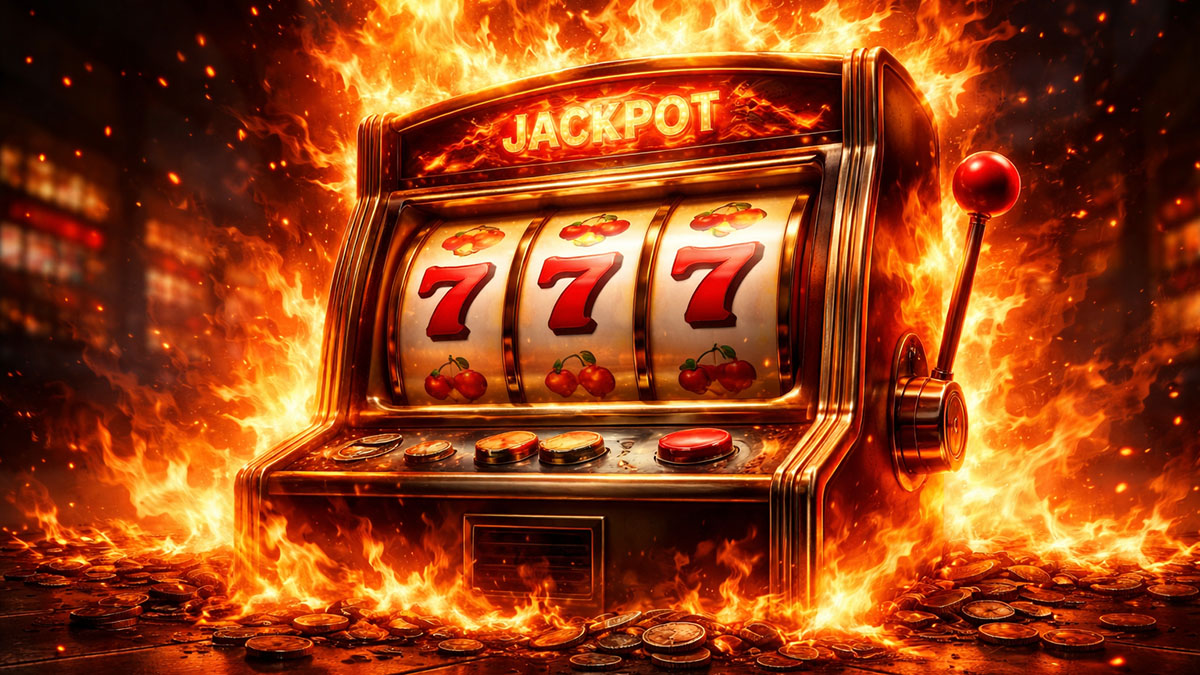
Cryptocasino Stake has pushed back on insinuations made by Bloomberg Businessweek that its in-house slots might have been rigged in favor of the site’s ambassador Drake when he went on a hot streak on live stream. PokerScout has examined Businessweek’s analysis and determined that Stake is correct in criticizing the methodology, as Businessweek’s research overlooks how the bonus buy features on slots operates.
Although it’s impossible to rule out the possibility of funny business, a deeper level of analysis than was conducted by Businessweek would be necessary to say how improbable or not the win streak in question was.
To summarize Businessweek’s claims:
- Other streamers appear to win a 1000x or higher prize about once in 10,000 “spins” (using Businessweek’s definition of a spin, which is the key in all of this).
- Drake had been winning at about that clip while playing third-party games.
- At the behest of Stake co-founder Ed Craven, Drake switched to slots by Easygo, a studio owned by the same parent company as Stake.
- Following this, Drake hit prizes of 1000x or higher six times in 15,000 spins, about four times the baseline rate, although he still booked a losing session.
At a glance, it’s easy to see why this sequence of events would seem suspicious.
A Stake spokesperson told Businessweek that their analysis was “categorically incorrect” and “ignores how game mathematics work.” In its defense, Businessweek says that all the slots it analyzed have similar payout rates, and are therefore comparable. Yet, RTP does not tell the full story for a slot. More importantly, though, Businessweek’s way of counting “spins” is fundamentally flawed in a way that makes it hard to glean anything useful from the data.
Businessweek’s data reporter and tech editor did not respond to PokerScout’s request to discuss the analysis.
Keep Reading
How Improbable is Drake’s Win Streak at Face Value?
To begin with, let’s take Businessweek’s data at face value and assume Drake really did play 15,000 spins and win 1000x prizes six times. How unlikely is that? It’s something that Businessweek’s analysis omits, but which tends to work in their favor.
The odds of getting a certain number of successes in a certain number of trials at certain odds are given by something called the Binomial Formula. Although the numbers involved in a problem like this are very large, automated tools like Wolfram Alpha can spit the answer out easily enough.
It’s about 0.21% for exactly six jackpots. It’s a little higher if we include the possibility of winning more than six times, but still less than 0.3%.
Although it’s not impossible for something like that to happen by chance, the timing would seem suspicious if this were what was really what’s going on.
The numbers for adinross, another streamer Businessweek highlighted as suspicious, are less convincing: the anomaly in his case is just a single win over a sample size of 2000 spins, which is roughly a 20% chance taken at face value.
However, in reality, neither Drake nor any of the other streamers Businessweek examined played anything close to the number of spins being claimed.
High-Stakes Streamers Employ ‘Bonus Buy’ Mechanics
To calculate the number of “spins” each player made, the researchers used Claude (an AI) to watch for drops in the player’s balance, corresponding to wagers being made. They then divided that by the bet size to get the number of spins.
However, these streamers could not possibly have been playing the base game for much of the time, based on the spin volumes involved. A typical online slot plays at 12-15 spins per minute, or up to about 900 spins per hour. With turbo mode on, you might get up to 1,200 or so.
Only a couple of the streamers in Businessweek’s table fall into that range. Many are north of 10,000 “spins” per hour. The only way that is achievable is through using bonus buy features, which cost many times the base bet amount — 80x is a fairly common multiple. Businessweek acknowledges this, writing:
These rounds are sometimes sold on Stake as equivalent to a certain number of regular spins—a bonus round equal to 100 spins, for example, costs $1,000 in crypto given a $10 base bet—so Businessweek’s methodology takes this at face value.
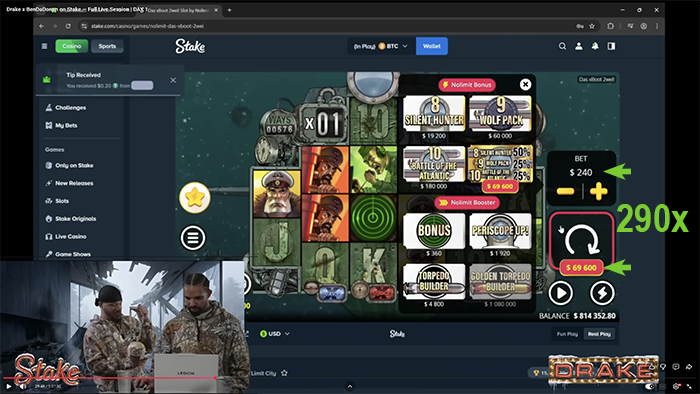
Unfortunately, slots math doesn’t work like that at all. A feature that costs 100 bets to play doesn’t equate to 100 spins of the base game. It will typically be equivalent to triggering the free spins bonus round, which offers a smaller number of spins but with added benefits. For instance, 12 spins with sticky wilds might work out to the same return-to-player as 100 spins of the base game. But the volatility won’t look the same at all. The player paying for the bonus round will experience much higher variance — and therefore more 1000x payouts — than a player playing 100 spins on the base game.
More importantly, many slots offer multiple different bonus buy options, each with a different bet multiple and degree of volatility.
Were ‘Luckier’ Streamers Just Playing More Aggressive Features?
To establish whether there’s anything out of the ordinary with Drake’s streak would require more information about the specific games’ bonus features — not just their RTP — and how each streamer was interacting with the game.
PokerScout does not have access to that information, so it’s impossible to say with certainty. However, there is at least circumstantial evidence in Businessweek’s data that the seemingly luckier streamers, including Drake, were using more expensive features. Even if the intrinsic variance of these is similar, the effective volatility will be higher due to compressing a larger number of nominal “spins” into a smaller sample.
For instance, 100 plays of a 100x feature and 40 plays of a 250x feature would both count as “10,000 spins” in Businessweek’s reckoning, but the latter is a much smaller sample size and subject to higher variance.
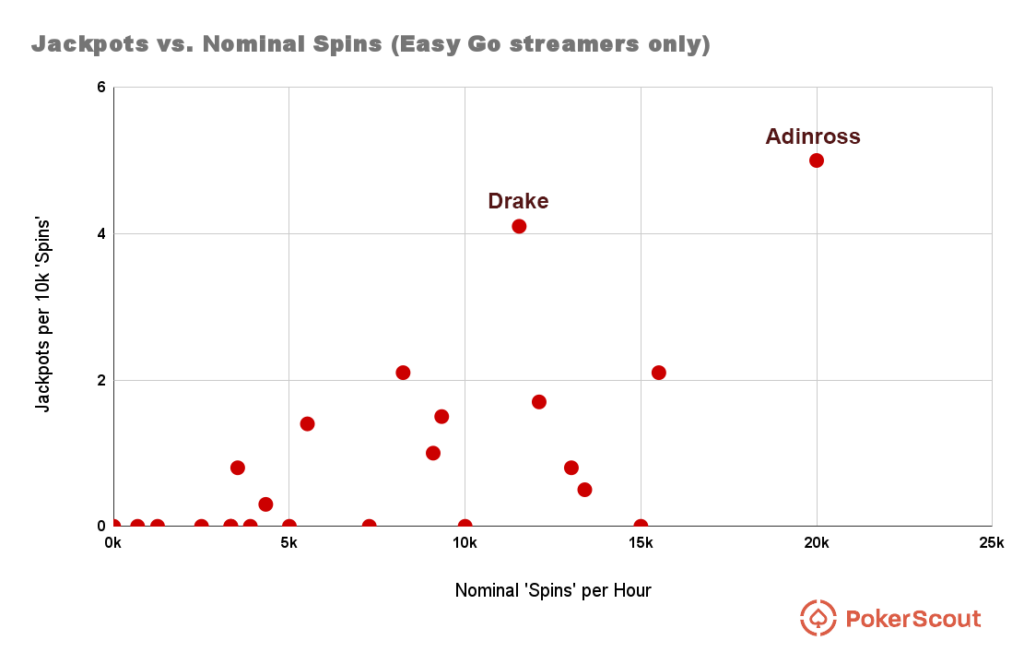
Businessweek’s analysis includes 49 data points, dividing individual streamers’ sessions up based on whether they were playing Easygo games or ones from a third party. PokerScout has excluded one outlier: a streamer named virex, whose pace of 86,500 nominal spins per hour was far out of anyone else’s range.
Grouping the remaining data points using Businessweek’s metric of “big wins per 10,000 spins,” we see the following correlation with the nominal pace of play:
| Jackpots per 10,000 | Spins/Hr (All) | Spins/Hr (EasyGo) | Spins/Hr (Third Party) |
|---|---|---|---|
| 0.0 | 7,152 | 4,750 | 7,867 |
| 0.1 to 0.9 | 9,346 | 8,571 | 9,733 |
| 1.0 to 1.9 | 11,733 | 9,011 | 12,822 |
| 2.0 and up | 12,486 | 13,821 | 7,143* |
(*only one data point)
The correlation is considerably stronger for EasyGo games than for third-party games, suggesting that EasyGo’s games feature more expensive, aggressive features that produce more big wins and losses.
Although Drake and Adin do stand out as having a higher jackpot rate even than other EasyGo players, they also played a higher number of nominal spins per hour than most other streamers. That likely indicates more frequent use of the most expensive features and isn’t far off from the trend established by the luckiest contingent of other EasyGo streamers.