Poker Writer


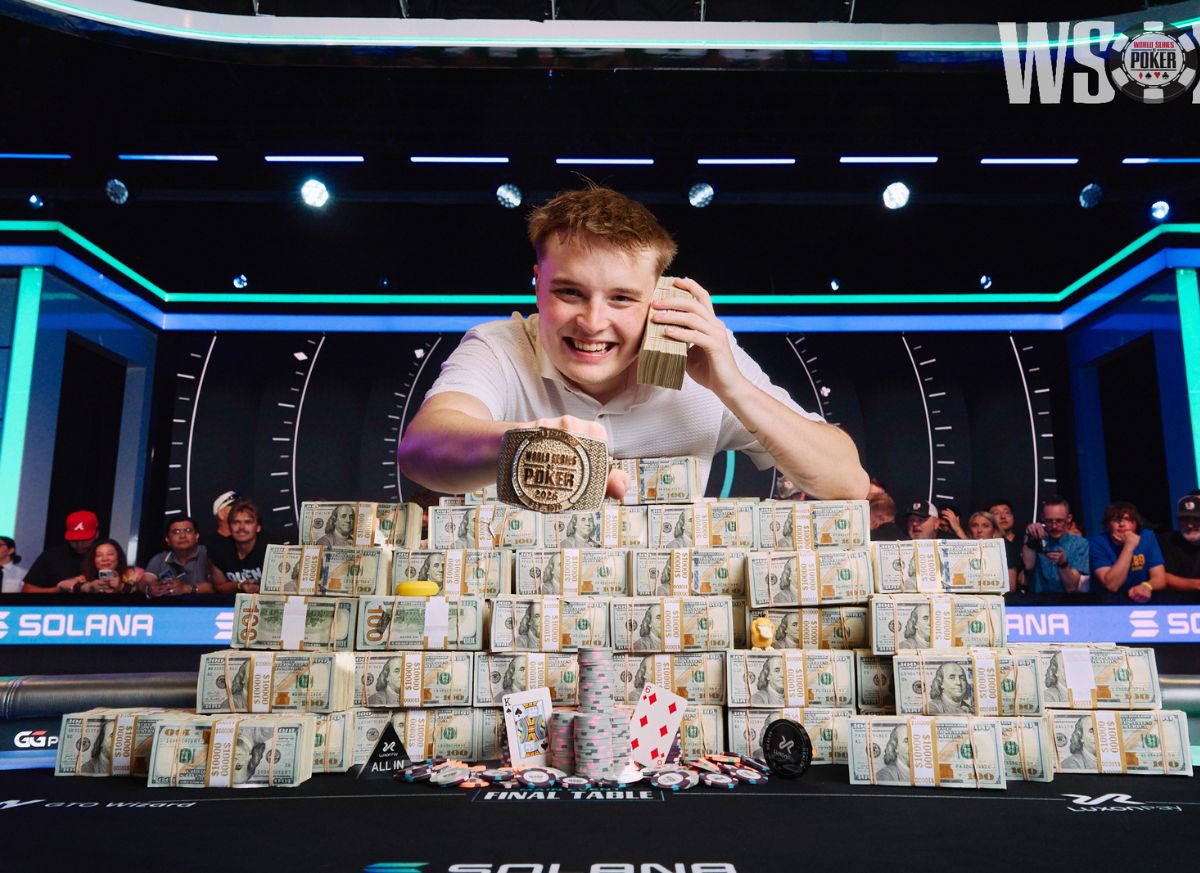
Lucas Jumalon became the second-youngest World Series of Poker main event champion after he defeated Lauri Saaskilahti heads up on the final day to win the $10 million grand prize, potentially creating an important new catalyst for younger players in poker.
Jumalon and Saaskilahti entered the final day as the only two players left. The Spokane, Washington, native led the Finnish player by a chip count of 109 big blinds to 75 big blinds, holding about 59% of the chips in play. After some explosive hands, Jumalon took down the title after about 90 minutes of heads-up play.
Keep Reading
Bringing Back Poker’s Youth Movement
Jumalon’s win could serve as a sort of rejuvenation to the poker youth movement. Recent comments from 2024 WSOP main event champion Jonathan Tamayo, suggested that poker is a slowly dying game with the pool’s average age going up. And while there does appear to be some evidence that fewer 20-somethings play the game these days, Jumalon’s win could change that dynamic.
Every year for the main event, there is always talk about how the champion could be an “ambassador for the game” and how good (or bad) the winner is for poker. Some of that talk is overblown, as one particular champion is unlikely to really make a big impact. Exceptions could be a woman or a champion from a country like Japan, Brazil, or India, which could start a poker boom in the winner’s country.
But there is some potential in the story of a 22-year-old winning it all. Jumalon is the second-youngest winner ever, behind only Joe Cada in 2009.
Jumalon First Under-30 Champion since 2017
His win breaks a streak of older winners in recent years.
| Year | Champion | Age at time of winning |
|---|---|---|
| 2025 | Michael Mizrachi | 44 |
| 2024 | Jonathan Tamayo | 38 |
| 2023 | Daniel Weinman | 35 |
| 2022 | Espen Jorstad | 34 |
| 2021 | Koray Aldemir | 31 |
| 2019 | Hossein Ensan | 55 |
| 2018 | John Cynn | 33 |
| 2017 | Scott Blumstein | 25 |
| 2016 | Qui Nguyen | 39 |
| 2015 | Joe McKeehen | 24 |
| 2014 | Martin Jacobson | 27 |
| 2013 | Ryan Riess | 23 |
| 2012 | Greg Merson | 25 |
| 2011 | Pius Heinz | 22 |
| 2010 | Jonathan Duhamel | 23 |
| 2009 | Joe Cada | 21 |
| 2009 | Peter Eastgate | 22 |
As the table shows, it used to be common for players in their 20s to win, and even younger than 25 was the norm for several years. But that average age rose sharply after Scott Blumstein’s win in 2017, and Jumalon is now the first winner younger than 30 since then.
Does this make any tangible difference to the overall age in poker moving forward? It’s impossible to say right now, but it doesn’t hurt when a young player sees an age peer winning $10 million on the biggest stage.
Jumalon also seems like a positive figure for the game, with a good attitude and someone who appears to care about being a face for poker from early returns. That is not something that can be said about every young champion in the past. Peter Eastgate and Pius Heinz disappeared from poker entirely shortly after winning. Joe McKeehen is famously prickly and didn’t welcome the spotlight.
In this day and age of social media, it is vital for Jumalon to embrace being the champion and be willing to tell the story of winning $10 million to 20-somethings who could aspire to play tournament poker.
A win from a likable 22-year-old is more likely to attract people to play than a generic 30-to-40-something. If poker wants to push back against the rising average age, Jumalon is the perfect winner to try to reverse the trend.
The Defining Hand in the 2026 WSOP Main Event
Jumalon was coached by CoinPoker’s Patrick “padspoker” Leonard at the final table. Leonard appeared multiple times sweating the all-ins with Jumalon and giving him advice during the TV breaks.
Shortly after Saaskilahti won a dramatic all-in where he went runner-runner flush to survive and pull the chip counts near even, the defining hand of the entire final table happened.
On a four-spade board, the Finn decided to make a hero call with just a pair of jacks. He called a 2x-pot bet on the turn before hero-calling an overbet on the river. Jumalon had the nut flush with the queen of spades, which decimated Saaskilahti down to just under 10 big blinds.
Video of the hand on WSOP’s X account shows the tense moments before he decided to call, only to find that he ran into a monster.
Continued Dominance By Heads Up Chip Leader
Jumalon’s chip dominance was the overarching story of the final table. He held the largest % of the chips heading into the final table of any chip leader in recent years, with more than 35%.
His win was wire-to-wire as he never relinquished the chip lead, which is something that PokerScout accurately predicted last week. The closest any player got to his chip lead was Saaskilahti during heads-up play after his double-up.
One interesting trend that continued with Jumalon’s win is the continued dominance of the heads-up chip leader at the WSOP main event. The chip leader at the start of heads-up play has now won 20 out of the last 25 times, meaning that heads-up comebacks are quite rare on poker’s biggest stage.
Numbers provided by the user ‘rjen47’ on the TwoPlusTwo forums break down the only winners since 2001 who entered heads-up play with a chip deficit: Heinz, Ryan Riess, Qui Nguyen, John Cynn, and Tamayo. In four of those cases, the chip counts were very tight and turned into long, drawn-out battles. In the case of Nguyen, he took the chip lead quickly in heads-up and dominated Vayo for most of the heads-up play.
The lone exception in recent years was Tamayo, who entered heads-up play with less than 30% of the chips. His comeback was controversially aided by on-the-rail solver-centric coaching from other players, which led to controversy and a special “Tamayo Rule” for future WSOP events.
Photo credit: Alicia Skillman / WSOP