Poker Expert


As a variant of Seven-Card Stud, Razz uses the same betting structure. However, hand rankings are turned upside down, as the aim is to avoid high cards and form the lowest possible hand.
This guide explains how to play Razz poker, taking you through the rules, betting, and strategy of this fun lowball game.
All You Need to Know
- Razz poker is the lowball variant of Seven Card Stud. Players are dealt up to seven hole cards and aim to make the lowest possible combination.
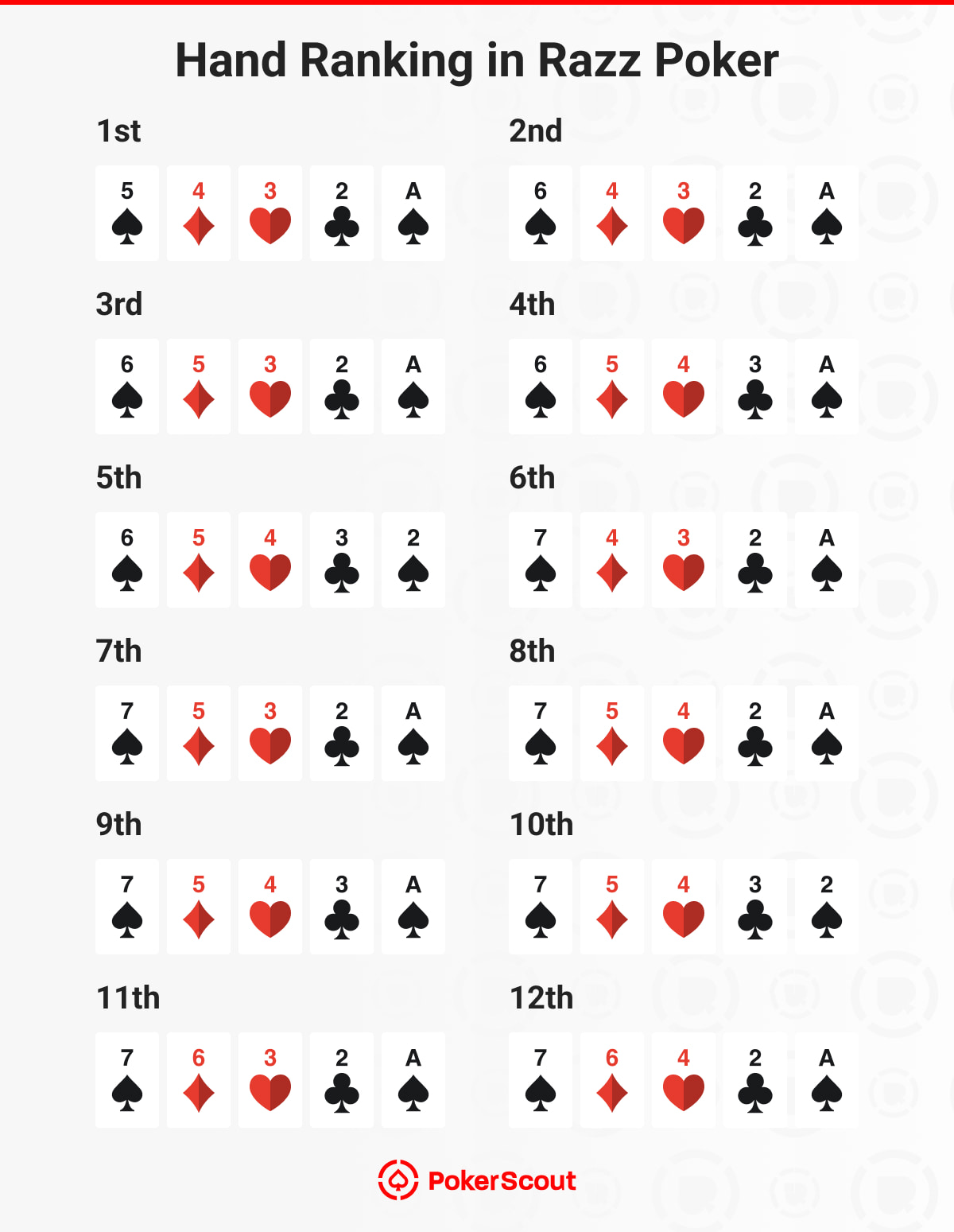
- Aces are low, while straights and flushes don’t count, so the best hand in Razz is A-2-3-4-5.
- Razz poker rules utilize antes, a bring-in bet, and a fixed-limit betting structure
- Razz poker strategy involves proper starting hand selection, awareness of the board, and applying pressure with visible upcards.
What Is Razz Poker?
Razz is a lowball variant of Seven-Card Stud.
In terms of structure, the two games play out in much the same way. Players are dealt up to seven cards, some face-up and others face-down. However, the object of Razz is to make the lowest hand possible, not the highest.
Aces are low in Razz, while straights and flushes don’t count, so the best hand in Razz poker is five-high with A-2-3-4-5, known as the wheel.
Razz Poker: What You Should Know First
Before learning how to play Razz poker, it is helpful to have a basic understanding of poker. In particular, if you’re already familiar with Seven-Card Stud, you’ll have no problem picking up the Razz poker rules.
Understanding Seven-Card Stud
In both Stud and Razz, players are dealt seven cards each across five rounds of betting. Both games use a fixed limit betting structure, which caps the maximum bet and raise size on each street.
What Makes Lowball Different
Razz poker is a lowball poker variant. Instead of trying to make the highest-ranked hand, you’re aiming to make the lowest possible five-card combination. More specifically, you are aiming for low, unpaired combinations.
How Does Razz Differ from Other Poker Games?
To give you more of a picture of how to play Razz poker, here’s a quick rundown of how it compares to similar games:
- Razz vs Seven Card Stud: As explained above, Razz poker rules are the same as Seven Card Stud, but with lowball hand rankings.
- Razz vs Stud Hi-Lo: In Stud Hi-Lo, the pot is split between the highest hand and the lowest qualifying low hand. In Hi Lo, only an eight-high or lower qualifies to win the low half of the pot.
- Razz vs Other Lowball Games: Lowball poker games can vary in their hand rankings. In 2-7 Triple Draw, for example, aces are always high, while flushes and straights count against your hand.
Razz Poker Hand Rankings
According to the Razz poker rules, the lowest-value cards are the most powerful. Aces are high, and you can disregard flushes and straights. With that in mind, here are the best hands in Razz.
How to Play Razz Poker
You can win the pot by having the lowest hand at showdown or by betting and getting other players to fold. Here’s a guide on how to play Razz poker for beginners, taking you through a full hand from start to finish.
How to Play a Razz Poker Hand
- Before the cards are dealt, every player places an ante. Each player then receives three hole cards, starting from the dealer’s left. The first two are dealt face down, with the third card dealt face up. This is known as third street.
- Whoever has the worst upcard, which is the highest card in lowball games like Razz, pays a small forced bet known as the “bring-in”.
- Action moves clockwise around the table. Players have the option to call, complete, raise, or fold.
- After the first round is complete, another face-up card is distributed to all players who remain in the hand, known as fourth street. This is followed by another round of betting, led by the player showing the lowest door card.
- The fifth and sixth street cards are also dealt face-up, with a round of betting after each new card is dealt. Again, the player with the lowest upcard goes first.
- Seventh street is dealt face down. This is the final card, followed by the final round of betting, led by the same player who bet first on sixth street.
- If two or more players remain in the pot, the hand goes to showdown. The player with the best combination according to Razz hand rankings wins the chips.
This structure remains consistent across all five betting rounds, making Razz poker straightforward to follow once you understand the basic hand flow.
Bring-in Bet Explained
Unlike other poker games, such as Hold’em, Razz poker rules utilize antes and a bring-in bet.
In Razz, the bring-in is paid by the player who has the highest upcard showing on third street. The bring-in player has the option to complete by matching the full small bet amount. You can think of the bring-in bet like the blinds in Hold’em or Omaha. They are there to boost the pot and force action.
All players are also required to pay an ante before cards are dealt, which is usually 20% of the small bet.
Fixed Limit Betting Structure
Razz is played with a fixed-limit structure, where all bets and raises follow predetermined limits.
A defined small bet and raise sizing can be used on third and fourth street. This switches to a big bet sizing on fifth, sixth, and seventh street, which is typically twice the amount of the small bet. For example, if the game is $ 1/$2 Razz, you can only raise $1 at a time on third and fourth street. But on the fifth, sixth, and seventh street, any bets and raises are in $2 increments.
Only four total bets can be made during each betting round, so one bet and three raises between all players.
After that, the action is capped, and players can only call or fold. However, most Razz games allow uncapped raising on the final betting round, as long as it’s a heads-up situation.
Other Razz Poker Rules
One Razz poker rule to keep in mind is that when two or more players have the same rank upcard on third street, ties are broken using suits to decide who makes the bring-in bet. The suit ranking, from highest to lowest, is:
- Spades ♠
- Hearts ♥
- Diamonds ♦
- Clubs ♣
So, the player with the highest suit would make the bring-in bet.
If someone has the K♥ and another player has the K♠, the K♠ pays the bring-in. This is the only time suits are used to break ties. Whenever two players have identical Razz hands at showdown, the pot is shared equally. Another Razz poker rule is the deck shortage rule. In rare cases when eight players remain active through seventh street, the dealer may run out of cards.
When this happens, a single community river card is dealt face up in the center of the table for all players to share.
Razz Poker Variants
There are a couple of interesting Razz variants to be found. However, you’re not likely to see them online, as they’re pretty rare.
London Lowball
London Lowball plays exactly the same way as traditional Razz poker, but straights and flushes count as valid hands.
This means that a non-flush 6-4-3-2-A becomes the nuts. As the name suggests, this game is almost exclusively played in Europe. It’s normally played with pot limit structure.
2-7 Razz
Similar to London Lowball, straights and flushes do count in 2-7 Razz. However, the main difference is that aces only play as high cards. The best possible hand, therefore, is an unsuited combination of 7-5-4-3-2.
Razz Poker Strategy
Okay, so we’ve covered the rules. But how do you play Razz poker optimally?
Here’s a quick guide to Razz poker strategy, covering the best starting hands in Razz and some advice for playing later streets.
Starting Hand Selection Guide
Like other types of poker, selecting a starting hand is crucial in Razz. Here’s a rundown of the best starting hands in Razz, playable hands, and hands you should nearly always fold.
Premium Starting Hands (Three to a Wheel)
Any hand that contains three cards that are 5 or lower with no pairs qualifies as a premium starting hand in Razz. Ideally, you want all of your cards to be lower than your opponent’s upcard. In any case, you should nearly always raise with these hands:
- A-2-3 – the absolute best starting hand in Razz.
- A-2-4
- A-3-4
- 2-3-4
- A-2-5, A-3-5, 2-3-5, A-4-5
These starting hands give you the potential to make the nuts in Razz, A-2-3-4-5.
With three cards to a wheel, you can even afford to brick once or twice and still stay strong enough to play. With a low upcard, you can also apply pressure to win the pot early.
Playable Starting Hands
Other playable Razz starting hands typically feature three low cards, with a value of 7 or lower.
It also helps if your upcard is one of the lowest at the table. The following hands are playable, but require caution and an awareness of the board:
- A-2-6
- A-3-6
- 2-3-6
- 3-4-5
- A-2-7 (situational)
You can nearly always complete or call with playable hands, raising only when you have the board advantage and other players have higher upcards. Proceed with caution if you brick on fourth street.
A-7 low is really the cutoff point for playable hands and becomes more situational, based on upcards and action.
When to Fold on Third Street
Some hands are not playable in any situation.
You should fold them quickly on third street to avoid paying too much with a weak draw. Here are a few general rules to keep in mind:
- You have a high card (8 or higher), and your opponent shows a much lower upcard.
- Your hand contains a pair, and your opponent’s upcard is lower.
- Your upcard is worse than most of the visible board cards.
- The pot is raised and/or multiway, and you don’t have a smooth low with connecting cards.
You can simplify the above points and fold most of the time when your hand is worse than A-7 low and/or your upcard is dominated.
6 Razz Poker Strategy Tips for Later Streets
When learning how to play Razz poker, follow these pointers to improve your strategy on later streets:
- Hand selection does matter: As we’ve mentioned, hand selection in Razz matters just as much as in any other form of poker. You should be folding a lot. The best starting hands contain three to a wheel, but any three below 8 are acceptable. At a full table, you should always fold a paired starting hand unless you’re showing an ace.
- Bluffing is important: In Razz, you need to represent hands much more than in other poker games. Imagine you start with (K-Q)-5, for instance. This is clearly junk. But if the players behind you are showing 9, J, and Q as their door cards, a complete is almost certain to result in you winning the antes, blinds, and bring-in.
- Observe the visible cards: Pay attention to what others are showing. This helps you pick stealing opportunities, but it’s also crucial when drawing. You might have (3-2)-A, for example. But if everyone else is showing 4s and 5s, you can’t hit what you need for the nuts. Your hand is blocked and so not as strong as at first glance.
- Draws can be huge favorites: A made hand is by no means guaranteed to be a lock. It all depends on the strength of the other cards. Compare J-T-7-2-A to Q-7-3-2-A, for instance. The J low is actually a 25.64% underdog in this matchup. The Q low can hit a 4, 5, or 6 to improve to an unbeatable 7 low, or take the lead with an 8, 9, T, or J.
- Don’t overplay marginal edges: One card can change everything in Razz. Even if you have a strong hand with an apparent edge, you don’t want to get too crazy, especially in tournaments. Imagine (4-2)-5 against a 6. You’re ahead, but what happens if you catch a Q on fourth street? If your opponent is super aggressive, slow down in those spots.
- No hero folds on seventh: Finally, as a fixed limit game, seventh street pots are often huge in relation to the amount required to call. So, unless you have something insanely bad, it usually makes sense to just call a bet to make it to showdown. A made 9, for example, still has a chance of winning, and you’ll almost certainly be getting the right odds to play. If your hand is too weak to play, you should have folded long before seventh street.
Setting Up a Razz Poker Game
To incorporate Razz into your home game, you’ll need nothing more than a standard 52-card deck, a table, and a set of chips. A maximum of eight players can sit in the game.
Although it’s possible to use a Pot Limit structure or even No Limit betting, Fixed Limit is by far the most common way to play Razz.
When playing Razz poker online via real money poker apps and sites, the software takes care of everything for you. Still, Razz really isn’t a complicated game to deal, especially if you already understand the rules of Seven-Card Stud.
Common Mistakes to Avoid in Razz
On your journey learning how to play Razz poker, avoid these common mistakes:
- Playing too many hands: Calling with high hands like 8+ or large gaps is a losing proposition.
- Ignoring upcards: The upcards tell you what cards are left in the deck and give you hints about other players’ hand strength. Ignore them at your peril.
- Chasing from behind: Drawing with a rough low hand of uncoordinated cards is rarely profitable when an opponent likely has a smooth low.
- Continuing on later streets: If you miss or, worse still, pair your hand on fourth or fifth street, it’s time to consider either slowing down or folding.
- Failing to apply pressure: Razz involves a lot of bluffing and betting for protection with strong upcards. Don’t miss out on these profitable opportunities to win pots uncontested.
Razz poker offers a refreshing twist on traditional Seven Card Stud by rewarding the lowest hand instead of the highest. While the lowball rankings take some adjustment, mastering starting hand selection and reading visible upcard will quickly improve your results.