Poker Writer


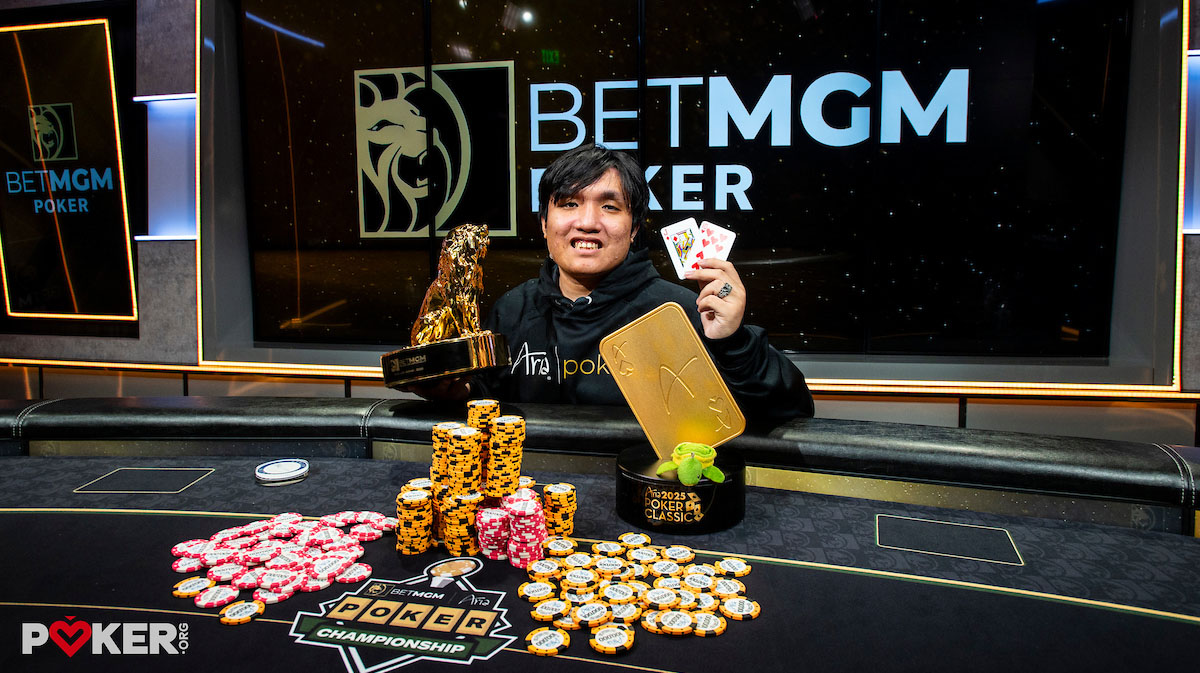
Last Friday, the BetMGM Championship at Aria wrapped up with one of the most epic comebacks in tournament poker history. Conventional poker wisdom is that call you need is “a chip and a chair” to have a chance in a tournament, but rallying from a single chip to win is rare in practice.
That’s exactly what Nguyen Le did, however, after a failed bluff left him with just a single chip in front of him with eleven players left in the tournament. He quickly spun that back up to become the final table chip leader and ultimately claim a $777,777 victory. Even before that mishap, he’d already outlasted 1,841 players from the a field of 1,853 in the $3,500 buy-in event.
The first BetMGM Championship took place in 2022. Over just a few years, it has grown considerably and the top prize is now almost as large as the entire prize pool was in the tournament’s first year.
David Mileaf, BetMGM’s Senior Manager of Poker Operations, described Nguyen’s win as “possibly the most epic poker comeback of the summer that captured the wild swings and emotions of poker.”
The “chip and a chair” a well-known bit of poker lingo often trotted out to console and encourage a player who has become short-stacked. Le’s win is a reminder that it isn’t just hollow talk. As long as a player is still alive in the tournament, they really do have a chance to win it.
Origins of the Phrase
The phrase ‘chip and a chair’ itself originated with a similarly literal scenario.
It dates back to the 1982 WSOP Main Event—just the third year in the history of the series—when Jack Strauss came back from a single chip to win the bracelet. Accounts of the specifics vary. However, in one popular telling of the story, Strauss didn’t intentionally leave himself with the chip, but found it under a napkin after committing the rest of his stack. Since he never verbally declared all-in, he was able to keep the chip and fight his way back into the tournament.
Though such stories are rare, Strauss and Le aren’t the only two players to have battled back from that kind of deficit. It’s a little more common if we include scenarios where players have had a handful of low-denomination chips that collectively amount to less than a single high-valued one.
In fact, we’ve already seen that happen once at this summer’s WSOP. Michael Wang won the $10,000 Pot-Limit Omaha Championship after having less than a single big blind in front of him at one point.
Wang had five chips, not one. Yet they added up to a measly 65,000 with the big blind at 100,000 on the penultimate day of the event. Worse, he had been under the gun during the collision that left him so badly short-stacked, and was all-in as the big blind on the very next hand.
Greg Merson Might Have the Best Comeback Story
There’s more to a good comeback story than just the number of chips or big blinds, however. As remarkable as Le’s and Wang’s feats were this summer, the best comeback of all time might still belong to Greg Merson.
There aren’t many bigger spots for a comeback than the WSOP Main Event. Merson found himself down to just 2.5 big blinds during the 2012 Main Event, when there were still 150 players left in the tournament. Over the course of days he built those chips back up and finally won the bracelet and $8.5 million.
Poker odds and probabilities being what they are, there’s a lot of luck involved in these kinds of comebacks. A player with a few big blinds to play with can fight back by stealing the blinds. However, being as short-stacked as these players were takes all fold equity away. The players are forced to go all-in at the first opportunity, with whatever cards they’re dealt, and hope to win against one or more callers looking to snuff them out and get a pay bump. It may even require several of these double- or triple-ups before the player has a stack capable of doing anything other than going all-in and hoping.