Poker Writer



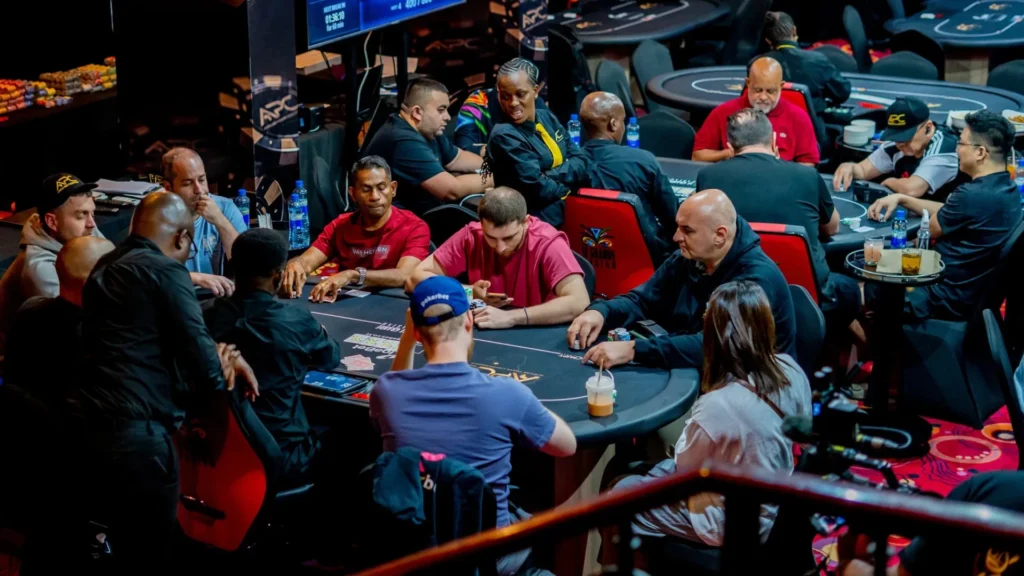
Tournament staff at the Seminole Hard Rock Poker Open Championship declared a player’s hand dead in a livestream on Saturday night when he revealed three hole cards at showdown. That was the correct decision based on Tournament Directors’ Association (TDA) rules, but created some controversy and confusion in the moment.
Niall Costigan was the player at the center of the wild hand during Day 1b of the $5,300 buy-in event. Tournament staff awarded his opponent the pot after the highly unusual showdown.
Highly Unusual Showdown At SHRPO Championship
The hand between Costigan and Daniel Cove seemed normal until the river, when Costigan revealed what he thought was a winning full house with pocket Kings on a paired board. But he also had the Ace of Spades to make for three cards in the hole.
Costigan reacted first in disbelief, then anger, claiming he didn’t notice the issue until he turned over his cards. He flung them in frustration, seemingly knowing what was coming.
Several players at the table said they had never seen that happen before as tournament directors arrived to make a ruling. At least one player said the hand would be declared dead.
Another player, Brian Green, questioned whether Costigan hadn’t actually known he had three cards the whole time or not. Another said Costigan knowing wouldn’t make any sense.
“Why would he do that if he knows his hand’s going to be dead?” he asked.
Misdeals: What the TDA Rules Say
After a lot of chatter from the entire table, recapping the hand, the tournament directors finally had a chance to discuss the next step. Both floor tournament directors declared that Costigan’s hand was dead and the entire pot would go to Cove.
Costigan did not like the ruling as he argued his case:
Why is it not just split pot? … So instead of just the most fair thing, I get punished for playing well?
The top supervising tournament director replied:
You get punished for playing a three-card hand. I’m not deying that you didn’t know but it is a general rule.
Costigan tried to argue again that he did not know it was a three-card hand until the end. That argument proved moot in the face of the standard rules of tournament poker, as laid out by the TDA. In their current form, these state:
In misdeals, the re-deal is an exact re-play: the button doesn’t move, no new players are seated, limits stay the same[…] Once substantial action occurs, a misdeal cannot be declared; the hand must proceed unless the deck is fouled[…]
The rules define “substantial action” as any three actions by players, or any two actions that involve voluntarily putting chips into the pot.
Why Kill the Hand?
Costigan argued that the hand was a misdeal from the moment he had three cards, so all subsequent actions should have been voided. However, significant action had occurred long before the hand reached the river, so the ruling, in accordance with TDA rules, was that no misdeal could be declared and the hand was dead.
Ultimately, the player has responsibility for verifying that they have the correct number of cards. They should declare immediately if they received too many or not enough.
Both TDs present at this table maintained that three cards on the river meant a dead hand regardless of the initial uncalled misdeal.
This rule prevents angle-shooting or outright cheating in such situations. If “rewinding” the hand was possible after belatedly discovering a misdeal, a player with the wrong number of cards could bluff with impunity, relying on the misdeal as a backup plan if called down. They would thus be freerolling their bluff, mucking their hand without declaring the misdeal if their opponents folded.
Such a situation can still come up in a slightly different situation: if the deck is “fouled,” meaning it contains anything other than the standard 52 cards. If a fouled deck is discovered mid-hand, a do-over is possible even after significant action. For instance, if a player holding the Ten of Diamonds sees another Ten of Diamonds on the flop, they should declare a fouled deck immediately. An unscrupulous player could attempt to bluff and only “notice” the duplicate card later, but would be risking punishment if tournament staff believe the oversight was intentional.