Managing Editor


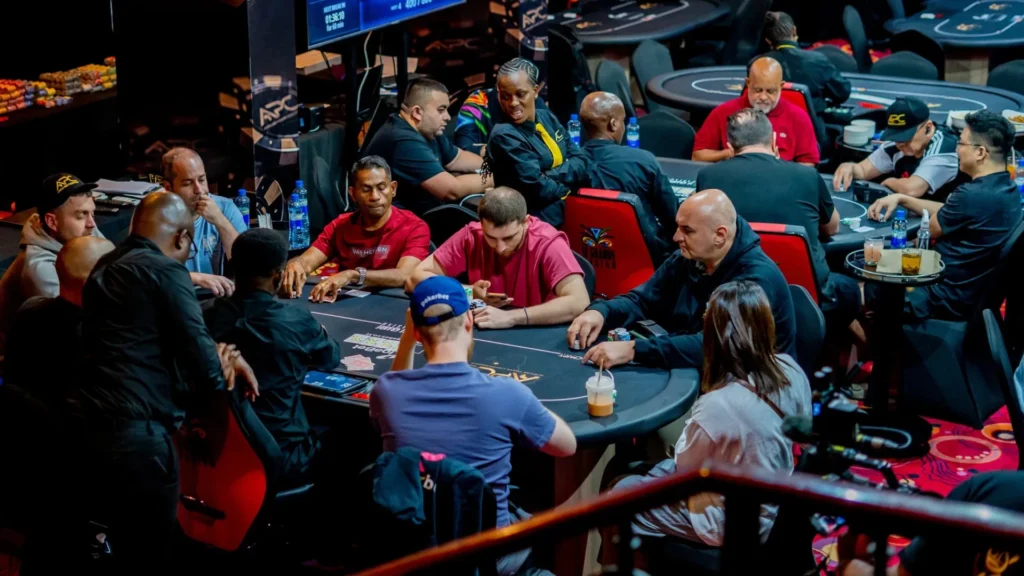
On Sunday, The Lodge in Texas hosted a WPT side event called Wildcard Mystery Bounty Chaos, featuring perhaps the most absurd twist on the bounty format yet seen in an official event. Now, I’m someone who is all about innovation in poker — the wackier the better, to a point. However, as a game designer myself, I’m going to go on the record and say I don’t think this one was particularly well thought-out. I’d have avoided playing it if I’d been in town, and I don’t think they’re likely to run too many more that are quite like this.
The reason has nothing to do with the purity or strategy of poker. Extreme variance is great for the game, just not for professionals. My objection has to do with what some of the twists are likely to feel like for players. Game design is inherently focused on experience. Many party games are inherently broken, yet tons of fun if not taken too seriously. Conversely, it’s entirely possible for a game to offer a balanced and intricate strategy and yet be entirely unfun to play.
Some aspects of Wildcard Mystery Bounty Chaos seem almost like they were designed to be fun-ruiners.
Like a more “traditional” Mystery Bounty event (if we can call that format traditional now), players who eliminate an opponent get to open an envelope. However, instead of just randomized cash prizes, those envelopes could contain cash or one of a variety of advantages or penalties.
The penalties, in particular, were promoted on social media during the event, showing players forced to play with their cards face-up or exchange chips with the short stack.
As a play for attention, I suppose it worked. I’m writing about it, after all. Yet those are the sort of experiences I’d want to avoid imposing on players.
There’s a Difference Between Randomness and Arbitrariness
The book Characteristics of Games (Elias, Garfield & Gutschera) is important reading for any would-be game designer. It includes a thought experiment about a chess variant in which the only difference is a single die roll at the end. On a 1-2, White wins, on a 3-4, Black wins, and on a 5-6, the player who delivered checkmate wins.
The point being made in the book is that, despite the introduction of an element of chance, the resulting game has exactly as much strategic depth as regular chess, just higher variance. However, it’s also worth noting that it’s a fundamentally stupid game from an experiential standpoint. The checkmated player will not receive any satisfaction from winning by a die roll after knowing they’ve been outplayed. Yet the checkmating player may be frustrated by losing that way.
In other words, no one’s experience benefits from the addition of arbitrariness to a game of skill. Games of pure chance can be enjoyable — just ask a slots player — but by the same token, they wouldn’t benefit from the addition of a bunch of complicated decision-making that ultimately proves meaningless.
What makes the luck components of poker fun is the ability to manage your variance. That’s what poker is: an exercise in managing variance.
The problem with replacing some bounties with penalties is that it lacks a way to manage the variance. You’re arbitrarily punishing people for doing the thing that you’ve given them as an objective, namely winning bounties. Getting “sucked out on” is everyone’s least favorite part of poker, and the arbitrary penalties add more of that, without any corresponding beneficiary in most cases.
Even some of the advantages feel arbitrarily punitive to other players at the table.
More Restrained Wildcard Bounties Would Work
That said, I don’t hate the concept broadly. The addition of advantages in lieu of cash prizes is probably a good innovation, if dialed back a little.
For instance, making a few envelopes instant double-ups would likely have been enough to create a novel format. It would be the manageable sort of variance in that it creates an incentive to build a deep stack before bounty-hunting, and create interesting “reverse ICM” considerations.
More importantly, doubling the bounty-winner’s stack could, depending on circumstances, be of greater value than any of the cash prizes. Yet that additional equity would come from everyone remaining in the tournament, so no one would feel unduly punished. Even at the final table, when the EV loss for the other players would be highest, they would feel they’d also had a chance to win that bounty and get the double-up themselves. It’s the manageable sort of variance, particularly if the players know how many double-ups remain among the unopened envelopes.
The problem is solely with the “kitchen sink” approach the WPT took in designing this event. Many of the advantages and penalties feel like the result of a brainstorming session without a subsequent editorial process to remove the more problematic ideas.
The structure sheet for the event doesn’t supply the exact set of advantages and penalties, and leaves some details about their functioning vague. Nonetheless, let’s go through the sample of possible wildcards they list and evaluate each.
Case-by-Case Analysis of WPT Wildcard Mystery Bounty Chaos Effects
Advantages
Add the average chipstack to your stack: Reasonable and less aggressive as a concept than my instant double-up. If they had stuck with this sort of effect, I think the format would be better.
Seat/table change: Likely to be disappointing to most players compared to a monetary bounty. I’d leave this out.
Void one hand you’re involved in at any point: A bad one, as it’s arbitrarily punishing to the opponent it’s used on. It’s also unduly powerful in the hands of a chip leader, as it means they can semibluff all-in with impunity and no one will want to call, given that they won’t win any chips even if their hand holds up. It’s a tragedy of the commons waiting to happen, in that everyone will be folding and hoping someone else forces the deep stack to burn their immunity. Any tournament using this would be a deal-breaker for me.
Come back with an average stack after elimination: A good one, similar to the instant double-up, but even stronger for ICM reasons.
Steal the button one time / Win the button up to three times: Both fine, but wildly underpowered compared to the chip top-up and “respawn” effects. Like the seat change, it’s likely to be a disappointment.
Replace the river card one time: Has the same problems as voiding a hand, but not as extreme. I would still suggest avoiding advantages that penalize the first opponent willing to play a big pot with the player.
Never pay the small blind again: Fine. Slightly punishing to the rest of the player’s table, but not unduly so.
Win with 7-2, collect 1 BB from all players: Probably fine. It could be punishing to the other players at the table, and could even backfire for the player themselves, but in a manageable way for all involved.
Return to the final table with an average stack if eliminated before: Okay in that it’s huge for the player who gets it, but the equity loss for others is spread around. However, it’s extremely powerful and not even on the same planet as stealing the button once or changing your seat.
Penalties
Pay three rounds of blinds and antes to a splash pot: This is a lot, but if we need to have penalties, it’s not terrible. The key is that the player winning a bounty has just collected the chips of the player they eliminated, so it’s unlikely that this penalty would be a tournament-ender.
Can’t play your button for a level: Probably the most manageable of the penalties. It could even be fun if combined with a strong advantage as a balancing factor.
Lose half your stack: Like the splash pot effect, this isn’t a tournament ender, but would be frustrating and arbitrary for a player who just did a supposedly good thing by winning a bounty. Unlike the splash pot, there’s no ability to win the chips back by winning the pot, and the equity upside is distributed among everyone in the tournament and unlikely to be noticed except at the final table.
No raising for an orbit: You might as well just make the player sit out an orbit, as it’s suicide to play a hand under this limitation. It might be better if it prevented raising preflop, but allowed for raises on subsequent streets.
Forfeit all monetary bounties previously won: Feels the worst out of any of them, emotionally speaking, as you’re almost literally robbing the player of cash they feel they’ve already won. Deal-breaker.
Switch stacks with the shortest stack in the tournament: Another deal-breaker, as it could be effectively equivalent to elimination, depending on how short the shortest stack is. Among players who’ve experienced the format before, it could lead to bubble-like stalling among short stacks hoping for a stack-swap.
Forced tag-team: An entertainment bad-beat. It’s not as monetarily punishing as some of the others, but it seems like anti-fun. Who goes to a poker tournament to be forced to stand around and watch someone else play for them? Also a recipe for hard feelings between two strangers, especially if one refuses to tag out and subsequently busts.
Next hand cards up: Not listed, but evidently included due to the video. Arguably the least bad of the lot. However, it would mostly just cause a reasonable player to fold until they can limp in and fold the flop to rid themselves of it.