Poker Expert


Once you know the basics of Texas Hold’em, you’re ready to learn how to play Short Deck poker, the action-packed variation that makes it easier to make strong hands.
In this guide to what Short Deck poker is and how to play it, we’ll take you through the rules, hand rankings, and offer some strategy tips to get you started.
All You Need to Know
- Short Deck poker rules and betting structure are similar to Texas Hold’em.
- In Short Deck poker, all cards lower than a six are removed from the deck, increasing the probability of players being dealt strong starting hands.
- The smaller 36-card deck also changes probabilities, hand equities, and hand strengths.
- Flushes are ranked higher than a full house, while straights become easier to make.
What Is Short Deck Poker?
Short Deck poker is a variant of Texas Hold’em that follows the exact same betting structure. The key difference is that in Short Deck, also known as 6+ Hold’em, all cards lower than a six are removed from the deck.
This drastically alters hand strengths and the probabilities of making strong hands. The gameplay is much faster and more action-packed in Short Deck.
Short Deck Poker was added to CoinPoker in April 2026. If you sign up using the code POKERSCOUT, you’ll get an extra $10 bonus to use on 6+ or any other games.

Prerequisites: What You Should Know First
Prior experience with Hold’em isn’t required but helps significantly. We recommend starting with our Texas Hold’em guide before diving into 6+ Hold’em.
Once you understand basic poker concepts, such as blinds, betting, and position, your transition will be much smoother.
How Does Short Deck Differ from Texas Hold’em?
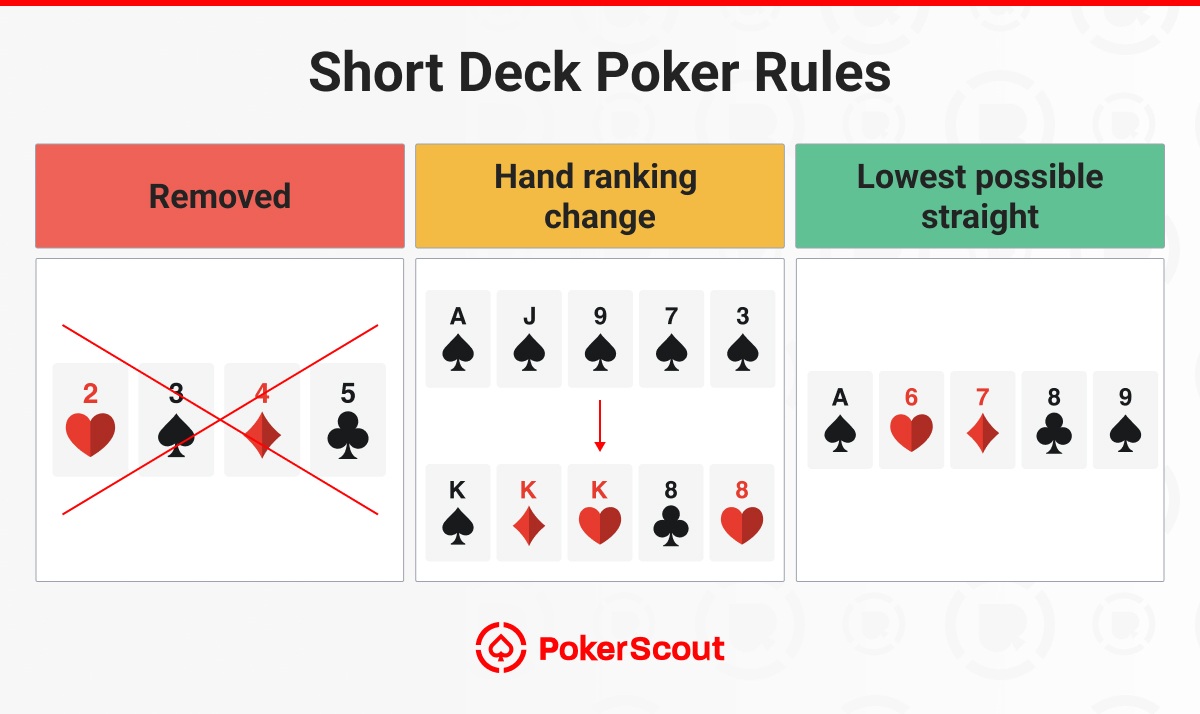
Beyond the removed cards, there are several key differences that only apply to Short Deck poker:
Deck Composition Differences
The main difference between Short Deck poker and Texas Hold’em is that the former has fewer cards in play. Traditional Hold’em uses a full deck of 52 cards. In Short Deck poker rules, all of the 2-5s are removed, leaving 36 cards in the deck.
Hand Ranking Modifications
With the lower-value cards removed, the odds of making certain hands change.
This changes the Short Deck poker hand rankings. We’ll cover hand rankings in detail soon. For now, the main difference is that a flush beats a full house.
Using Aces in Low Straights
Something else that’s written into the rules of Short Deck poker is that aces can be used as high or low when there’s a possible straight:
- Straight with a low ace: A♦ 6♥ 7♦ 8♠ 9♣.
- Straight with a high ace: 10♦ J♣ Q♥ K♣ A♠.
In the case of the low straight, the Ace takes the place of the 5, which has been removed from the deck.
Ante-Only Structure Explained
In Texas Hold’em, players in the corresponding positions place small and big blinds before cards are dealt.
Short Deck poker rules utilize an ante system. All players place a small compulsory ante bet before each hand, while the button pays an additional ante.
Short Deck Poker Rules: Step-by-Step Guide
Aside from the differences mentioned above, the Short Deck poker rules and betting rounds are exactly the same as in Hold’em. Here’s how a hand is dealt and played:
Step 1
All players place an ante, and the button also places an additional ante before the cards are dealt.Step 2
Each player receives two hole cards, dealt one at a time in a clockwise direction starting with the player to the left of the dealer.Step 3
A preflop betting round takes place. Action always starts with the first active player to the left of the button.Step 4
After the first betting round, three community cards are dealt, known as the flop. This is followed by the second round of betting.Step 5
A fourth community card is dealt, known as the turn, followed by the next betting round.Step 6
A fifth community card is dealt, followed by the final betting round.Step 7
If two or more players remain in the pot after the final betting round, the hand goes to showdown. Whoever has the strongest five-card combination, according to the Short Deck poker hand rankings, wins the pot.
As in other poker games, it’s also possible to win the pot during any betting street by forcing all other players to fold.
How to Bet in Short Deck Poker
Short Deck is typically a no-limit game, which means you can bet or raise up to the value of your entire stack during any round.
There are a total of four betting rounds: preflop, the flop, turn, and the river. Action always proceeds clockwise around the table, starting with the first active player to the left of the dealer. If no bets have been made, you can make the first bet or choose to check. If a bet has already been made during the current round, you’ll need to at least match the size of the bet.
You can also raise up to any amount or fold your hand.
Once all players have either folded or matched the bet size, the betting round is over, and the next stage of the hand begins.
Short Deck Poker Hand Rankings
When learning how to play Short Deck poker, you’ll need to pay close attention to the hand rankings so that you know the order of hand strengths that you’re playing to hit.
They are different from Hold’em.
Here are the standard Short Deck poker hand rankings:
| Poker Hand | Description | Example |
|---|---|---|
| Royal Flush | A straight from 10 to ace with all cards of a matching suit | 10♦ J♦ Q♦ K♦ A♦ |
| Straight Flush | A straight with cards of a matching suit | 6♥ 7♥ 8♥ 9♥ 10♥ |
| Four of a Kind | Four cards of the same value | A♦ A♥ A♠ A♣ 8♥ |
| Flush | Any five cards of the same suit | 6♣ 9♣ 10♣ K♣ J♣ |
| Full House | One pair and one three-of-a-kind | K♦ K♥ 7♦ 7♠ 7♣ |
| Straight | Five cards in sequential order, but without matching suits | 6♣ 7♦ 8♥ 9♥ 10♠ |
| Three-of-a-Kind | Three cards of the same value | A♦ A♥ A♠ 9♠ J♥ |
| Two Pair | A pair plus another different pair | A♠ A♥ 6♣ 6♠ X |
| A Pair | Two cards of the same value | J♣ J♠ 10♣ 9♥ 6♣ |
| High Card | A hand with no other value than that of its highest card | K♣ J♠ 7♣ 8♥ 6♠ |
*Note that, in rare variations of Short Deck Hold’em, three-of-a-kind beats a straight.
How & Why Rankings Differ from Texas Hold’em
With fewer cards in the deck, some hands become harder to make – flushes in particular – which is why the rankings differ from standard Hold’em.
Meanwhile, other hands, such as full houses, become easier to make. Short Deck poker hand rankings are based on these altered probabilities.
The main differences to remember are:
- Aces can be used high or as a low card in a six-high straight, A-6-7-8-9.
- Flushes beat full houses in the Short Deck poker hand rankings.
In terms of gameplay, you’ll hit a greater frequency of strong hands in Short Deck poker games, and that’s very much part of the appeal.
Understanding Short Deck Probabilities
Removing cards and giving aces slightly more power not only separates Short Deck poker from traditional Hold’em, but it also generates more action.
It’s much more likely that you’ll be dealt a strong starting hand like a premium pair, and more likely that you’ll complete high-ranked hands like straights.
How Often You’ll See Premium Hands
When learning how to play Short Deck poker, you’ll notice pretty quickly that you’ll be dealt a lot more strong and playable starting hands. For example, you’ll make a premium pair or suited Broadway hand around twice as often as you usually would.
Here’s how the probabilities compare in Texas and Short Deck Hold’em:
| Hand Type | Hold’em | Short Deck | Why It Changes |
|---|---|---|---|
| Any pocket pair | 5.88% | 8.57% | Fewer total combinations, so pairs are more common. |
| TT+ pocket pair | 2.26% | 4.76% | Low pairs are removed, so high pairs appear more often. |
| Pocket Aces (AA) | 0.45% | 0.95% | Fewer total hands, so AA nearly doubles in frequency. |
| Two broadways (T–A) | 14.34% | 30.16% | Deck becomes top-heavy, so broadways almost double. |
| Suited broadway | 3.02% | 6.35% | A smaller deck nearly doubles the frequency of suited broadways. |
| Ace-X (any) | 14.48% | 20.32% | Removing low cards increases all A-x combinations. |
However, keep in mind that other players also benefit from the same enhanced probabilities.
So, in Short Deck, you can expect to see more clashes, coolers, and multiway pots. Even though there’s a greater chance of making strong starting hands, the equity of hands runs closer together in Short Deck.
For example, pocket aces have around 80% equity against a strong range in Texas Hold’em, whereas they only have around 74% in Short Deck.
Drawing Odds in Short Deck
Similarly, the odds of completing draws and improving hands increase in Short Deck poker due to the reduced number of cards.
Straight draws in particular become easier to hit.
The main exception to this is a flush draw. With only nine of each suit in the deck, the probability of completing a flush is lower. This is why it is highly ranked, sitting above a full house in the Short Deck poker hand rankings.
Here are the drawing odds in Short Deck compared to Texas Hold’em:
| Draw Type | Outs | Hold’em | Short Deck | Notes |
|---|---|---|---|---|
| Open-ended straight draw (OESD) | 8 | 31.47% | 45.59% | Straights are easier in a 36-card deck, higher chance of hitting a connected card. |
| Double-gutshot straight draw | 8 | 31.47% | 45.59% | Same outs as OESD, higher chance of hitting in Short Deck. |
| Gutshot straight draw | 4 | 16.47% | 24.52% | Improved odds from a smaller deck with more mid-ranked cards. |
| Flush draw | 5 | 34.97% | 30.11% | Suits only have 9 cards in deck instead of 13, so flushes are harder to make. |
| Pair → Trips | 2 | 8.44% | 12.69% | Easier to make trips in Short Deck due to fewer total cards. |
| Two Pair → Full House | 4 | 16.45% | 24.52% | Short Deck increases the chance of hitting a full house. |
| Trips → Quads | 1 | 4.26% | 6.45% | Fewer total cards slightly increases quad odds. |
Equity Shifts from Texas Hold’em
Given the changes to probabilities, Short Deck hand equities are different from Hold’em and tend to run much closer together. Here’s a comparison for common situations on the flop:
| Scenario on Flop | Hold’em Equity (approx.) | Short Deck Equity (approx.) | Notes |
|---|---|---|---|
| Flush Draw vs. Top Pair | ~35% | ~30% | Flush draws are less frequent and have lower equity in Short Deck, making the pair a bigger favourite. |
| Open-Ended Straight Draw vs. Top Pair | ~32% | ~45% | Straight draws have significantly higher equity in Short Deck and are nearly flipping against top pair. |
| Overpair vs. Flush Draw | ~63% | ~68% | The value of a made hand (overpair) increases slightly in Short Deck versus a pure flush draw. |
| Set (Trips) vs. Flush Draw + OESD | ~54% | ~48% | Combo draws have similar equity in both games. In Short Deck, there’s less chance of completing the flush, balanced by more chance of hitting a straight. |
| Top Pair Top Kicker versus Two Overcards | ~80% | ~75% | Overcards are slightly stronger in Hold’em, as there’s more chance you’ll hit one from the reduced deck. |
Short Deck Poker Tips & Strategies
Before you rush off and play Short Deck poker online, we want to leave you with a few tips.
In general, the strategy concepts that apply to Texas Hold’em also apply to Short Deck. Specifically, you should think about the strength of your hand in relation to your position and the table dynamics.
The key difference with Short Deck poker strategy, as we’ve shown in the probability tables above, is the changes to probabilities and the way hand equities run closer together, which impacts starting hand selection and postflop play.
Preflop Strategy Adjustments
As it’s likely that other players will wake up with monster hands, only the very strongest starting hands are considered premium in Short Deck, such as pocket aces, queens, and ace-king suited.
Even hands like pocket queens and jacks tend to be flipping against a strong range.
So, even though you’ll be dealt strong hands more often, their relative value falls. Position becomes even more important in Short Deck poker strategy. You should play very tight from the early position, focusing on strong pocket pairs and suited broadways. From late position, you can loosen up to include more suited connectors, connectors, suited aces, and so on.
Post-Flop Play Differences
The main consideration for your postflop Short Deck poker strategy is the differences in hand equities, particularly when it comes to the odds of completing draws.
Straight draws become more valuable and make great semi-bluff hands, while you’ll need to exercise caution with a flush draw and be careful not to pay too much to draw. When making a continuation bet on the flop, you’ll need to go bigger to price out potential straight draws, whereas flush draws are less of a concern.
You can still c-bet small on dry boards.
Bankroll Management for Short Deck
Short Deck Hold’em is a volatile format of the game, with a lot of clashes between hands that run closely together in terms of equity.
This calls for an even more conservative bankroll management strategy than you would typically adopt for Hold’em. Consider approaching Short Deck with a larger bankroll or dropping down in stakes.
Common Mistakes to Avoid in Short Deck
Here are the most common mistakes that players tend to make when learning how to play Short Deck poker:
- Overvaluing starting hands: Every player has a chance of making stronger starting hands, so don’t fall into the trap of thinking strong Hold’em hands hold up in Short Deck.
- Overvaluing flush draws: Don’t chase flushes unless you have the correct odds to justify the reduced probability of making the hand.
- Ignoring the power of straights: Straight draws complete more often in Short Deck, so don’t neglect your drawing odds; consider semi-bluffing.
- Misreading the strength of pairs: Hands like top pair top kicker or overpairs can actually be flipping or behind against strong draws.
- Neglecting fundamentals: Even though it’s a different game, Short Deck poker strategy still involves Hold’em fundamentals like position, stack sizes, and board texture.
Where to Play Short Deck Poker
Knowing how to play Short Deck poker is a useless skill if you don’t have anywhere to ante up.
Despite its popularity increasing, Short Deck Hold’em isn’t as prevalent as its more established namesake. The good news is that many offshore poker sites now offer Short Deck tables, often pooling players into a shared space. This increases the chances of finding active cash games, sometimes at stakes of up to $1/$2, along with the occasional Short Deck tournament.
Now you know how to play Short Deck poker.
The removal of low cards creates an action-packed format that changes probabilities and hand equities. With just a few strategic adjustments, you’ll be ready to take on the online Short Deck table and enjoy one of the most exciting modern twists on Hold’em.