Poker Expert


Five Card Poker is a classic variation of the game that is easy to learn and enjoyable to play.
Learning the rules and basic strategy will also set you up for success in other poker games, including Texas Hold’em. This guide walks you through the key aspects of how to play Five Card Draw.
All You Need to Know
- In Five Card Draw, players receive five hole cards and have the option to discard and redraw cards.
- There are two betting rounds in Five Card Draw, one before and one after the draw.
- Five Card Draw rules allow you to discard any number of cards, from zero, known as standing pat, to your entire hand.
- Hand selection is important for Five Card Draw strategy. Playing strong cards or hands with potential sets you up for successful draws.
What Is 5 Card Draw Poker?
Five Card Draw is a classic poker variant where each player receives five private hole cards.
There are no community cards like there are in Texas Hold’em and Omaha. Instead, players have the chance to discard and redraw cards to attempt to make their best hand.
Learning how to play Five Card Draw is straightforward, as the rules and gameplay are simpler than those of many other poker games.
History of 5 Card Poker
The history of Five Card Poker is somewhat complicated.
There are threads that trace it back to Mississippi in the late 19th century, while others go as far back as the mid-1800s in the old American West. Five Card Poker really began to spread in the 1870s and 1880s in the Wild West and soon became the main type of poker played right up until the late 20th century.
It’s now considered a classic poker game and has been overtaken in popularity by Hold’em and others, which are more widely available at casinos and offshore poker sites.
5 Card Draw Rules Explained
With only two betting rounds and a single drawing round, the Five Card Draw rules are straightforward.
The objective is to make the strongest possible five-card combination after the redraw. You can also win the pot by making bets that get other players to fold. A Five Card Draw poker hand involves one pre-draw betting round, followed by the draw, and then a second betting round. If two or more players remain in the pot, the cards are revealed, and the best hand wins.
You can discard any number of cards during the draw, or “stand pat” by keeping your original hand and drawing no cards.
Five Card Draw typically uses a fixed betting limit structure. Players can only bet or raise by a capped amount, using a “small bet” during the first betting round and a “big bet” during the second betting round.
How to Play 5 Card Draw Poker (Step by Step)
Here, we’ll explain how to play Five Card Draw through every step of the hand, from the deal to showdown.
The Initial Deal
Five Card Draw poker hands start with players posting either blinds or antes, depending on which structure is being used.
Antes are small bets placed by every player at the table. Blinds are compulsory bets placed by the two players to the left of the dealer button, known as the small and big blind. Once posted, every player receives five cards face down, known as hole cards. They are private cards that are only seen and used by the player to whom they are dealt.
You can now look at your hand and assess your situation. Then, it’s time for the first betting round.
First Betting Round
The betting action always starts with the player to the left of the dealer. When it’s your turn, you’ll have the option to:
- Fold: Give up the hand.
- Call: Match the current largest bet.
- Raise: Increase the size of the current bet.
If at least two players match each other’s bets, the hand continues on to the draw phase.
The Draw Phase – Discarding and Drawing Cards
During the draw phase, all remaining players may discard cards and exchange them for new ones.
In Five Card Draw rules, you can redraw anywhere from zero to five cards. Remember, your aim is to make the best hand possible, so part of your Five Card Draw strategy is knowing which cards to redraw.
Keeping all of your cards is known as standing pat. It’s a strong move because it suggests that you already have a made hand.
Second Betting Round
The draw is followed by the second betting round, which is your final opportunity to act. If no bets have been made, you can check or bet. If bets or raises have been made, you can call, raise, or fold.
If two or more players match each other’s bets during the second round, the hand goes to showdown.
Showdown and Determining the Winner
Players who are still in the pot after the final bets are complete show their hands.
The player who has the strongest poker hand wins the pot and adds the chips to their stack. The Five Card Draw hand rankings are the same as in other types of poker.
5 Card Poker Hand Rankings
Understanding hand rankings is fundamental to learning how to play Five Card Poker.
Thankfully, the Five Card Draw hand rankings are exactly the same as in many other poker games, such as Texas Hold’em. Here is an easy look at how the different hands stack up. They are ranked in order, from Royal Flush at the top to High Card at the bottom.
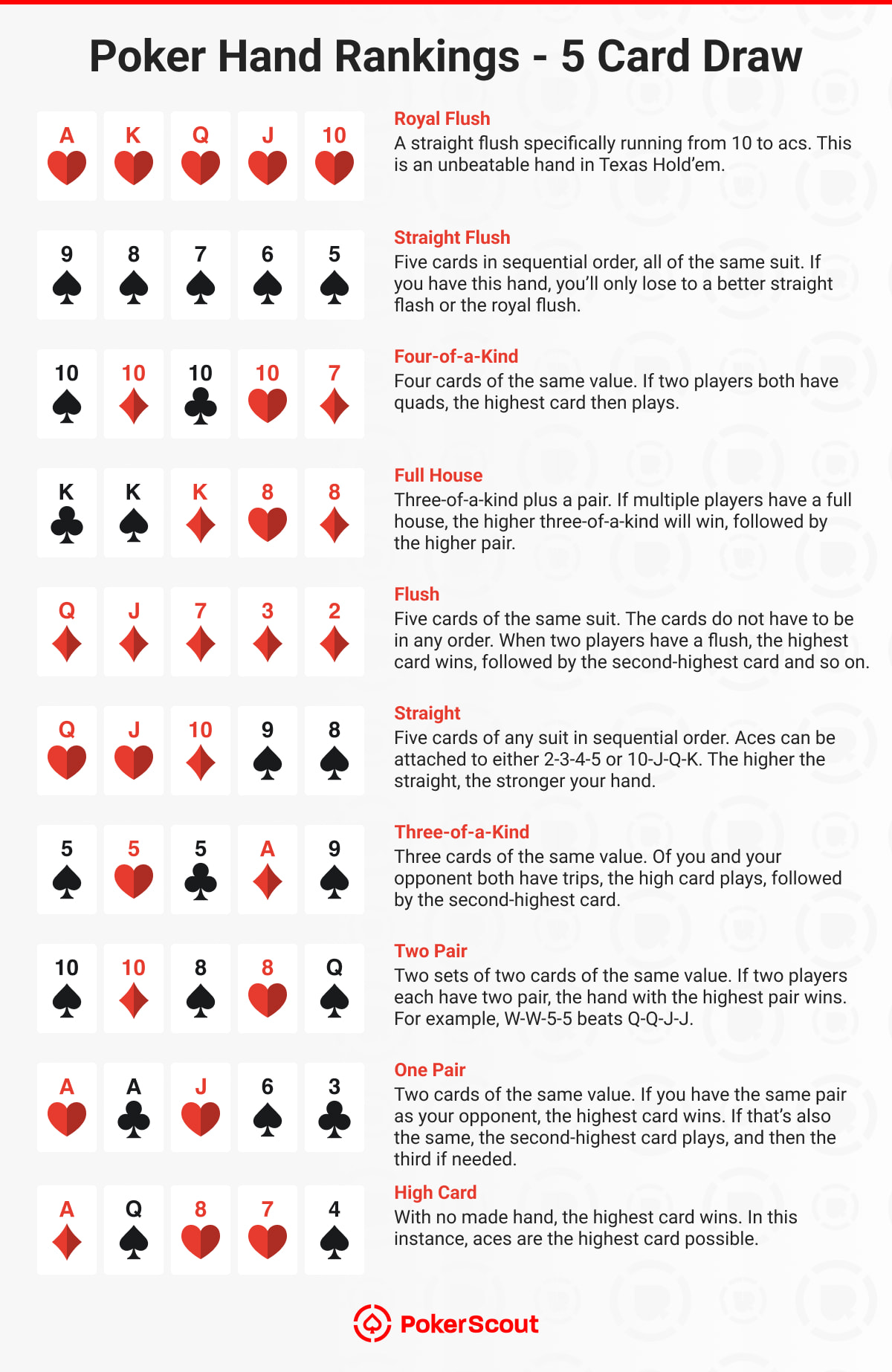
Keep the following in mind when it comes to Five Card Draw hand rankings:
- The Royal Flush is the absolute strongest Five Card Draw poker hand.
- High Card is the weakest type of hand. It is the absence of any pair or better.
- Higher cards beat lower cards. For example, a pair of aces beats a pair of kings.
- If two or more players have the same hand, the other cards, known as kickers, play.
- If two or more players have exactly the same hand, the hand is tied, and the pot is split.
In Five Card Poker, you’ll be using all five cards in your hand to make your best combination.
Basic 5 Card Draw Strategy for Beginners
Understanding hand rankings and rules is just the beginning when it comes to learning how to play Five Card Poker. To succeed, you’ll need a solid Five Card Draw strategy to guide your decisions.
Starting Hand Selection – What to Play
Hand selection is a key aspect of every poker variant, and Five Card Poker is no exception. Choosing which hands are worth playing is one of the key strategy decisions you’ll need to make.
Avoid overplaying weak hands or wasting money chasing unlikely draws. Instead, focus on either made hands or hands that have good drawing potential, including:
- Any pat hand, such as a straight, flush, full house, or four of a kind.
- Three of a kind.
- Two pair.
- High pairs, such as pocket jacks or better.
- Four cards to a flush or straight.
In Five Card Draw poker rules, you only get one chance to redraw your cards, so you should avoid hands that are too weak or unlikely to improve, such as no pair or low one pair hands, or three cards to a flush or straight.
How Many Cards Should You Discard?
The number of cards that you should discard depends on your starting hand. Generally speaking, you’re looking to keep the strong parts of your hand and discard weak hands to give yourself a chance to improve. Here’s a general guide:
- Made five card hand – Stand pat and don’t discard.
- Three of a kind – Discard the other two cards for a chance to improve to quads or a full house.
- Two pair – Discard one card to draw to a full house.
- One pair – Discard three cards to draw to trips or better.
- Four cards to a flush or straight – Discard one card to attempt to complete the draw.
If you need to discard four or five cards, then you probably shouldn’t be in the hand and should likely have folded pre-draw.
Playing Position in 5 Card Draw
As with other poker variants, position is key in Five Card Draw strategy.
From early position, you should play a tight range of only strong hands, like a high pair or better. You can play a wide range of hands and be more aggressive from late position because you have the advantage of seeing how other players act before making your move.
You can assess an opponent’s hand strength based on how many cards they discard or keep, as well as how they bet.
Hand Reading in 5 Card Draw
When learning how to play Five Card Poker, one of the crucial strategy lessons is knowing how to compare your own hand strength to other players based on their drawing and betting patterns.
If your opponent stands pat, they likely already have a made hand. If they are drawing just one card, then they could be close to making a big hand, such as a straight, flush, or full house.
Combine this information with their bets to get a feel for how their hand stacks up against your own.
Common Beginner Mistakes
Here are the most common mistakes that new players make when learning how to play Five Card Poker:
- Playing too many weak hands or three-card draws.
- Splitting pairs and trips to attempt to make a flush.
- Ignoring position, playing too many hands from early position, or not loosening up from late position.
- Betting with weak hands or playing passively with strong hands.
- Focusing only on your own cards without observing opponents’ drawing and betting patterns.
Other Variants of 5 Card Poker
There are several other variants of Five Card Poker, such as Ace to Five Lowball and 2-7 Lowball.
Ace to Five Lowball
This variant of 5 Card Poker is the opposite of 5 Card Draw in terms of hand rankings. In this game, the lowest value hand wins, not the highest hand. Straight and flushes are ignored, and the ace plays as a low card. So, the strongest hand possible is A-2-3-4-5.
2-7 Lowball Draw
This is the most popular of the five card variants and is often regarded as a game of high skill. The lowest hand value wins the pot, just like ace to five, but it differs in that aces are high, while flushes and straights do count. The best hand 2-7 Lowball is therefore 2-3-4-5-7 with no flush.
Advantages of 5 Card Poker vs Other Variants
There are a few reasons why you should learn how to play Five Card Poker.
It is the simplest form of the game to master, making it ideal for beginners. In fact, it’s the version many players start with when first learning poker. Five Card Poker involves less betting pressure than many other variants. With fewer betting rounds, you have a bit more freedom to focus on the fundamentals of the game, rather than always worrying about your stack, which can be daunting for a new player.
The main benefit of Five Card Poker is that it allows you to focus on the fundamentals of making strong hands.
There is less overall focus on complex strategies compared to games like Texas Hold’em, where betting is a skill set of its own. Mastering the Five Card Draw strategy can give you the foundation you need to become a very strong all-around poker player.