Poker Expert


Poker etiquette rules can seem intense, especially for beginners. If you’re new to playing live poker, you won’t want to come across as disrespectful. Worse still, by failing to grasp the unwritten rules, you might even be accused of angle shooting – the most heinous of poker crimes. This guide to poker etiquette will teach you exactly how to behave at the poker table, what you can get away with, and what you simply never do.
All You Need to Know
- Poker etiquette is a set of written and unwritten rules that keep the game running smoothly.
- Proper poker etiquette helps to prevent cheating, keep up the pace of the game, and cultivate a respectful environment.
- It covers betting, angle shooting, revealing information, table talk, and more.
- Poker etiquette rules are particularly important in a live casino setting, but some etiquette also applies when playing online.
What Is Poker Etiquette?
Poker etiquette is a set of written and unwritten rules that help the game run smoothly. Poker etiquette rules cover everything from behaviours that could potentially be seen as cheating to minor annoyances that disrupt the game.
The severity of the potential punishment for breaking these rules depends on the nature of the offense. For example, poker etiquette on talking and showing bluffs is really at your own discretion and the staff’s discretion. On the other hand, poker etiquette on betting has to be followed, or you could face an in-game penalty or even a ban.
When learning how to play Texas Hold’em poker or other variations, you should also be aware of proper poker etiquette and how your own behaviour is coming across.
Why Poker Etiquette Matters
It’s important to follow this guide to poker etiquette for a number of reasons. Even if the rules don’t immediately make sense to beginners, poker etiquette helps the game move smoothly and minimizes potential conflicts.
Here’s why poker etiquette matters:
- Poker involves competition for real money. Poker etiquette on betting, showing cards, and sharing information is essential for game fairness.
- Poker etiquette rules help the game run smoothly and at a reasonable pace.
- Poker is emotionally charged. Poker etiquette, including talking, slowrolling, and general behavior towards others, ensures that a level of mutual respect is maintained between players and towards staff.
Guide to Poker Etiquette: Unwritten Rules of Poker
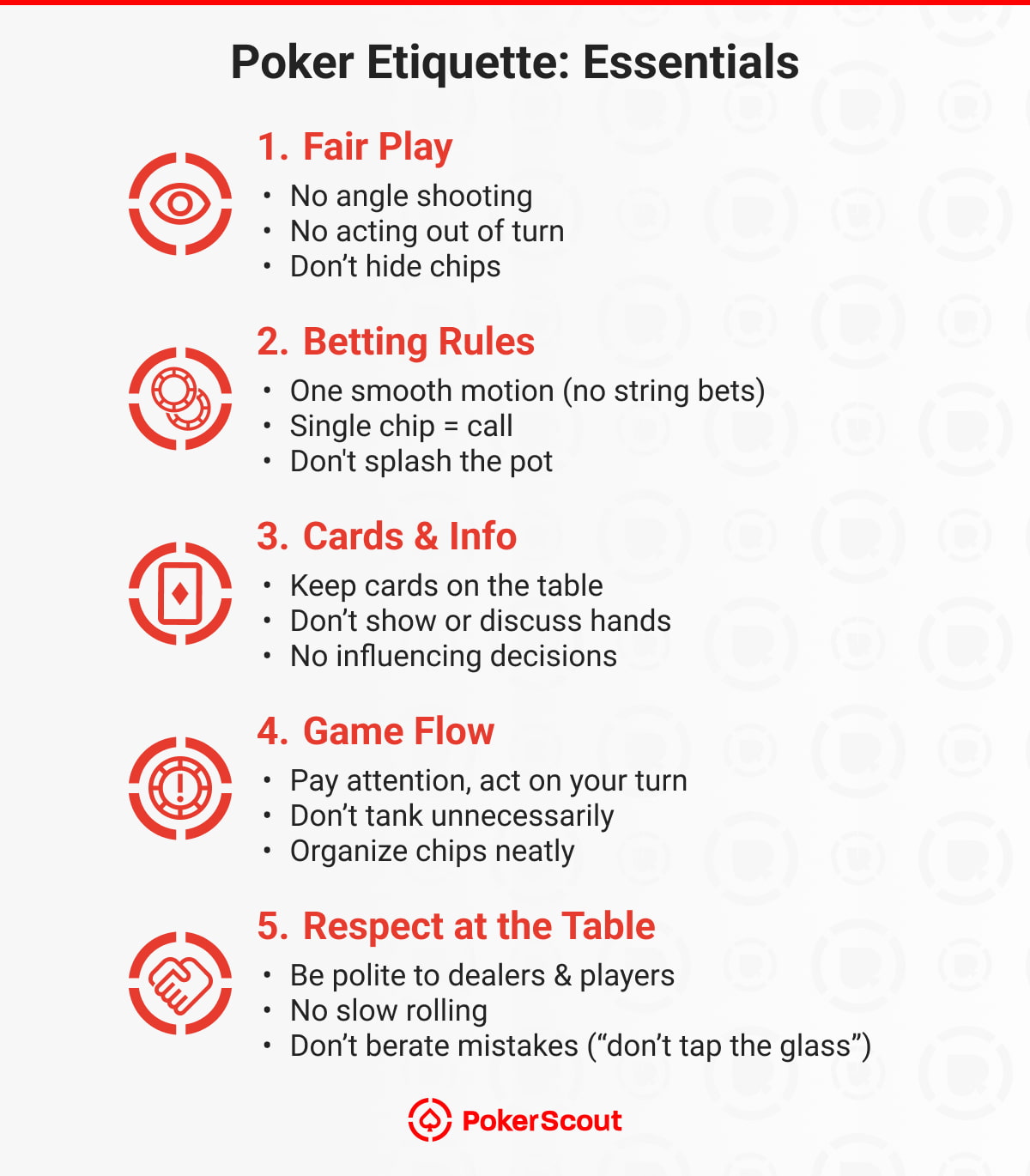
Without further ado, let’s get into our guide to poker etiquette. We’ve broken down poker etiquette into three categories based on the reasons outlined above.
Poker Etiquette Rules for Game Fairness
In a sense, poker etiquette on betting and game fairness should be a priority to learn. Ethically speaking, you should never break these rules. Doing so can also have consequences ranging from penalties to bans.
Angle Shooting in Poker
“Angle shooting” is the collective term for a range of tricks that, while not necessarily against the rules, are calculated to gain an edge.
Here are some notable examples of practices widely considered to be angle shooting in poker:
- Acting out of turn intentionally.
- Trying to sneak a peek at a nearby opponent’s hand.
- Hiding larger denomination chips behind your stack.
- Verbally declaring a better hand than you really have.
- Faking a bet or raise in order to elicit a response from an opponent.
- Throwing out a single chip to call “by accident” and claiming you meant to raise.
- Declaring that you’ve won at showdown before revealing a losing hand.
As a beginner, you may occasionally make a mistake and look like you’re angle shooting. That’s okay, and it’s only likely to result in a verbal warning from the dealer or scornful look from players.
Repeated angle shooting, though, is very bad poker etiquette. Having a reputation as an angle shooter is not something you want. The poker community is tight, and word gets around. Angle shooters are likely to be uninvited from home games and may even wind up banned from card rooms.
Don’t String Bet
When betting and raising, you must move chips forward in one smooth and continuous motion. For example, if you want to raise $40, you can’t push a $20 chip over the line, then go back for a second $20.
Similarly, you’re not allowed to lift multiple chips and drop them over the line one at a time. Nor can you say something like “I call that bet and raise $40”, which is the verbal equivalent of string betting.
The first chip you put over the line, or the first verbal declaration you make, is binding. Anything after that is an illegal string bet in poker. This well-established rule is designed to combat angle shooting. If it didn’t exist, you could theoretically make your raise, watch the opponent for a reaction, then add more chips.
For beginners learning poker etiquette, you should also be aware that tossing in a single chip always signifies a call, even if it is a larger denomination chip. When making a raise, either use multiple chips or verbally announce your raise to make it clear. That way, nobody can accuse you of angle shooting if you make a mistake.
Don’t Splash the Pot
“In my club, I will splash the pot whenever the f**k I please.” – Teddy KGB (Rounders, 1998)
We all remember the famous scene when Mike chastises the John Malkovich character for splashing the pot. There are several reasons that he told Teddy KGB off, and why you also shouldn’t splash the pot in poker.
First of all, splashing the pot isn’t proper poker etiquette because it’s suspicious. If you declare a raise, then immediately dump a massive pile of chips into the middle, it’s hard for others to follow the action. How can anyone be sure that you’re not angle shooting, or worse, cheating by putting in less than you claimed?
Second, it’s really annoying for the dealer, who now has to count the entire pot to make sure you didn’t underbet before playing can continue. This just slows the game down and could even lead to arguments. So don’t splash the pot.
Cards on the Table
This is a simple poker etiquette rule that’s often forgotten about.
Your cards should remain on the table at all times.
You’re obviously allowed to lift them in order to see what you have. But usually, players simply pinch the corner of each card, helping to keep them out of sight of your opponents.
If you really have to lift them off the table entirely in order to look, it’s allowed. But you can’t continually hold them in the air like you’d see in a badly-acted movie. They must go straight back to the table, so the dealer and other players can easily see who is left in the hand.
Don’t Share or Discuss Hands
A huge no-no in poker etiquette rules is sharing your cards with anyone else. Don’t show them to spectators on the rail, or to other players at the table, whether they’re involved in the hand or not.
Depending on where you’re playing, poker etiquette on showing cards during the action is more than just a guideline; it’s a hard and fast rule that will result in immediate punishment.
It’s also against poker etiquette to talk about your own or another player’s hands when the action is ongoing. This includes those that you are not involved in, especially if it’s a long, drawn-out hand with lots of chips at stake. There are clearly some big decisions to be made, and nobody needs to hear your analysis.
Not only is unnecessary distraction, but it could also influence their actions, which is highly unethical.
The only exception to this rule is when the hand is heads-up. In this case, you’ll have more freedom when it comes to talking about the hand and even the cards. If you want to be on the safe side, though, just never do it.
Poker Etiquette Rules for Game Pace & Flow
If nobody was paying attention and everybody was taking too much time, poker would become boring and obnoxiously slow. Many of the poker etiquette rules are about keeping the game flowing.
Pay Attention
For a poker game to flow properly, it’s really important that you’re always aware of what’s going on. If you don’t realize it’s your turn to act because you’re messing around on your phone, everyone’s going to be annoyed with you.
Proper poker etiquette includes posting your blinds on time before the cards are dealt, keeping up with any bets or raises during a hand, and then acting only when it’s your turn to act.
For those who are poker etiquette beginners, the dealer will prompt you if you miss the occasional blind. Acting out of turn, however, is a more serious offense because it can impact the game.
Don’t Tank Unnecessarily
Tanking is a scourge of the modern game. There always seems to be one guy in a hoodie, shades, and headphones who “thinks” for ages every hand, before making a routine fold.
Everyone understands that, from time to time, you’ll be faced with a tough decision. If all of your chips are at stake, it’s accepted that you might need to think long and hard. It’s even acceptable to take a few moments to pretend you’re struggling when faced with a reraise. After all, table image and timing matter in poker. We get it.
The problem comes when a player consistently sits in silence for minutes at a time for most hands, even when the decision is trivial, such as a single preflop raise. This is not proper poker etiquette. You’re not clever, you’re just ruining it for everyone.
This one applies to online poker, too. You can tank a little as part of a gameplan, but if you’re maxing out your timebank every single hand because you’re distracted, your opponents will get frustrated.
Few players do this, and most sites such as CoinPoker have a solid pace. If you’ve never played there, you can sign up with the code POKERSCOUT to get $10 free.

Calling the Clock
If someone is taking too long over a decision, you’re well within your rights to call the clock. That means getting the officials involved and forcing the player to decide what to do.
When it comes to poker etiquette rules, there’s nothing wrong with calling the clock if you’re fair about when you do it and how much time you allow. Calling the clock prevents players from tanking too much and is generally good for the game flow.
However, it’s a major breach of casino poker etiquette to call the clock too quickly. It’s imperative that you give your fellow players enough time to think, especially if it’s obviously a crucial hand or tough decision.
There’s no hard and fast rule about how much time is acceptable. Just treat others as you would have them treat you. If you’re unsure, look around the table and see how everyone else is reacting before calling officials. It shouldn’t be too difficult to reach an unspoken consensus about whether or not it’s been too long.
Organize Your Chips
Another aspect of poker etiquette for beginners is to learn how to arrange your chips carefully. This becomes increasingly relevant as tournaments enter their later stages and players start to amass huge piles of chips.
First of all, there’s the angle shooting aspect, where someone seeking to gain an edge might deliberately hide their biggest chips to look like less of a threat, or to confuse their opponents about stack sizes.
However, that’s not the only reason that stacking chips correctly is an important part of poker etiquette. By neatly arranging chips into piles of the same denomination, players can size up chip stacks a lot more easily, leading to quicker decisions. Similarly, dealers can count chips much faster, which helps the game to flow.
Poker etiquette at casinos usually encourages players to stack chips in piles of 20s or 10s. Remember to keep the larger denominations at the front so they are clearly visible.
Poker Etiquette for a Positive Atmosphere
The remaining points in our guide to poker etiquette cover respect at the tables between players and towards staff. There are no hard and fast poker etiquette rules here. Rather, it’s all about common sense and decency.
Respect Staff
This part of our guide should really go without saying. Try to be respectful to staff at all times. Even if you’re taking a beating in the game, there’s no need to lash out at other people.
Remember, the dealer has no control over the cards. They’re not trying to make you lose on purpose. Even if you’re behaving badly and they wanted you to lose, there’s literally nothing they can do to influence events, and they certainly wouldn’t risk their jobs to try.
Similarly, the waitress bringing you a drink is just doing her job. The Tournament Director is only applying the rules, and you’d do well to remember that their ruling is final. It’s not all a massive conspiracy to gang up on you, so keep your emotions in check and be polite.
Finally, if you’re having a good time, consider leaving a tip, although this is by no means obligatory when it comes to poker etiquette in casinos.
Never Slow Roll Poker Opponents
Slow rolling persists, despite the community’s agreement that it’s one of the most egregious breaches of poker etiquette.
The meaning of a slow roll in poker is when a player deliberately delays revealing what is obviously the winning hand.
An extreme example would be if your opponent rivered a royal flush and you decided to bluff, shoving all-in. This is a snap call situation. However, imagine your opponent elects to slow roll, meaning you have a completely unnecessary sweat before turning over the stone-cold nuts..
Doesn’t feel good, right?
Some players believe slow rolling is a funny and valid part of the game. However, most players feel that it’s disrespectful. If you want to follow poker etiquette on betting, always make the final decision quickly and then show your hand.
Never Tap the Glass
All around the world, there’s an accepted piece of poker etiquette on talking: don’t tap on the tank. If there’s a fish at the table and they’re making terrible plays against you, don’t draw attention to them. Telling someone off because they made a bad play is bad poker etiquette for several reasons.
First of all, it’s unfair and mean to embarrass players for their moves or skill level. Everyone who has bought in has the right to play how they choose. Nobody wants to sit and be berated by strangers.
Second, don’t you want to face bad opponents? Why would you be offended or try to help them improve their game? Tapping on the glass is bad for the entire poker ecosystem – don’t do it.
Take the Ws & the Ls
To truly master the game of poker, you have to learn to take the rough with the smooth. Genuinely reacting the same way to a bad beat as a victory is the ultimate achievement.
If someone sucks out on you, take it on the chin. Nobody wants to hear you whining about it for the next hour, bringing down the mood. Save it for a quick moan to friends at the break or, preferably, put it to rest and move on.
Equally, if you win a big hand, it’s not proper poker etiquette to jump up and run around screaming and shouting. If you’re doing that, you’d better make sure it’s the final hand of the WSOP Main Event.
In short, don’t overcelebrate and keep your hard luck stories to yourself.
Table Talk
So, given that you should always be respectful, never berate players, and try not to act too emotionally, what is the proper poker etiquette for talking at the table? What are you actually allowed to say?
The sociable among you will be glad to hear that it’s totally fine to talk about poker or any off-table subject, as long as you stick to the poker etiquette rules outlined so far, and as long as nothing crosses over into the realms of abuse.
Be respectful and mindful of the action, don’t talk excessively during hands, and keep up the pace of the game. Beyond that, feel free to chat or not, as you prefer.
Cash Game Poker Etiquette: Don’t Hit & Run
One of the least clear-cut aspects of poker etiquette is leaving the table, as in the infamous “hit and run”. This is where a player buys into a cash game, quickly wins a monster pot, then cashes out their chips right away.
Of course, there are no rules against this. The whole point of a cash game is that you can dip in and out as you please. But it’s quite frustrating to sit grinding for hours, only for someone to drop in for a few hands and take your chips.
Poker etiquette on leaving the table encourages players to at least offer a small chance of letting others win them back. An acceptable compromise would be to stay for at least one full orbit. Ultimately, though, this one is entirely up to you.
Online vs Live Casino Poker Etiquette
There’s a lot more casino poker etiquette to learn than there is etiquette for playing online. When you’re playing at an online poker site in the USA or beyond, there are fewer ways to angle shoot, blinds and bets are posted automatically, there are no chips to organize, and all players have automatic time banks, reducing tanking and removing the need to call the clock.
For poker etiquette beginners, it can be useful to start your journey online, where you can get used to the betting and pace of the game before moving on to a live environment.
However, some poker etiquette still applies when playing poker online:
- Keep up the pace: Even though you have time banks, you should still make an effort to keep up with the game and not use the full amount of time for every little decision.
- Multitabling: To make sure you keep pace, don’t play more tables than you can comfortably handle.
- Angle shooting: You should always avoid any intentional or unintentional angle shooting in poker. Online, this can include stalling to raise the blinds, disconnecting intentionally, or using chat to reveal information or mislead.
- Sharing hands and information: Poker etiquette on showing cards is very important online. Do not share info or hands with other players in the game, either via the online poker site or using external software. It’s highly illegal and could result in a ban.
- Chat: Most online poker apps and sites have a chat function that you can use to talk and banter with players. Make sure that you keep chat friendly and never abusive.
Conclusion
There have been a couple of unwritten rules in this poker etiquette guide that you may not have encountered before, but there’s nothing to fear. Good poker etiquette is mostly about common sense. If you’re new to the game, the dealer and other players will guide you if you make an honest mistake. As long as you’re trying to be respectful, you’ll be just fine. If you’re in doubt, learn the cardinal rules and then just be a nice person.