Poker Expert


Learning how to play Pai Gow Poker is quick and easy, especially if you’re already familiar with other formats of the game. But there are some important differences in this player-versus-dealer casino version of poker. This guide will show you the Pai Gow poker rules, hand rankings, basic strategy, and more.
All You Need to Know
- Pai Gow Poker games are played against the dealer. The aim is to make a five-card hand and two-card hand using seven starting cards.
- Players are free to set their hand strategically, but the five-card (high) hand must always be stronger than the two-card (low) hand.
- Pai Gow Poker joker rules outline that a joker can be used to complete a straight, flush, or to substitute for an ace.
- There are a number of side bets that can be made in Pai Gow Poker games, such as betting that you’ll make a valuable hand using all seven cards.
What Is Pai Gow Poker?
Pai Gow Poker is a casino card game played against the dealer using a 53-card deck (52 cards plus a joker). Each player is dealt seven cards and must split them into:
- A five-card high hand
- A two-card low hand
Your high hand must always rank higher than your low hand.
You win if both hands beat the dealer’s hands. You lose if both hands lose. If you win one hand and lose the other, the result is a push.
How to Play Pai Gow Poker
If you already know how to play Texas Hold’em, adapting to learn how to play Pai Gow Poker shouldn’t be too hard. While there are some significant differences, which we’ll explain in this guide, your existing poker knowledge will certainly give you a head start.
The Goal of Pai Gow Poker
Your goal in Pai Gow poker games is simple: Beat the dealer’s hand by creating two strong hands. Each player is dealt seven cards, which must be split into a five-card high hand and a two-card low hand.
Basic Rules of Pai Gow Poker
- Number of players: Up to six players can join a Pai Gow Poker game.
- Cards dealt: Each player gets dealt seven cards.
- Hand setting: The high hand must rank higher than the low hand.
Dealing
Step 1
Players place their bets.Step 2
The dealer then distributes seven cards face down to each player while moving counterclockwise around the table.Step 3
Once everyone has their cards, they must set their five-card high hand and their two-card low hand before the showdown.
Setting Your Hand
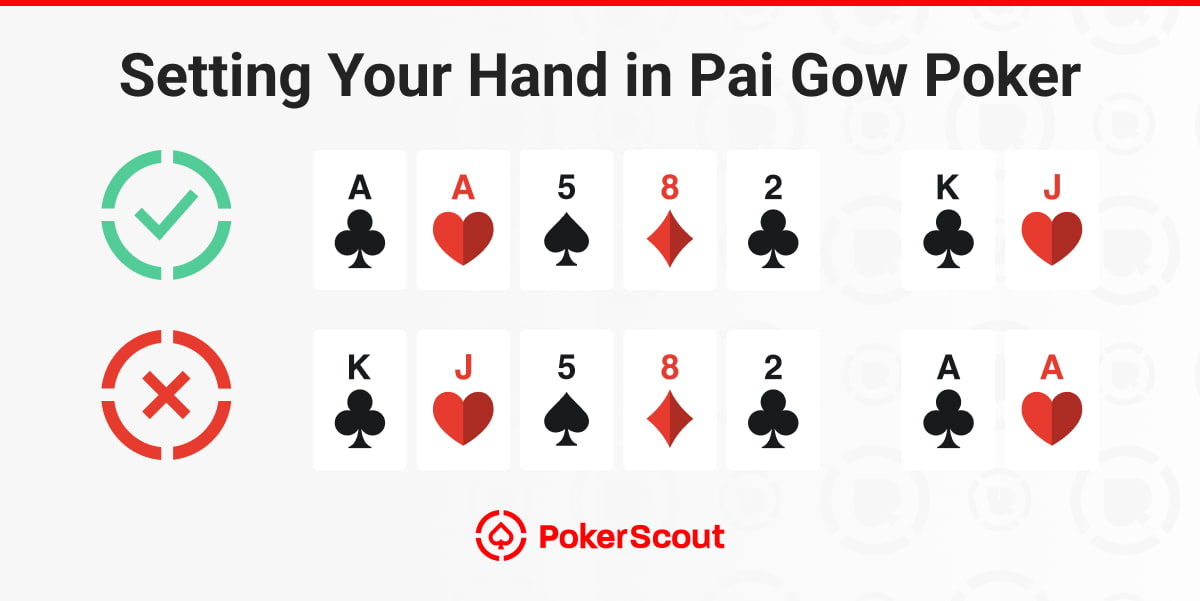
Here’s where the Pai Gow Poker strategy and fun come in. Once the starting cards are dealt, players must arrange their hands into a five-card high hand and a two-card low hand.
How you arrange these cards is entirely your choice, although some ways give you better Pai Gow Poker odds than others. Don’t forget, though, the high hand must always beat the low hand.
Pai Gow Poker Showdown
Once everyone has set their hands, the dealer reveals their cards. You then compare your hand to the dealer’s.
You can win, push, or lose:
- Win: Your high and low hands both beat the dealer’s.
- Push: You win one hand and the dealer wins the other. This is called a “push” or tie. Neither the player nor the dealer wins, and the player gets their bet back.
- Lose: Both of the dealer’s hands beat your hands.
Pai Gow Poker Joker Rules
One interesting element of the game is the addition of a joker into the pack. When learning how to play Pai Gow Poker, you’ll need to be aware of how this card can be used.
The joker is a wild card, but there are restrictions on what cards it can substitute. Pai Gow Poker joker rules state that it can only be used to complete a straight or flush, or as an Ace.
Still, the joker is very powerful. It will help you to complete strong five-card hands, win the two-card hand as a high-card or pair of aces, and can even be used to make the ultimate Pai Gow hand, five of a kind aces.

Pai Gow Poker Hand Rankings
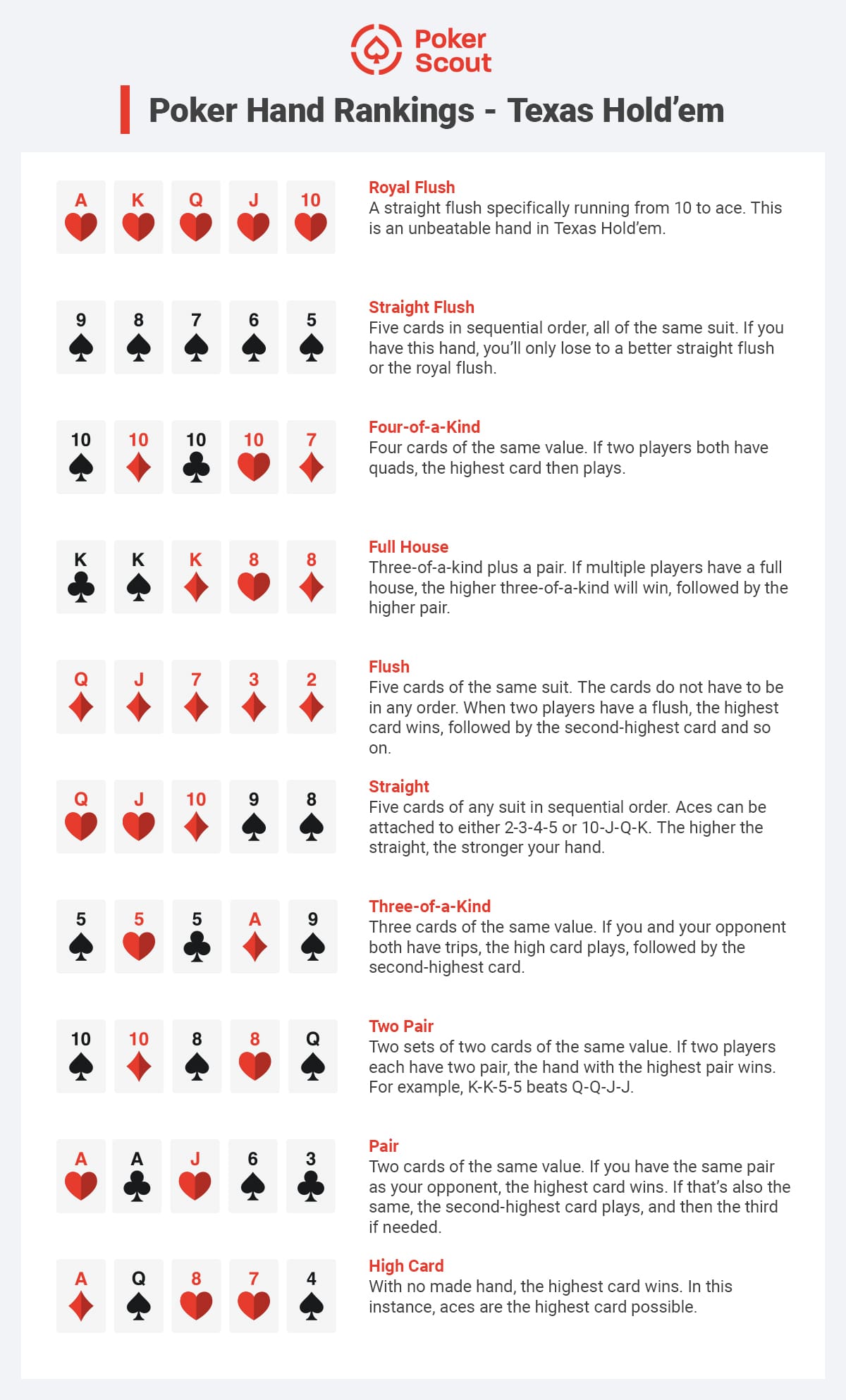
If you already know how to play poker, you’re likely familiar with the hand rankings of Pai Gow Poker. They’re essentially the same as Texas Hold’em.
In the two-card hand, it’s only possible to make one pair or high cards. In the five-card hand, the rankings follow the same order as in other popular poker games. The only difference is that you have one hand that beats the Royal Flush.
Five aces is the highest possible hand in Pai Gow Poker. It can only be made with a joker and the four aces.
Here’s a quick refresher for experienced players or a reference for new players who are just learning how to play Pai Gow Poker.
Pai Gow Hand Rankings Cheat Sheet
Pai Gow Poker Payouts and House Edge
By now, perceptive players will have noticed that the Pai Gow Poker odds of winning hands are 50-50 against the dealer. The chances of you pushing, winning, or losing are the same as the dealer’s chances. So, how does the casino or online poker site make money?
Well, first of all, the Pai Gow poker odds are not exactly even. When you have exactly the same five-card or two-card hand as the dealer, they will win due to the “copy rule”.
Pai Gow Poker games also charge a small commission on player wins, usually around 5%. So, true Pai Gow Poker payouts are slightly less than double your bet. For example, if you bet $50 and win both hands, you’d get $45 in return.
Players enjoy a good amount of playtime due to the high number of “Pushes” and decent odds of winning, but ultimately, the house has a small edge of around 2.5% to 2.7%.
Pai Gow Poker Side Bets
On top of the usual Pai Gow Poker payouts, you can place side bets with various payouts based on how difficult they are to hit. The side bets are usually based on your seven cards as a whole rather than the split.
Payouts for side bets vary widely between casinos and online sites. The Fortune Pai Gow Poker side bet table is widely available at casinos. Here’s an example of the side bets and accompanying Pai Gow payouts.
| Hand | Description | Payout |
|---|---|---|
| 7 Card Straight Flush | Seven consecutive cards of the same suit | 8,000 to 1 |
| Royal Flush and Royal Match | A, K, Q, J, 10 of the same suit | 2,000 to 1 |
| 7 Card Straight Flush w/ Joker | Five consecutive cards, including a joker | 1,000 to 1 |
| 5 Aces | Five aces | 400 to 1 |
| Royal Flush | A, K, Q, J, 10 of the same suit | 150 to 1 |
| Straight Flush | Five consecutive cards of the same suit | 50 to 1 |
| Four of a Kind | Four cards of the same rank | 25 to 1 |
| Full House | Three of a kind plus a pair | 5 to 1 |
| Flush | Five cards of the same suit | 4 to 1 |
| Three of a Kind | Three cards of the same rank | 3 to 1 |
| Straight | Five consecutive cards | 2 to 1 |
Types of Pai Gow Poker
Here are some of the most popular variants of Pai Gow Poker. Each has its own quirks and side bets, so it’s worth checking out your options:
- Fortune Pai Gow Poker: Offers side bets for specific hand combinations. Pays out according to the seven cards you are dealt, regardless of the split. Fortune Pai Gow Poker is very popular for its variety of betting options.
- Face Up Pai Gow Poker: The dealer’s hand is face up, removing some of the guesswork. There’s also no commission on bets in Face Up Pai Gow Poker. To compensate, the hand will push when the dealer has an ace-high hand with no pair.
- Pai Gow Mania: Allows two side bets for more ways to win or lose. Players can place side bets on the first three cards dealt to them, the full seven-card hand, as well as the standard Pai Gow action.
- Emperor’s Challenge: Features a side bet on making qualifying hands with your seven cards, similar to Fortune Pai Gow Poker, with an additional insurance bet for making a “no hand.”
- Progressive Pai Gow: A progressive jackpot runs, and players can pay an extra bet to qualify to win it. The qualifying hand is something rare, usually starting with a seven-card straight flush or five aces with a joker. The jackpot grows with every bet made until someone wins all or part of it.
Understanding the Pai Gow Poker House Way
The Pai Gow Poker rules state that dealers must follow a specific set of rules for setting their hands. This is known as the House Way in Pai Gow Poker. It removes any subjective or strategic play on the dealer’s part.
The House Way varies from one casino or online site to another. Studying how your chosen casino or platform sets hands allows you to know how best to set your own. It’s a crucial part of developing a good Pai Gow Poker strategy.
Pai Gow Poker Strategy Tips
Once you’ve figured out how to play Pai Gow Poker, it’s time to develop your game. Our experts have put together five simple tips to quickly improve your Pai Gow strategy, even if you’re a relative newcomer to the game:
- The basics of hand setting: You can’t forget that the high hand must beat the low hand. However, your Pai Gow Poker strategy should always focus on balancing your hands rather than trying to maximize the strength of just one. The aim is to win both hands to scoop the pot.
- Use the joker wisely: Use the joker to complete straights and flushes. If neither of those options is available, you typically want to treat the joker as an ace.
- Don’t split pairs: If you have a single pair, don’t split it up. Use it in your five-card high hand along with the other three highest-ranking cards.
- Consider breaking full houses: This Pai Gow Poker strategy may seem counterproductive, as a full house is typically one of the strongest hands you can make. However, to give yourself the best chance of winning both the high and low hands, our experts usually recommend breaking it up into three of a kind in your high hand and a pair in your low hand.
- Be aware of the push: One of the best parts about Pai Gow Poker is the frequent number of pushes. Many hands will result in a push, which allows for longer playtime and better bankroll management.
Where to Play Pai Gow Poker
If you’re looking to play Pai Gow Poker, there are plenty of options available for playing at online sites. Many platforms offer a range of Pai Gow Poker variants, a smooth and user-friendly playing experience, and attractive bonus offers for new players.
Pai Gow Poker games can also be found at large casinos and gaming hubs, such as Las Vegas, where they are a regular fixture at tables.
Pai Gow Poker vs Texas Hold’em
Although Pai Gow Poker and Texas Hold’em both fall under the poker umbrella, the two games differ significantly. Learning how to play Pai Gow Poker is nowhere near as tough as mastering Hold’em.
In Texas Hold’em, available at all US online poker sites, players compete against each other. In Pai Gow Poker, you’re up against the dealer, with no bluffing involved at all, making it more of a casino table game.
Additionally, in Pai Gow Poker, players are dealt seven cards to make two hands. In Texas Hold’em, you are dealt two hole cards and five community cards, which all players can use.
Both games offer unique strategies and approaches to winning. However, beyond knowing how to split your hand, Pai Gow Poker strategy is limited in comparison to Hold’em. It’s essentially a game of chance with a strategic element.
If your preference is for Hold’em, CoinPoker is a great option, as it has stacks of weekly MTTs and 24/7 cash games. Plus, if you sign up using our exclusive bonus code POKERSCOUT, you’ll get an extra $10 on top of the usual welcome bonus.

Conclusion
Now that we’ve discussed the fundamentals of where and how to play Pai Gow Poker, you should feel more confident about diving in and competing. Whether you choose to play online or in brick-and-mortar casinos, Pai Gow Poker offers an enjoyable alternative to more complex poker variants like Texas Hold’em.
Remember, although some strategy is involved, luck also plays a significant role. So, always play responsibly.