Poker Expert


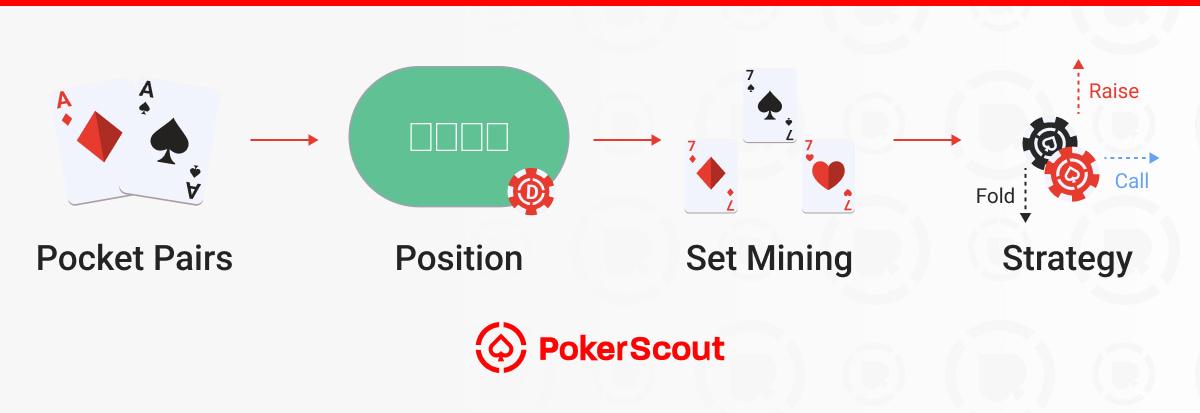
Being dealt a pair is about as good as it can get preflop, but in order to turn these excellent starting hands into profit, you’ll need to know how to play pocket pairs. This is where the pocket pairs strategy comes in handy; without it, you won’t be able to take advantage of your fortunate situation. We’ll guide you through all aspects of playing pocket pairs in poker, from set mining with small pairs to maximizing value with premium hands like aces.
All You Need to Know
- Pocket pairs in poker are starting hands that include two hole cards of the same rank.
- High pocket pairs, such as aces and kings, are among the best starting hands in the game; they should be played for maximum value.
- Small pocket pairs are usually used to set mine and can be readily folded if the action heats up.
- Knowing how to navigate tough postflop spots is the key to playing pocket pairs effectively.
What Are Pocket Pairs?
A pocket pair is a preflop poker hand consisting of two hole cards of the same rank, such as 2♥2♦ or K♣K♦. They can be of any suit. The rank is all that matters here.
Pocket pairs run from deuces at the low end of the spectrum all the way up to pocket aces at the top, which is the best starting hand in poker. All pocket pairs in poker can be playable when effective stacks and position allow for profitable set-mining, but the higher the pair, the better your chance of crushing other players and winning at showdown.
Pocket Pair Odds Explained
The odds of being dealt any of the pocket pairs in poker are 5.9 percent, which is around once in every 17 hands. As you can see, this is a common scenario that you can expect to face often at the poker tables.
However, the odds of picking up a specific pocket pair in poker, such as the odds of getting dealt pocket aces, are just 0.45 percent. That’s an average of just once every 220 hands.
What can we learn from these pocket pair odds? First, you’ll need to know how to play small pocket pairs in poker, as you’ll get these much more often than you will aces or kings. Second, in the rare moments that you are dealt a monster pair, you’ll want to make the most of it by getting paid off.
How to Play Pocket Pairs in Poker
Essentially, when you are dealt a pocket pair in poker, you have been given a ready-made hand before the flop. You have a pair, which is technically ahead of anyone who doesn’t have a higher pair, at least preflop.
Pocket pairs have the potential to become some of your most profitable hands. Still, it’s crucial to be aware of how to play small pocket pairs compared to medium pairs and premium hands.
The first step in knowing how to play pocket pairs in poker is evaluating their strength. There are 13 different Texas Hold’em pocket pairs, ranging from the lowest, pocket deuces, up to the elusive pocket aces.
Pocket pairs can be categorized as premium, medium, and small:
- Premium poker pocket pairs: JJ – AA (sometimes TT)
- Medium poker pocket pairs: 77 – TT (sometimes 66)
- Small poker pocket pairs: 22 – 66
Although these categories are generally set, hands can be categorized differently depending on your position and the stage of the game. For example, pocket nines are a medium pair in early position, but if it folds to you in the small blind or on the button late in a tournament, pocket nines can be considered a premium pocket pair.
Being aware of this and other pocket pair tips will help you stand out from your opponents.
Pocket Pairs Preflop Strategy
So, you’ve been dealt a pocket pair and need a solid preflop pocket pair strategy to match. Whether you raise, call, or fold preflop depends on some key factors:
- The strength of your pocket pair.
- Position and stack sizes.
- The moves your opponents make.
- The board texture postflop.
Pocket pairs lose relative equity as more players see the flop, so controlling the number of opponents is an important part of your preflop strategy.
Premium Pocket Pairs Preflop
These are: A♣A♠, K♥K♦, Q♠Q♣, and J♦J♥.
Premium pocket pairs are a matching pair of face cards or Aces. These are the best pocket pairs in poker. They are so strong that they can be played profitably from any position. If you are dealt these at any poker room or on any poker app, the best strategy is usually to bet them strongly preflop.
Betting and raising preflop protects you from being outdrawn by random hands postflop, particularly in multiway pots. Ideally, you want to either stack off your chips preflop or reach a heads-up situation postflop so that you can win a huge pot.
The emphasis when playing strong pocket pairs is on value. Hands like pocket aces and kings are the best possible starting hands in poker; make sure you extract the maximum by playing them aggressively and confidently.
Always consider the board texture and stack-to-pot ratio (SPR). Dry boards favor strong continuation bets, while coordinated boards call for pot control.
Medium Pocket Pairs Preflop
Medium pocket pairs are the cards immediately below the face cards: 10♦10♥, 9♥9♠, 8♣8♦, 7♥7♦
These hands are among the toughest to play. They have a lot of equity preflop, but can run into trouble postflop if overcards fall on the board. How you play medium pocket pairs in poker is very situational.
Your preflop strategy depends on position, stack sizes, and opponents’ tendencies. Often, the best pocket pairs preflop strategy for medium pairs is to either open-raise if action folds to you, or flat call bets from early or middle position raisers.
You may also find spots to three-bet versus aggressive late position raises, especially with the higher-end medium pairs like pocket nines and tens.
Postflop, you’ll usually play medium pocket pairs aggressively when you flop a set, or when the board is low and your opponent shows hesitance. If overcards fall, you’ll definitely want to slow down and use pot control to make it to showdown. If the betting picks up, be prepared to fold on high boards.
Small Pocket Pairs Preflop
Small pocket pairs are all of the remaining combinations of paired cards: 6♠6♣, 5♥5♦, 4♣4♠, 3♠3♥, 2♦2♣.
The plan for playing small pocket pairs is to try to see a flop as cheaply as possible, with the intention of hitting a set, also known as three of a kind. This occurs approximately 11.8 percent of the time on the flop and increases to roughly 19–20 percent by the river, when all five community cards are revealed.
This isn’t often enough to justify calling big bets. Set-mining is profitable only when effective stacks are at least 10-15 times the size of the call preflop. However, you can open-raise small pocket pairs if stacks are deep enough, or flat call raises in position or from the blinds. If the action picks up, be prepared to fold your small pocket pairs.
On the flop, if you don’t land the set you were hoping for, don’t panic. You should mostly just play passively and fold, losing a minimal investment. A common mistake is for players to make a bluff with pocket pairs here, or, worse still, continue calling bets, putting themselves in deep trouble.
Pocket Pairs Postflop Strategies
The flop has come down, and you have a pocket pair in hand. But what next?
If you have one of the best pocket pairs in poker, you need to consider two things:
- Does the flop have any overcards, meaning any cards of higher value than yours? If no overcards come down, you are most likely still ahead, and you should bet accordingly to try and maximize your potential winnings.
- Although your cards were some of the best to get as starting hands, don’t become too attached to them. If the flop has lots of betting action, overcards have come down, or there are flop or turn cards with straight or flush potential, don’t be afraid to fold. Living to fight another day is better than throwing away your chips.
For medium pocket pairs, your aim is to see a flop. What you do next can depend on four factors:
- How many players see the flop with you.
- Whether or not you hit a set.
- The presence or absence of overcards.
- Your position.
If you end up playing against more than one opponent postflop and there are overcards on the board, a wise strategy would be to fold to any raise. If heads up, you could use pot control to make it to showdown or chance your arm at a bluff, but only if you feel that you have a good chance of making your rival fold.
All of this changes if you hit a set on the flop when playing these pocket pairs. Then, the odds are that you have the best hand, play it accordingly by betting, calling, or re-raising, depending on the texture of the board.
When playing small pocket pairs, hopefully, you will have reached the flop without investing many chips.
If you do find yourself on the flop without having hit a set, this is the time to stay calm, don’t go down a rabbit hole trying to bluff your way to winning the pot. There are many better times to do so other than here.
However, let’s say you have flopped the set. Once again, unless the board texture is full of flush and straight potentials, you’ll often have the best hand. On rare occasions, you might be up against someone with a better set. For the most part, though, bet and raise for maximum value.
Even when you hit a set, be cautious on connected boards or when facing heavy action, as higher sets or better hand types may be possible.
Mistakes to Avoid with Pocket Pairs in Poker
Pocket pairs in poker are some of the most exciting hole cards to get. But this doesn’t mean that they are invincible. Even when you are playing on an online poker site using our pocket pairs tips, there are still pitfalls to be aware of.
Ignoring your position, stack size, or overvaluing your cards can all bring a great hand undone. Many players fall into the following traps. Don’t let this be you!
Overvaluing Small Pocket Pairs
Overvaluing small pocket pairs in poker is a sure-fire way to come unstuck. Remember that a small pocket pair only has value when you see the community cards and make a set.
If the betting is strong preflop, it is better to stay out of the action and fold to avoid bleeding unnecessary chips. If you miss your set postflop and face action, muck your hand.
Ignoring Position
Although having premium pairs means that you have a strong hand no matter what position you play them from, for all other pocket pair combinations, position is key. Pocket pairs have different values depending on the poker positions in which you are dealt them.
The most important thing to keep in mind is that acting from an early position means you won’t have access to information, and information is everything. You’ll also have multiple players left to act behind you.
For example:
If you raise with a low pocket pair from an early position, you leave yourself vulnerable to re-raises or calls. If you do make the flop, which is less likely, you’ll have very little room for maneuver when it comes to taking free cards or bluffing.
Conversely, if you are on the button, you will already have seen how everyone else has played their cards before deciding whether to stay in the hand or not. Calling a small bet at this point so you can see the flop is not a bad choice.
Stack Sizes
Stack size will also influence how you play your pocket pairs in poker, so pay attention to how many chips you and your opponents have.
At the beginning of a tournament, you will have a healthy stack, so flatting or opening could form part of an effective poker strategy with small and medium pairs. As stacks get shallower, small and medium pocket pairs become less playable, and it’s relatively more costly to see a flop.
On the other hand, if you have medium or premium pocket pairs, then you can use a healthy stack to raise and reraise, as well as set up betting lines postflop. When stacks are shallow, it’s easier to stack off on preflop or on the flop with pocket pairs in poker.
In tournaments, pocket pairs lose value as stacks shrink and blinds rise, since there’s less room to see cheap flops and realize implied odds. When stacks are short, below around 25 big blinds, the best pocket pair strategy is often push-or-fold, while deep stacks favor set-mining and postflop play.
Conclusion
Played well, and with a slice of good fortune, pocket pairs in poker can seriously bolster your stack and set you on the course to victory. Adjust your pocket pair strategy to your opponents. Against tight players, raise more often for value; against loose or aggressive tables, slow down and control pot size. Playing pocket pairs badly can have the opposite effect: you can lose a significant amount of your total or prematurely bow out of the game.
The best pocket pairs strategy relies on understanding their strengths and how to play them effectively. Study our tips to feel confident at the tables when you get dealt a pair. Have fun trying out our time-tested strategies, and fingers crossed for pocket aces!
If you need the perfect place to try out your new pocket pair knowledge, you can get a $10 bonus when you join CoinPoker using the bonus code POKERSCOUT.