Managing Editor



Next weekend will mark the first run of the Sunday Sweat, an experimental new Mystery Bounty format developed by the PokerStars Open tour that will involve picking the winner of one of that day’s NFL matchups. Many sports prediction games offer advantages to those willing to go against the grain and pick the underdog, but is that the case here? With the assistance of a computer simulation, PokerScout set out to answer that question.
The tournament will work mostly like a typical $300 buy-in Mystery Bounty event, but with one twist. Unlike some other recent experiments (we’re looking at you, WPT), there’s nothing too crazy going on here. The gimmick is that every player has to guess which team will win the designated game. When drawing bounties, players who guessed correctly have the option to mulligan. That is, they can opt to return the bounty they pulled and try again, but only once… and they must keep the second bounty, even if it’s worse than the one they forfeited.
In a traditional Mystery Bounty event, there’s no strategy to the drawing of bounties. The prizes are purely random, and a player cannot gain or lose any advantage by delaying their selection to see what others have pulled. However, the Sunday Sweat is quite different because of the mulligan mechanic.
For one thing, you want to draw your bounty as early as possible in the Sunday Sweat, for reasons we’ll explain shortly. But what about your pick for the game?
In some sports-selection games like daily fantasy or certain kinds of betting pool, there’s an advantage to being contrarian and choosing the underdog. We wondered if that’s the case for the Sunday Sweat.
It turns out not to be a trivial problem, but one we could solve with a simulation.
Sunday Sweat Strategy in a Nutshell: Pick the Favorite
Things are about to get a little nerdy in here, so if you just want the answer: For this inaugural Sunday Sweat, don’t overthink it; just pick the favorite.
We found that there can be an upside to picking the underdog, but only if the game odds are close to even, and other players’ picks are disproportionately lopsided.
In something like parimutuel betting, picking a 3-1 underdog if the other players’ selections are split 4-1 is a profitable move. But Sunday Sweat isn’t parimutuel. The advantage of being in the minority is smaller, and there’s an upper limit on it, as we’ll see shortly.
What that means is that for highly lopsided matchups, picking the underdog is always worse. Even if you’re the only one doing it.
How lopsided the match needs to be for that to be the case depends on the distribution of bounties in the pool. However, for a typical distribution that PokerScout tested, even a 2-1 underdog is never correct to pick.
And here’s the important thing: Although we don’t know which exact matchup PokerStars will select next weekend, all three possibilities are more lopsided than that.
A PokerStars representative told PokerScout that they will likely opt for whichever Sunday afternoon game looks closest. Based on current betting lines, that would be the Dallas Cowboys vs. Denver Broncos. But even that has the Broncos as better than 2-1 favorites.
Ergo, “Go Broncos!” if you care about your expected value (EV). If it’s one of the other games instead, take the Buccaneers over the Saints or the Colts over the Titans. And if you do win a bounty, collect it as soon as you can.
How Sunday Sweat Mulligans Change Bounty Probabilities
So, why doesn’t it matter when you select a bounty in a normal Mystery Bounty event? It feels like it should, because if you see someone else win a big prize, your EV goes down. On the other hand, seeing someone pull a disappointing prize makes your EV go up slightly.
The reason is that the change in probability only comes after you’ve already made your decision to open an envelope or to wait. At the time you’re making the decision, the chances that your odds go up if you wait exactly even out with the chances that they go down.
Imagine there’s a shuffled deck of cards and you want to pull as high a card as you can. Initially, it doesn’t matter if you take the first card or let a few other people draw first. However, if those other players get the chance to look at a few cards and return the bad ones, that’s hurting your odds.
That’s essentially what happens with the Sunday Sweat mulligans. Those who have a mulligan will not be exercising that option when they get a favorable bounty. So it’s only the bad ones going back in the pool.
Over the course of the tournament, more high-value bounties will get removed from the pool than low-value ones. That means the value of a bounty goes down, but the statistical value of a mulligan also goes down. Eventually, if all the remaining envelopes contain the minimum bounty, there’s no advantage to a mulligan at all.
Why Does It Matter if You Pick the Favorite or Not?
That effect is stronger the more players have a mulligan to use. If everyone picks the favorite and the favorite wins, then the value of the bounties and mulligans goes down quite rapidly.
Conversely, if everyone picks the favorite and the underdog wins, the effect disappears. Now you’re just playing a regular Mystery Bounty tournament.
So, if you’re the only one who picked the underdog and there’s an upset, you’re in a great position. Your mulligan continues to be valuable for the entire course of the event, unlike those who picked the favorite when their team comes out on top.
Counteracting that is the fact that you’ll earn your mulligan less often. By picking the underdog, you’re sacrificing up-front equity at the beginning of the tournament, when all bounties are available, in return for more EV from your mulligan later on in the event.
For the example set of bounties we used for our simulation, the EV of a single bounty draw in a normal format is $2,500, and an optional mulligan in the full bounty pool adds $1,000 to that.
That means the added EV for being a contrarian is guaranteed to be less than $1,000. Everyone’s mulligan EV starts there and only gets lower over the course of the event. The only question is how much faster it drops, in practice, when the favorite wins.
That’s where we need a simulation.
PokerScout Simulates the Sunday Sweat
To do our test, we had to create a sample bounty pool. We concocted an event with 100 bounties, ranging from $1,000 to $30,000, and with an average value of $2,500. These findings should hold qualitatively for any reasonable bounty pool, as long as it follows a typical “pyramid” structure with a small number of large bounties and many smaller ones. In our example, 85 of 100 bounties were worth either $1,000 or $2,000, so an EV-oriented player would be exercising their mulligan 85% of the time to start with.
We assumed that all players are choosing to mulligan or not in a rational way. That is, they mulligan (if able) whenever their first pick is less than the average value of the remaining bounties.
To start with, we imagine that the game and the players’ picks are both perfectly 50-50.
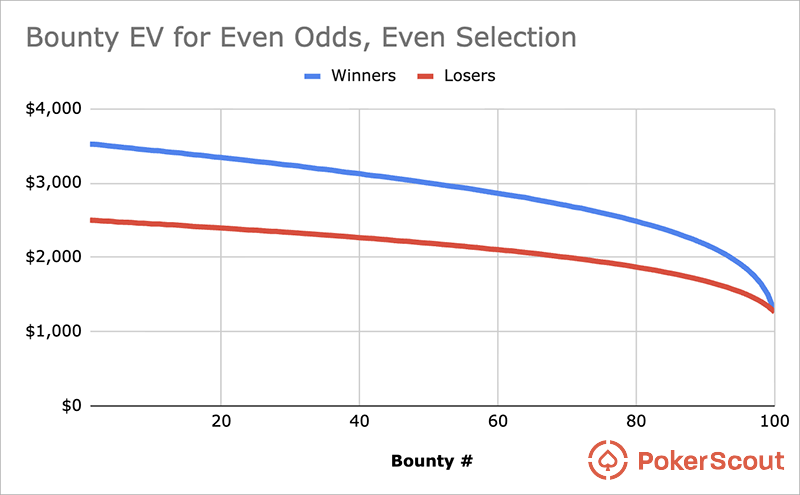
Here’s how the EV of the winners (who have the right to mulligan) compares to the EV of the losers (who do not), depending on the stage at which they win their bounty.
Initially, losers have exactly $2,500 EV, while winners will get $1,000 more on average by getting to return their low-value prizes and try again.
As the bounty pool thins out, both groups’ EV goes down, though the winners’ goes down faster toward the end, as the mulligan is less valuable in a more homogenous prize pool. For the last envelope, there’s no difference at all: even those with a mulligan would just get the same envelope right back.
By the end of the tournament, if half the players have access to mulligans, the statistical value of that last envelope has dropped to just $1,265. Most of the time, there will only be a $1,000 prize left.
Picking the Fave is Better in Lopsided Matchups
We looked at hypothetical games with favorites ranging from 51% (almost even-money) to 67% (2-1). We also considered scenarios in which anywhere from 50% to 99% of the field chose the favorite.
If Cowboys-Broncos is the game next weekend, then the Broncos are a 2-1 favorite. Our simulation suggests that it’s not favorable to pick the Cowboys even if 99% of players are going Broncos. However, a more realistic scenario might have 75% of players picking the Broncos out of team loyalty or strategic misunderstandings.
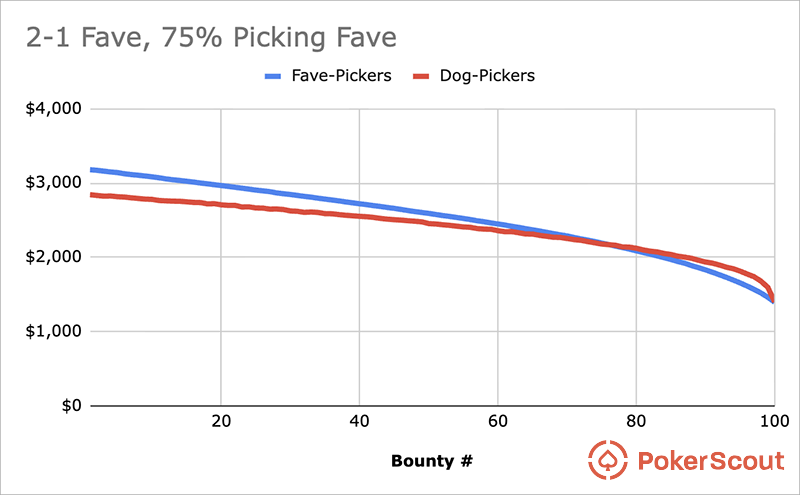
The graph below shows what that looks like. Here, the lines correspond to picks, and the calculated EV is an aggregate of both possible scenarios: Cowboys winning or Broncos winning. That is, the fave-picker line combines the 67%-likely scenario that the player wins alongside 75% of the field, and the 33%-likely scenario that they lose and only 25% of opponents win. This is the same way that poker hand EVs are calculated.
Recall that the value of a mulligan is about $1,000 when all bounties are still available. As expected, we see that fave-pickers get about $670 in average extra EV (on top of the $2,500 baselline), because they have that mulligan 67% of the time. The dog-pickers have half as much.
The dog-pickers’ EV benefit declines more slowly over the tournament, though. That’s because when they do have a mulligan, fewer opponents do, and so the bounty pool is thinning more slowly.
But it’s only better to have the underdog for the final 23 bounties, and the edge caps out at about $70. It’s not nearly enough to overcome that initial sacrifice. Averaged across the tournament, dog-pickers in this scenario win $167 less per bounty than fave-pickers.
In Close Matchups, a Few People Should Back the Underdog
Next weekend, there’s no value to picking the underdog. Yet that’s not always the case. Let’s take a look at a game that’s almost even, where the favorite has only a 55% chance of winning.
Now, those who are picking the underdog are giving up much less initial equity. The fave-pickers are getting that $1000 initial benefit 55% of the time and the dog-pickers are getting it 45% of the time, so they’ve only given up $100 in EV on the first bounty-pull.
If enough people are going for the favorite, then the late-tournament advantage of having the underdog is more than enough to overcome that.
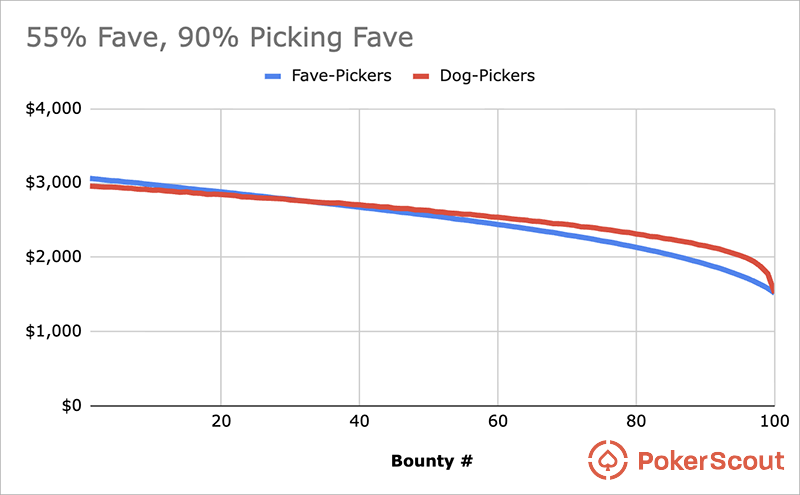
Choosing an extreme scenario to illustrate that, imagine that the favorite is the home team and 90% of players are choosing it. The graph below shows what that looks like.
If that’s the case, then the underdogs start to have the advantage after about 35 bounties, and it gets quite large by the end — as high as $270 with five bounties left.
Averaged across the tournament, that 10% group of contrarians enjoys a $70 edge.
It’s important to note, however, that the game theoretically optimal split for a game with a 55% favorite is not 55-45 as it would be in a parimutuel scenario. Instead, it’s closer to 70-30.
In conclusion, if the match is close, some people should be picking the underdog, but fewer than you’d think if you’re coming from other sports prediction games.