Poker Expert


Cash games are one of the main formats of the game, the other being tournaments. While learning poker cash game rules is quick and easy, consistent success requires a solid cash game strategy and an understanding of deep stack play.
Whether you have already tried your hand at a tournament or you’re trying out poker for the first time, this guide on how to play poker cash games will help you navigate the basics so that you’re ready to sit down and compete at the tables.
All You Need to Know
- Along with tournaments, poker cash games are one of the two main poker formats.
- In cash games, players buy in for any amount within a given range and receive chips that have the same, direct monetary value.
- Texas Hold’em is the most popular type of cash game poker. You’ll also find Omaha, mixed games, and, less commonly, older variations like Stud and Draw.
- Cash game poker strategy requires you to navigate tough situations with deep stacks. Hands often play out postflop over several streets.
What Are Poker Cash Games?
In cash games, players buy in for chips that have a real and direct monetary value.
A $50 cash game chip is worth $50 as soon as you cash it out. Each pot is played for real money, and you can sit down and leave whenever you want. When it comes to poker cash games versus tournaments, players tend to prefer one over the other. Tournaments bring excitement and intense competition, whereas cash games offer a steadier experience.
Having said that, there’s nothing stopping you from playing both.
You can even try cash games (or tourneys) for free when you join CoinPoker using the bonus code POKERSCOUT, which unlocks an exclusive $10 bonus.

What You Should Know Before Playing Cash Games
When learning how to play poker cash games, the first question to ask is: Do you already know how to play poker? Are you familiar with the basic rules of the game?
Do You Know How to Play Poker?
As a complete beginner, it’s recommended that you start your journey by learning the rules and basics of how to play Texas Hold’em, the most popular format of poker.
Get to grips with the following:
- Poker hand rankings.
- Texas Hold ’em cash game rules of poker, such as blinds, hole cards, community cards, and betting rounds.
- Betting options, such as checking, betting, calling, raising, and folding.
- Very basic strategies, such as position and starting hand selection.
Understanding Poker Hand Rankings
Hand rankings in poker cash games are exactly the same as in tournaments.
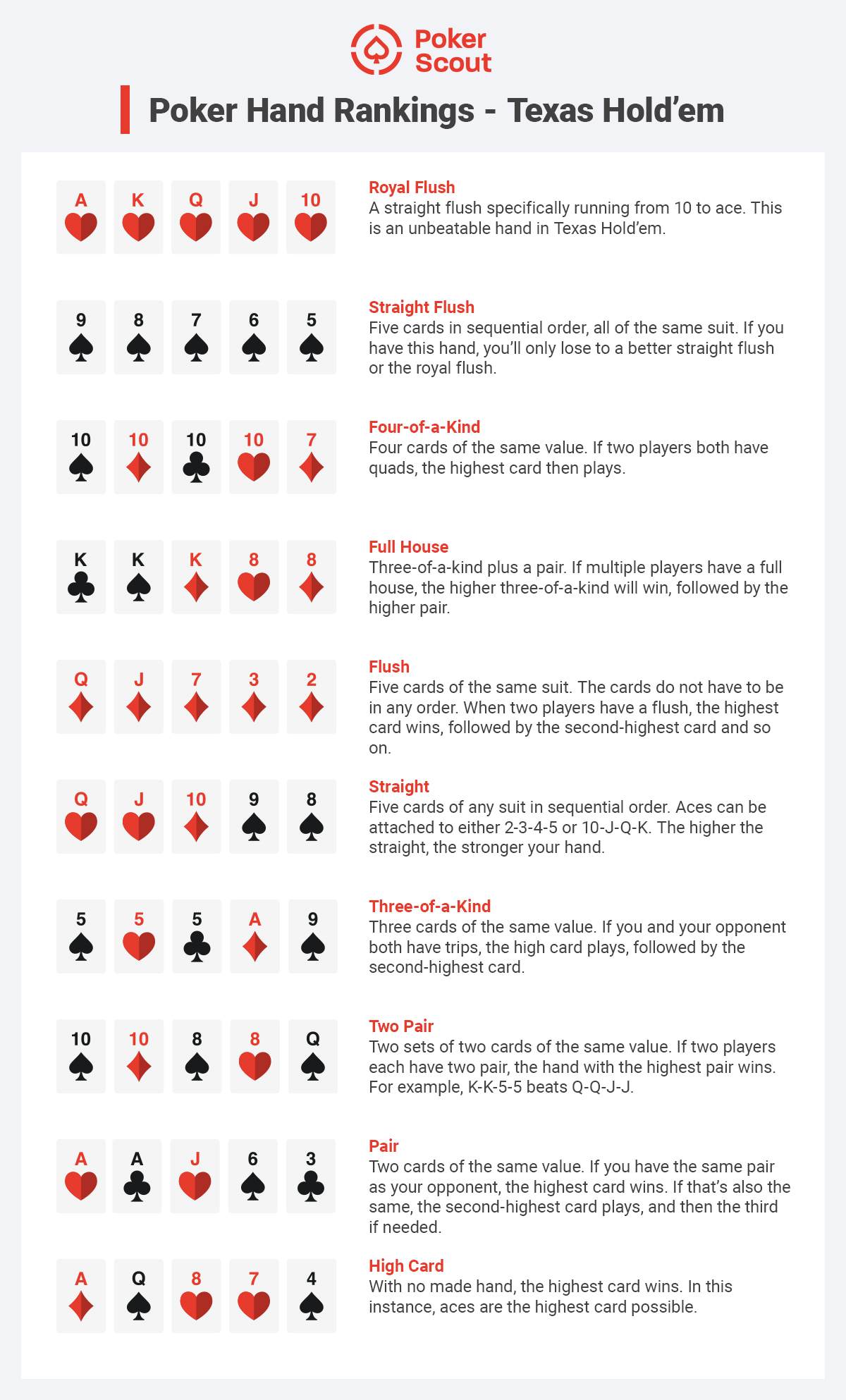
They depend on the type of poker you are playing. For popular poker games like Texas Hold’em, Omaha, and Stud, the hand rankings are always the same, running from a High Card up to a Royal Flush:
Cash Games vs Tournaments: What’s the Difference?
Although the main rules are the same, there are major differences between the structure of cash games versus tournaments.
Here’s an overview:
- Buy-ins: In tournaments, players pay an entry fee to secure a starting stack. In cash games, you can buy in for any amount within a range and are given the same value of cash game chips.
- Chip Value: Tournament chips have no value outside of the game. In cash games, you can leave at any moment and exchange your chips back into cash.
- Blinds: In tournaments, the blinds constantly increase, reducing relative stack sizes and forcing action. In cash games, blind levels stay exactly the same and determine the stakes of the game.
- Time: When it comes to cash games versus tournaments, cash games run around the clock as long as there are players to fill the tables. Tournaments have a scheduled start time and typically run for several hours.
Getting Started with Cash Games
To get started with cash game poker, purchase chips and then take your seat at a table.
Understanding Buy-Ins
In poker cash games, chip denominations represent real money.
There is a minimum and maximum buy-in, but within this range, each player decides exactly how many chips they want to bring to a cash game table. Blind levels determine the stakes in cash game poker. For example, in a $0.10/$0.25 cash game, the buy-in range will typically be 40-100 big blinds.
Players can buy in for between $10 and $25 and play with the equivalent number of chips.
Betting in Cash Games
As the name suggests, in cash games, every hand is played directly for cash. When you bet $25 in chips, that’s $25 of real money. Every hand is a direct opportunity to win money, but it also carries a risk of losing it. You can cash out at any time, so when players talk about being up from a cash game, it means they have cashed out for more than they started with.
Cash Game Rules for Blinds
The blinds always remain at the same level in cash games. This has a significant impact on gameplay when we compare poker cash games versus tournaments. The blinds define the stakes and have an impact on the average size of the pot. Stacks also tend to remain deep in cash games.
Choosing Your Stakes
As a beginner, it’s wise to play at the low stakes until you’re familiar with the format.
Online poker platforms offer micro-limit cash games for as little as $0.01/$0.02. At casinos, the lowest stakes you’ll find are typically $1/$2. If you don’t feel comfortable playing deep stacks, then feel free to buy in for the minimum, such as 40 big blinds.
Ideally, though, buy in for the maximum to give yourself flexibility when it comes to your poker cash game strategy.
How to Join a Poker Cash Game
The quickest way to play a real cash poker game is at an online US poker site, where you can find tables running at any time of the day. First, choose an acceptable site, then take these three simple steps:
Step 1
Register an account.Step 2
Deposit some money.Step 2
Join a table with an open seat.
To play live cash games, you’ll need to find a poker room or casino nearby. If there is a game running at a venue near you, all you need to do is buy some chips at the cashier and sit down at the tables.
Types of Poker Cash Games
There are many different poker variants that can be played as cash games.
New variants of poker are constantly emerging, gaining and losing popularity. However, over the last 20 years, No-Limit Texas Hold’em has been the undisputed king of both tournament and cash game poker.
Let’s look at the most common types of poker cash games played online and in live casinos around the world:
Understanding Rake in Cash Games
In tournament poker, players pay a set entry fee on top of their buy-in, which goes directly towards running costs and the house profit. In poker cash games, players don’t pay this entry fee. Instead, the house takes a share of every significant pot, known as the rake.
The rake in live cash game poker typically ranges from 5% to 10% of the pot, as there are staff fees and building costs to cover. At online poker sites, the cash game rake is typically 2.5% to 5% of the pot, due to the lower running costs associated with each table. O
Online sites may also offer rakeback deals, providing players with a percentage of the rake paid back.
No matter where you play, there’s nearly always a minimum pot size and maximum cap on the amount that is raked in each pot. The exact rules vary by casino or poker site. For example, a casino might choose to only rake pots that go postflop, up to a maximum rake of $10.
Alternatively, instead of raking each pot, some casinos collect a rake fee after a certain amount of time, such as every half an hour, from all players at the table. Whatever the case, rake is very important.
To be a profitable player, your poker cash game strategy and win rate must be sufficient to offset the rake.
Poker Cash Game Strategy for Beginners
In the most popular poker games, cash game strategy starts with an understanding of starting hand selection and position. We’ll also touch on some cash game poker tips that don’t apply to tournaments.
For a deeper dive into strategy, learn how to play Texas Hold’em, Omaha, or whichever specific variant of poker you decide to play in the cash game format.
Understanding Position
Position is a key factor in every form of poker.
Your position is determined by the dealer button, which rotates after every hand. The button is the best position, as it allows you to act last during every postflop betting round. This gives you a huge advantage, as you can react based on seeing what other players do first. Poker cash game strategy varies significantly depending on your position at the table. Generally, you should play tight from early positions and be cautious when you are out of position postflop.
From late positions, you can loosen up and play more hands.
Starting Hand Selection
Starting hand selection should be based on your current position. Here’s a loose guide on starting hand selection for beginners who are learning how to play Texas Hold’em cash games:
- Early position: Play a very tight range that includes mostly premium hands, such as medium to strong pocket pairs, suited broadway hands, AJ-AK, and a few other strong suited hands.
- Middle position: Add in most pocket pairs, all broadway hands, medium suited aces, and strong suited connectors.
- Late position: Loosen up and play a lot more hands, including all middle position hands, any ace, suited kings and queens, all suited connectors, and some offsuit combos, typically 50% of hands from the button.
- Blinds: Defend your blinds wider in cash game poker because the deep stacks allow you to call with the right pot odds and implied odds.
Deep Stack Cash Game Strategy
One of the defining factors of poker cash game strategy is that stacks are usually very deep.
Most players will buy in for 100 big blinds and can top up at any point. This creates a different dynamic to tournaments, where stacks are often shallow by the mid-stages. In no-limit cash games like Texas Hold’em, every hand you play could be worth up to 100 big blinds. That’s a lot to gain or lose in one hand, especially considering those chips have the same value in real money.
This has two implications:
Adjusting to Opponents
Poker is a game of adjustments.
A winning poker cash game strategy takes into consideration your opponents and the overall table dynamics. You’ll often sit down at the same table for a long time in cash games, allowing you to carefully observe other players’ tendencies and work out a plan on how to adapt. For example, if several players at your table are very loose and raise a lot, you may not need to generate action yourself.
You can tighten up with marginal hands, then go big or trap with your monsters.
Another important adjustment is to bluff more often against players who fold too much, while bluffing a lot less against players who don’t know how to fold. Understanding your opponents is the key to dominating your poker cash game table.
Table Selection for Beginners
Unlike in poker tournaments, you can sit down in any seat at any table in cash games.
The aim is to avoid the sharks and hopefully get seated with some weaker players. If you end up on a really tough table, don’t be afraid to leave and find a better seat. Table selection can actually be used as part of your poker cash game strategy to give you a bigger edge.
Bankroll Management for Cash Games
A sufficient bankroll is necessary to manage the variance in poker, which is due to the unavoidable element of luck.
Start by setting aside money that is just for poker, separate from everyday funds, and an amount that you are willing to risk. Then, you should choose stakes that allow you to play dozens of games before feeling the impact of negative results.
While optimal bankroll management depends on several factors like win rate, play style, and the skill level of your opponents, a general rule of thumb for a no-limit Hold’em cash game is to maintain a bankroll of 40-100 full buy-ins of 100 big blinds.
Some players, especially professionals, opt for even stricter bankroll management to further reduce the risk of ever going broke.
Stop Win & Stop Loss
If you are new to cash game poker, it can be helpful to set clear stop-win and stop-loss limits before you start playing.
This can prevent you from losing too much in one session or throwing away hard-earned winnings. Professionals often focus on volume, but beginners can benefit from this approach to mitigate the emotional impact of results.
Online vs Live Poker Cash Games
There are several differences between online and live poker cash games. Each has its own advantages and disadvantages, which we’ll explore below.
Pros & Cons of Online Cash Games
Pros
- Convenient and accessible from anywhere.
- Wide range of stakes, from $1 full buy-ins to high-stakes games.
- Huge game variety with easy switching between tables and formats.
- Play anytime from home – no travel required.
- No dress code.
- Multi-tabling allows for more action and potential profit.
- Ability to browse multiple sites for the best games and promotions.
Cons
- Lacks the social interaction of live games.
- Can feel isolated over long sessions.
- Tougher competition on average.
- Great-value games can be harder to find.
Pros & Cons of Live Cash Games
Pros
- More social and interactive experience.
- Ability to read physical tells and table behaviors.
- Many consider live poker to be the purer form of poker, and there is more information that a skilled player can use to their advantage.
- Softer games with more recreational players.
- Higher potential win rates due to more mistakes by opponents.
Cons
- Requires travel and a more time commitment, as well as other expenses.
- Limited game availability and fewer table options.
- Slower pace (only 20-30 hands per hour).
- Only one table can be played at a time.
5 Common Cash Game Mistakes to Avoid
Here are the most common mistakes that players tend to make when learning how to play poker cash games:
- Playing too many hands: Playing too many hands, especially from out of position, is even more costly in cash game poker because stacks are deep.
- Overvaluing medium hands: Tournament players will often overvalue hands like top pair when moving over to cash games, but building pots with medium strength hands often leads to losing full buy-ins.
- Calling too often: A very common beginner’s mistake is calling too often when you should be folding, often with a weak hand or when chasing a draw without the correct odds.
- Not adjusting to opponents: Other players will have their own tendencies and make mistakes in their own way, especially in live cash games where there are a lot of recreational players. You’ll miss a lot of spots if you fail to adjust.
- Playing on tilt: Playing when you are angry or tired leads to poor decisions. You can walk away at any time during a cash game, so there’s really no need to play on tilt.
Poker is a complex and fascinating game that is easy to learn but takes a lifetime to truly master. Poker cash game strategy is intricate, and stacks are deep. Every hand is played directly for real money.
We hope the cash game poker tips in this guide give you a strong foundation to start or improve your journey.