Managing Editor


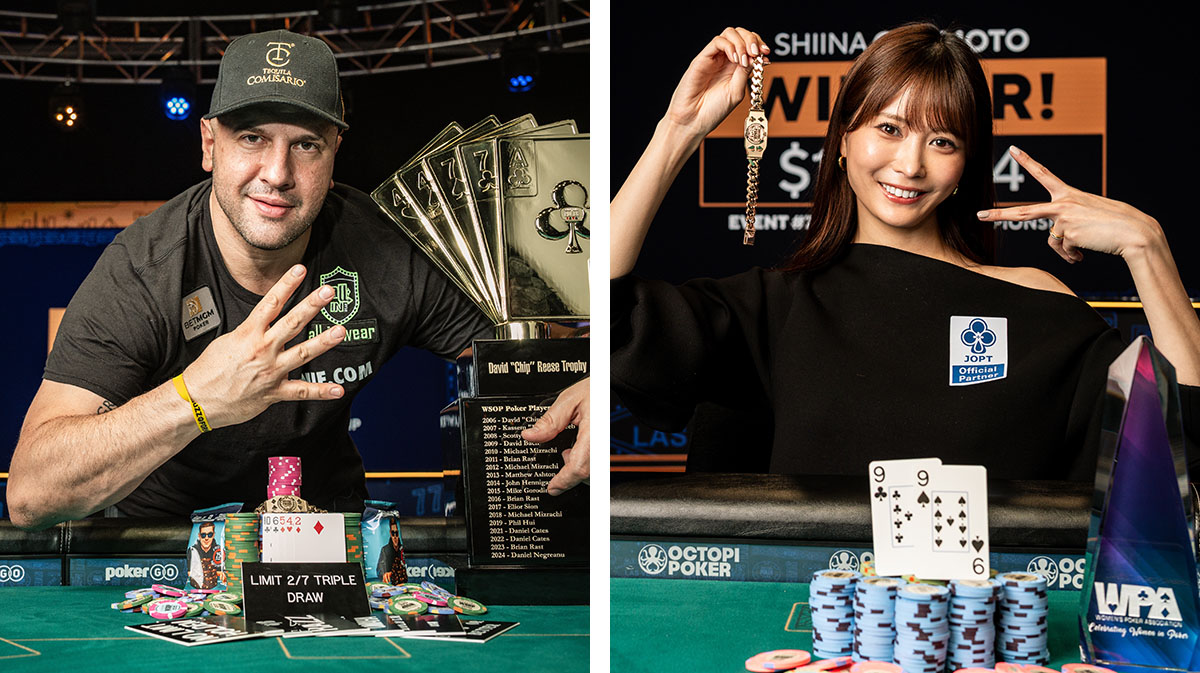
It’s hard to know who had the more impressive WSOP performance this weekend: Michael “The Grinder” Mizrachi or Shiina Okamoto. Mizrachi took down the same event for the fourth time since 2010: the $50,000 Poker Players Championship. Meanwhile, Okamoto won the $1,000 Ladies Event for the second consecutive year, or the third if you include a runner-up finish in 2023.
The Poker Players Championship is arguably the most prestigious annual event on the WSOP schedule. The Main Event gets most of the limelight, but its huge field makes it a notorious minefield requiring some luck to navigate successfully. By contrast, the PPC pits the best-of-the-best against one another in a 10-game mix format. That makes it perhaps a better indicator of all-around poker skill.
Until this year, two players were tied for the most PPC wins: Mizrachi and Brian Rast at three apiece. Four, however, is a record that you would expect to stand for some time. Mizrachi had to get through another giant of the game in Bryn Kenney, though he benefited from holding a 1.6-1 chip advantage when heads-up play started.
Mizrachi now has seven bracelets, more than half of those in the PPC. At age 44, the Floridian still has many years of play ahead of him to add to that total, and to his $19 million in career tournament earnings.
In contrast to Mizrachi, who was once as high as #7 in the Global Poker Index, Okamoto is less of a household name. Still, she has over $1 million in career earnings and currently sits just outside the GPI top 1000.
The Ladies Event lacks the same cachet as the PPC, but going 2nd-1st-1st in consecutive years in a 1000-plus field is improbable to say the least. So, which feat is actually harder to achieve?
Okamoto vs. Mizrachi—Evaluating the Individual Perspective
There are several ways to approach probabilities in cases like this. Many people’s instinct would be to look at it from the players’ perspectives, so let’s start with that.
Let’s also ignore the skill component of poker for a moment and consider the odds of achieving these feats by sheer chance.
From that perspective, Okamoto’s three-run streak is the more impressive due to the difference in field sizes. The PPC has averaged 100 entries over its 15-year existence in its current format. The Ladies Event has averaged nearly 1,000 over the same span.
The average player’s chances of going back-to-back in a field of 1,000 are literally one in a million (10002). Making it two wins and a second-place finish in the span of three years lengthens those odds to more like one in 150 million.
Going four in a row in a field of 100 would also be a one-in-100-million chance (1004). However, Mizrachi didn’t go four in a row. His wins are spread out over 15 attempts, which makes it 1365 times easier*, or about one in 75,000. (*15 choose 4, or 1,365.)
To be fair, we should evaluate Okamoto’s odds over the same period. Still requiring that the two wins and runner-up finish be in consecutive years, looking for a streak starting any time after 2010 improves the odds by about a factor of 10.
In summary, these are our baseline odds for a specific player, ignoring skill:
- Four PPC wins in any combination of years since 2010: one in 75,000.
- Two wins and a runner-up finish in the Ladies in any three consecutive years since 2010: one in 15,000,000.
Advantage Okamoto, then. It’s about 200 times harder to luckbox your way into what she did than what Mizrachi did.
More People Means More Chances Someone Does It
Looking at things from the point of view of an individual player is a bit unfair to Mizrachi, however. If we’re considering the odds of this happening by chance alone, the individual player’s perspective is the wrong approach. Instead, we should examine the entire field.
After all, we’re only looking at Mizrachi and Okamoto because we have the benefit of hindsight. The real question is not what the chances are of a specific person accomplishing these things, but the chances that anyone does. Because more people play the Ladies Event than the PPC, there are that many more chances for it to produce a fluke.
With an average of 100 people in the PPC, the odds that anyone would have managed what Mizrachi did are a more modest 1 in 750. Running a simulation confirms this — PokerScout found about 12,500 occurrences of a four-time winner out of 10 million 15-year trials.
Applying the same logic to the Ladies Event, there’s a 1 in 15,000 chance that someone would have pulled off Okamoto’s feat by random chance.
The advantage still remains with Okamoto, but it’s closer when looking at things through this lens.
Field Strength is the Big Question Mark
So, if poker were just luck, Okamoto’s streak would be ten times more surprising than Mizrachi’s. It’s not, of course, and the PPC field is much tougher than the Ladies Event.
To be perfectly fair to Mizrachi, we’d need an objective way of establishing a typical edge in each event. That’s much easier said than done. However, we can make hand-waving estimates.
The Main Event, with a field on the order of 10,000 players, produces about one winner from the GPI 100 each decade. We can infer from that that the best 1% of players win about 10 times more often than the average player.
Assuming Okamoto is in the top 1% of her field, there’d be about nine other players of similar strength. Each of them would be 103, or 1000 times more likely to pull off the feat than the average player. Ignoring the other 99%, we’d end up with a 1 in 1,500 chance that one of these elites would do it.
For the PPC, our best clue is Rast and his three wins. The fact that two players have done that tells us something. Our simulation puts the odds of a single three-time winner in 15 years at one in 24 by chance alone. That we have two in that time suggests the odds for an elite player are something like 48 times the baseline. That implies about 3.6 times the chances to win a single event.
Applying that to a four-win performance would make Mizrachi about 175 times more likely to pull it off than luck alone would indicate.
That makes his odds about 1 in 425. Given the very approximate nature of these calculations, that’s effectively a tie. If you want to pick one, you might still give Okamoto the edge.
Verdict: They’re Both Story of the Year Candidates
To summarize all that math, Mizrachi’s four-time PPC win and Okamoto’s back-to-back-to-back top-two Ladies Event finishes are both things with about a 0.01% chance to have happened since 2010, give or take a factor of two.
To see two similarly unlikely events happen in a single weekend seems pretty miraculous. But there’s one other thing to consider. There are now 100 events on the schedule each year. Moreover, these specific narratives aren’t the only two one-in-a-thousand events that could have occurred.
The same two players could end up going head-to-head on two different final table live streams, for instance. It could still happen that Benny Glaser will win a fourth bracelet this year, something no one has yet done at a single series. If you came up with a list of a few dozen potential miracles and multiplied them by those 100 events, you’d be likely to find a handful of stories each year that are on par with Mizrachi and Okamoto’s feats.
In other words, these will definitely be on the short list for the story of this year’s WSOP. At the same time, we may well see more contenders emerge before the dust settles.
At the end of the day, that’s kind of what the World Series of Poker is all about: with that many hands of poker being dealt in such a short time, it’s a machine for producing miracles through the power of probability.