Poker Expert


Poker is a game of part chance and part skill.
Even at the lower stakes, you’ll need to master basic Texas Hold’em poker strategy and understand the fundamental concepts behind the game if you want to win in the long run. As you gain experience and move up through the stakes, competition becomes tougher, and the basics will no longer be enough to give you an edge.
You’ll need to add advanced strategy concepts that will take your gameplay to the next level.
This guide takes you through Texas Hold’em betting tips for beginner, intermediate, and advanced players. At the start of your journey, you’ll learn about position and pot odds. By the end of it, you’ll be adept at switching between GTO and exploitative play to maximize your returns.
All You Need to Know
- Beginners can start by learning basic Texas Hold’em strategies such as hand selection, position, and how to bluff.
- For intermediate players, the focus shifts towards thinking in ranges, analyzing board texture, and planning betting lines across multiple streets.
- Advanced Texas Hold’em poker strategy is about finding marginal spots to value bet or bluff, using GTO to guide your decisions, and analyzing hands to plug small leaks.
- To master winning Texas Hold’em strategies, the aim is to switch seamlessly between GTO play and exploitative play based on your reads.
What Is Texas Hold’em?
Texas Hold’em is the most popular poker variant in the world.
Players are dealt two hole cards and up to five shared community cards on the board, with four rounds of betting in between. At showdown, the best five card combination wins.
Learning the basic poker rules is pretty easy. But if you want to know how to win at Texas Hold’em, you’ll need to study core strategies like hand selection, position, aggressive betting, pot odds, and how to adapt to your opponents.
One of the best sites for Hold’em is CoinPoker, where you can currently claim an extra $10 bonus when you sign up using bonus code POKERSCOUT.

10 Basic Poker Strategy Tips for Beginners
When it comes to Texas Hold’em strategy, your foundation should be made of simple advice and basic principles that have stood the test of time. These Texas Hold’em poker tips for beginners will help you to become familiar with essential strategy concepts.
1. Learn the Rules of Poker
Before you go into battle, you need to know the rules of engagement.
We recommend learning how to play Texas Hold’em because it’s the most popular variant of poker, making strategy advice and real money games readily available. Begin with the basics, including the rules surrounding blinds and antes, the flow of action, and the standard poker hand rankings.
Get used to the betting rounds, so that you get a feel for how hands play out.
If you want to do this without risking any money, use play money tables at online poker sites. Once you are used to the rules, you can start thinking about other aspects of Texas Hold’em strategy and moving on to real money games.
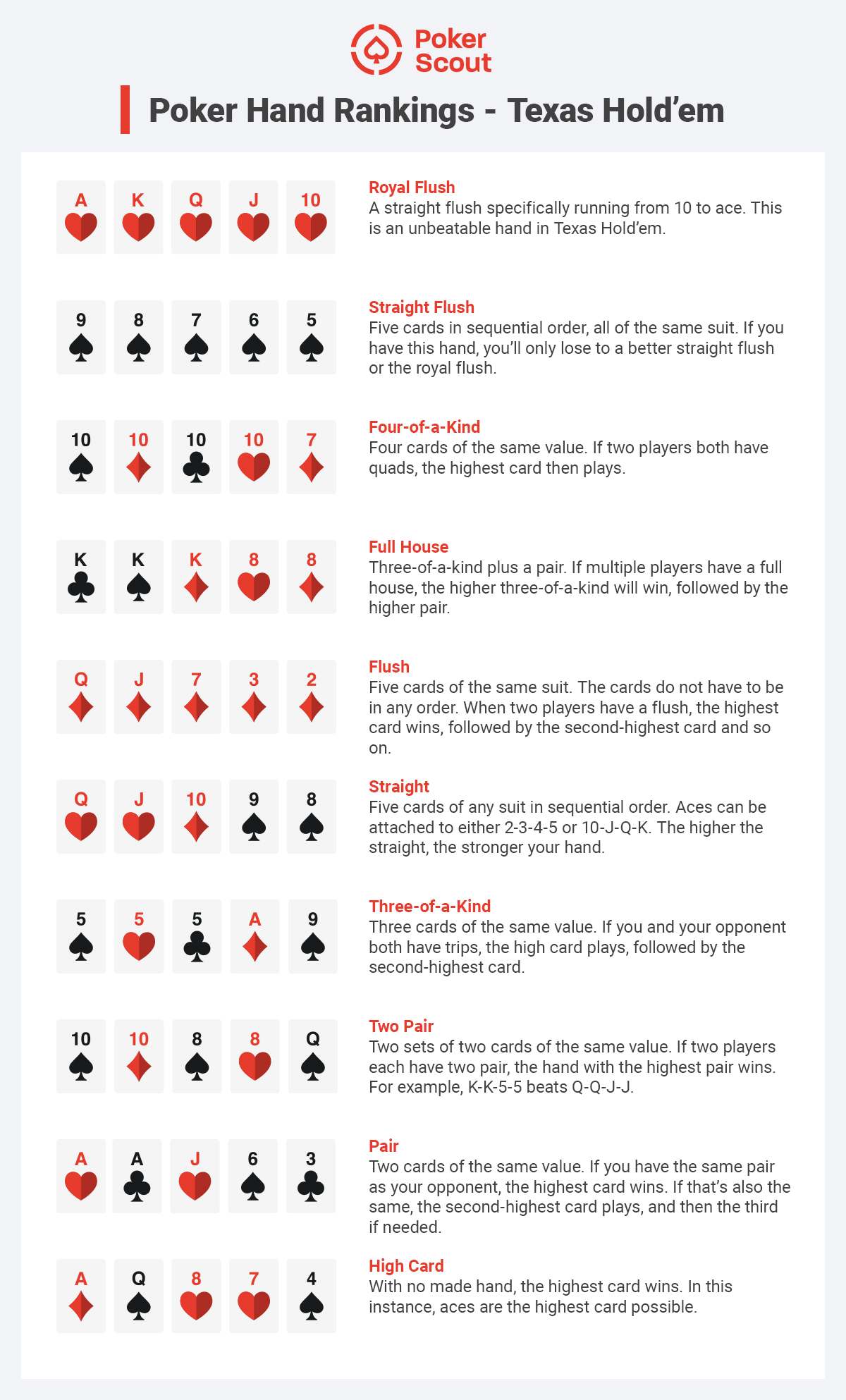
2. Play Tight: Starting Hand Selection
As a complete beginner at the table, it can be helpful to start off with a tight-aggressive strategy, entering the pot with a strong selection of hands and doing so by making a raise.
This Texas Hold’em strategy prevents you from overplaying weak hands, while encouraging selective aggression with strong hands. It’s a solid starting point to build on.
Once you get the hang of playing premium hands, you can start to loosen up from late positions.
3. Position Is King: Why Table Position Matters
No discussion on Texas Hold’em strategies would be complete without mentioning poker position.
The power of position can’t be understated. The player who acts last in a betting round gains more information, which is a significant advantage. Preflop, players in later positions have fewer players still to act behind them and are also more likely to gain position postflop. From the button, for example, only the blinds are still left, and they are always out of position.
Postflop, the informational advantage accumulates.
The player in position will get to close the action on each betting street, giving them much more control over the action and size of the pot. For that reason, starting hand selection varies dramatically based on position. Basic poker strategy advocates playing more hands in late position and playing more aggressively postflop.
If you take nothing else from this poker strategy guide, we urge you to think about your position at the table at all times.
4. Master the Poker Strategy Chart
Hand selection is one of the most important components of a winning Texas Hold’em strategy.
As we’ve touched on, which hands you play will depend on your position. As a general rule, play very tight from early positions and play a lot more hands from late positions. One of the easiest ways for beginners to learn Texas Hold’em starting hands is to study poker strategy charts, which give you a guideline of hands to open-raise with according to position and stack size.
Looking at these charts will give you an idea of what to play and when to fold.
However, you shouldn’t follow them blindly. Use Texas Hold’em strategy charts in combination with your own reads on players for the best results. For example, if a chart suggests that you should call a shove with K♥ T♥, but your opponent is very tight and only raises with very strong hands, you should always factor in your own read.
Various other poker cheat sheets are available to guide beginners in making better decisions in common scenarios.
5. Aggression Is Key
Once you can implement the Texas Hold’em poker tips we’ve given you so far, you can start to think about how you will play the hands you’re dealt and how to use your chip stack as a tool to gain yet more chips.
Aggression is really a cornerstone of Texas Hold’em strategy.
If you play passively by always checking or flat calling bets, you are relying too heavily on hitting your cards and missing out on loads of value when you have a strong hand. To extract the maximum amount of value, you’ll need to bet, raise, and reraise.
Likewise, bluffs are only possible by making a well-timed bet or raise. In both cases, aggression is key.
6. Sizing Up Opponents: Player Type Recognition
There’s nuance to every situation in poker, and a lot of this comes from the opponents you’re facing.
Whether you’re playing live or on one of your favorite poker apps, the way you play a hand against one player could be very different from how you play it against another.
You should always be looking to gain a read on your opponents based on:
- Preflop raises: How often does a player enter the pot preflop, and how often do they do so by making a raise. This will give you an indication of their potential hand strength when they enter a pot.
- Aggression frequency: How often a player bets or raises versus how often they take passive actions like calling. A player who calls more than they bet is likely to be weak and passive.
- Bet sizing: Does a player often bet too little or too much? Does their sizing give you any indication of their hand strength? Note down any times they seem to divert from the norm.
- Timing: Quick calls can sometimes indicate strength or draws, but timing tells online are unreliable due to multi-tabling and other factors. Use them cautiously in combination with betting patterns.
Once you get a feel for the other players at the table, you can start to adapt your play accordingly to target their weaknesses.
7. Don’t Get Attached to Starting Hands
Many new players become overly attached to their hands, which can be a significant mistake.
An important lesson to learn is that it’s okay to fold. Folding is not a sign of weakness, and it’s often the right way to play a hand. If you miss the flop and the action heats up, then there’s no reason to carry on.
For example, let’s say you start off with AJ preflop, but the board comes Q57 and you miss. Other players start betting and raising, and suddenly your ace-high looks weak. It’s perfectly fine and usually correct to fold here.
While we’re all up for digging in our heels and defending our stacks, a huge part of Texas Hold’em poker strategy is knowing when to save yourself the chips and make a fold.
Even pocket aces can lose on an unfavorable board.
8. Bluffing Needs to be Believable
New players tend to go one way or the other with bluffing.
They either completely neglect this important aspect of Texas Hold’em betting strategy or bluff at any available opportunity. In truth, bluffing needs to be carefully considered and well-balanced with value bets. As a starting point for understanding how to bluff in Hold’em strategy, always make sure your story is believable so that you accurately represent a strong hand. Target tight players who fold too often on boards that they miss.
There’s no point bluffing someone who calls any bet.
In any case, don’t go over the top and bluff too frequently in an attempt to replicate the glamour of high-stakes televised cash games. Use bluffs sparingly and only when there’s a high likelihood opponents will fold.
9. Game Selection: Choose the Right Table
You might be a great poker player, but knowing how to win Texas Hold’em often comes down to the games you play.
You wouldn’t jump into a cash game with Phil Ivey, would you? Likewise, if you’re sitting at a table with eight people who are better than you, it’s going to be a long night.
That’s why you need to find games you can beat. As a beginner, this is going to be the micro or low stakes. Specifically, look for player pools or cash games with passive or recreational opponents, large pots, and a distinct lack of sharks. In cash game lobbies, you can pick games with attractive stats, such as a large average pot size and flop percentage.
This usually implies an overly aggressive table, where players are getting involved in too many pots, creating an ideal environment for getting paid off for value hands.
10. Bankroll Management Rules
Money matters in poker.
Your bankroll is your lifeline, so treat it as such. This means only sitting in games you can afford. The general rule is that you should have at least 40-100 buy-ins for cash games and at least 150-300 buy-ins for tournaments. So, let’s say you want to play $0.25/$0.50 cash games with a maximum buy-in of $100. You’d need a bankroll of at least $2,000 to $5,000. For $5 tournaments, a bankroll of $750 to $1,500 or more should help you overcome the swings you’re likely to experience.
This also means that as you win, you should move up in stakes. If you lose, you should set your ego aside and move down in stakes. Doing so makes it very unlikely you’ll go broke.
What is a bankroll?
Your poker bankroll is money you can afford to lose. It’s disposable income, deliberately set aside solely for the purpose of playing poker.
Position-Specific Strategy
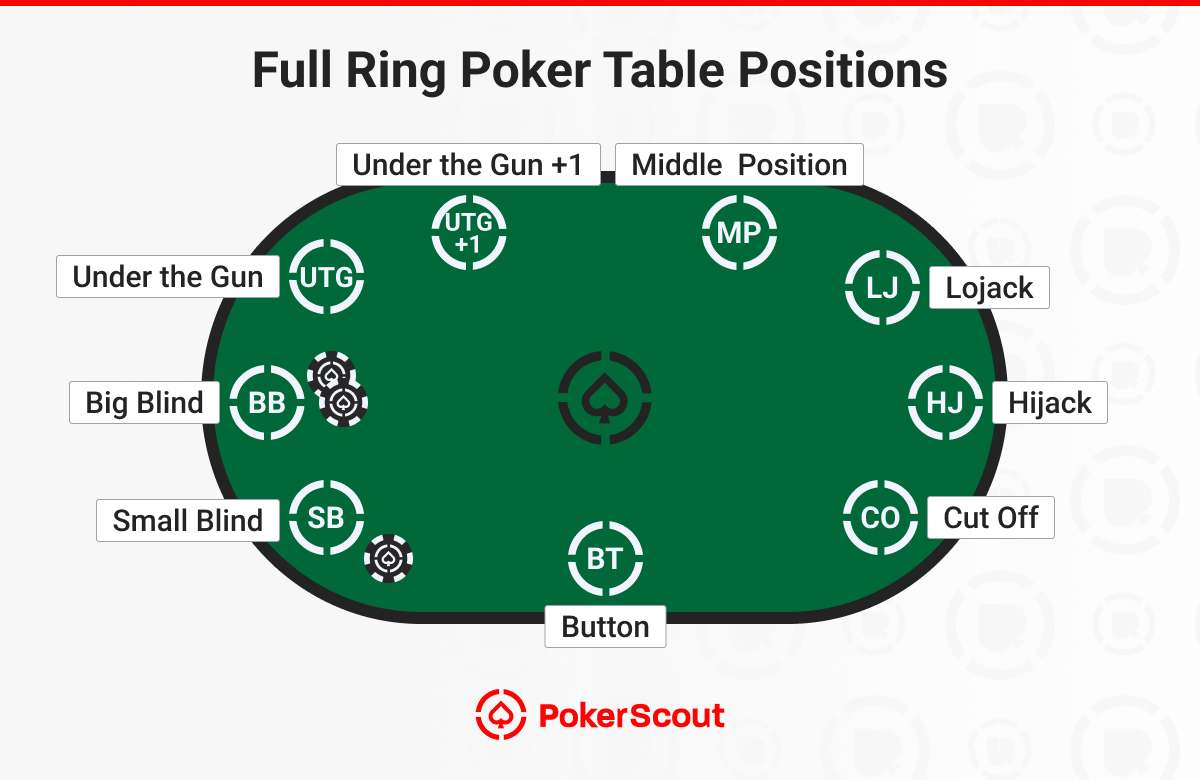
Position is such an essential part of Texas Hold’em poker strategy that we have included it here with its very own section.
As you move away from being a complete beginner, position is the first truly solid fundamental you’ll learn that will help you progress towards becoming a winning player. As such, position-specific strategy sits nicely here, tucked between beginner Texas Hold’em tips and our more advanced section that is coming up.
Below, you’ll find a quick guide to playing from different positions.
Early Position Strategy (UTG, UTG+1)
The early seats, such as UTG and UTG+1, are among the worst positions at the poker table.
Preflop, you still have the whole table left to act behind you, who could wake up with a strong hand. Postflop, you’ll act first on every street, which gives you less information and little control over the pot.
For that reason, it’s recommended that you play a very tight early position Texas Hold’em strategy:
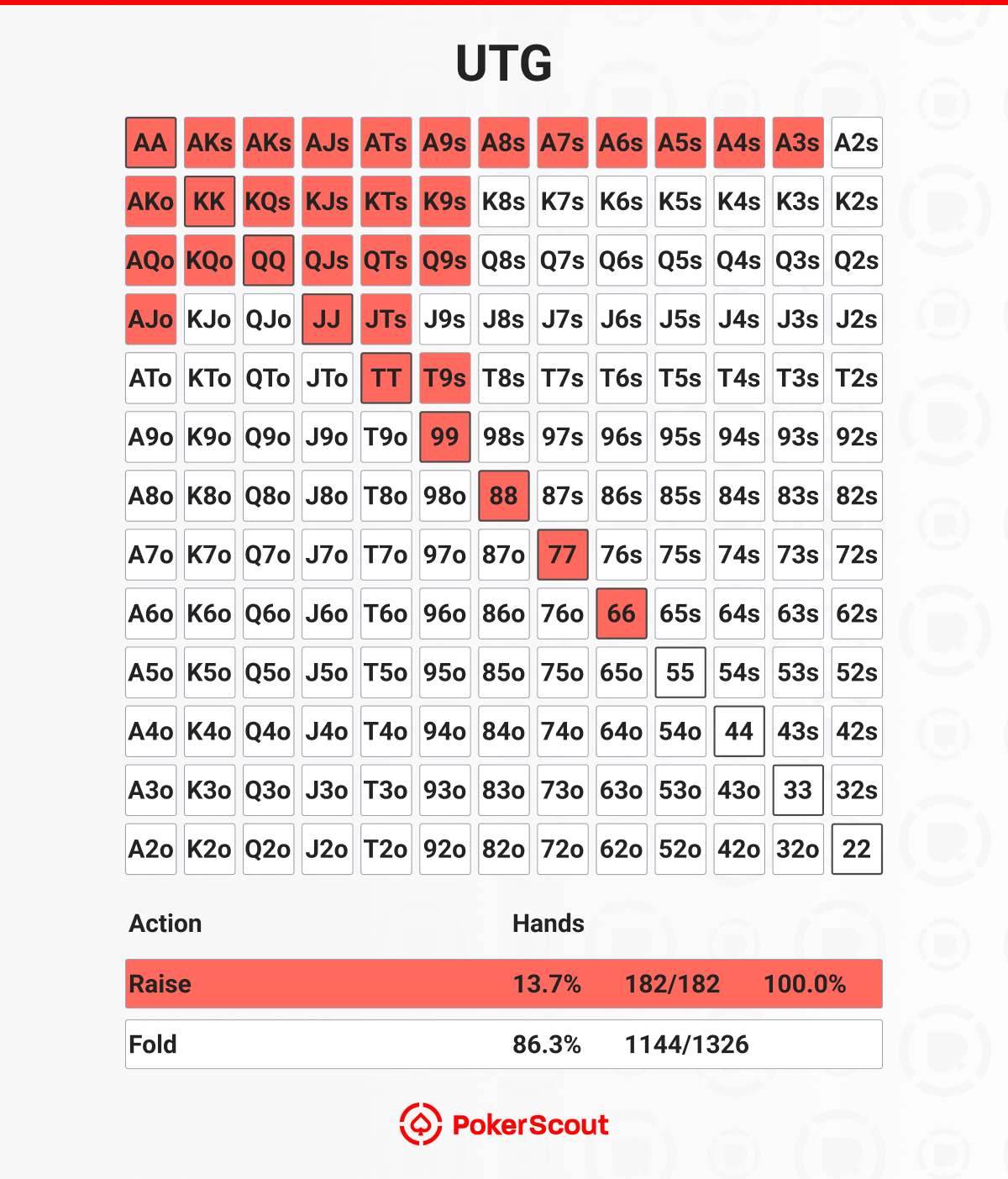
- Stick to a very tight starting hand selection from early positions, raising around 8 – 10% of hands.
- Your range should primarily consist of hands like 77+/ATs+/KQ+.
- Only three-bet premium hands from early position.
- Play in a straightforward way postflop, betting primarily for value and protection.
Middle Position Strategy (MP, HJ)
In middle positions, you’ll have fewer players left to act behind you.
However, there’s still a good chance players in the late position seats will call, and if they do, you’ll still be out of position postflop. For your middle position Texas Hold’em strategy, we recommend:
- Widening your range to include around 15 – 20% of hands.
- Along with early position hands, your range should also include lower pairs, suited aces, broadways, and strong suited connectors.
- Only three-bet with very strong hands.
- Postflop play depends on how many other players call and whether you have position.
- Adapt to opponents who are still to act. For example, if the late position players are very tight, you can widen your range to attempt more steals.
Late Position Strategy (CO, Button)
In late positions, most other players have already acted before you, and there are only a few left behind. You have opportunities to steal the blinds, and if called, you’ll have position postflop.
From late positions, aggression is key:
- Open a very wide range of hands from late position, around 30% from the cutoff, and 50% from the button.
- Your range should include any pair, Broadway, most suited connectors and one-gappers, lots of suited kings and queens, and playable offsuit hands.
- Look for spots to three-bet against late position and middle position raises.
- Use your positional advantage to win pots postflop.
- Adapt to opponents who act before you and to the players in the blinds. Consider flat calling raises against weak opponents to play in position. Ramp up aggression if the blinds are tight and underfend.
Blind Play Strategy (SB, BB)
The blinds are not favourable position.
You must pay a compulsory bet before the cards are dealt, and you’ll be out of position postflop. However, you’ll often have the odds to defend by calling a raise, particularly in the big blind. Here’s a quick rundown of Texas Hold’em strategies for the blinds:
- Defend the big blind very wide, typically with 50 – 70% of hands against a late position min-raise.
- You shouldn’t defend as wide from the small blind because you have worse pot odds. Fold most hands and three-bet around 10% of hands against mid to late position raises.
- If the action folds around, raise around 40 – 50% of hands from the small blind and limp a bunch more. Defend wide from the big blind versus a small blind raise.
- Adapt to opponents, particularly players in late position. Defend and three-bet more liberally against aggressive late position players.
Intermediate Poker Strategy
Once you’ve mastered the basic poker strategy, it’s time to turn things up a notch. Here are eight intermediate Texas Hold’em poker tips to help you tackle tougher players.
1. Think in Ranges
Beginners often make the mistake of putting opponents on a specific hand. Or, at least, that’s what they try to do.
In reality, putting someone on one hand is basically impossible. That’s why professionals think in ranges. Assign opponents a likely range of hands based on their actions and gradually whittle it down as you gain new information.
For example, a tight opponent raises from early position. From what you already know, you might put them in the following range: 99+, AJ+, ATs+, KQ+, and one bluff hand.
As the hand plays out, you can start to remove combinations from their range. For example, the flop comes 8♠ 5♠ 2♥, and your opponent checks back. At this point, you can remove their overpairs, because it’s likely they would bet any pair on this board. That leaves mostly missed ace-high and Broadway combinations left in their range.
You can then assess your own hand strength to decide whether you are ahead or behind an opponent’s range. Instead of guessing and making unrealistic assumptions, you now have a logical framework for making decisions.
2. Read Board Textures
Board texture is a crucial element of postflop Texas Hold’em strategy.
As the community cards are dealt, always think about how the board interacts with both your own and your opponent’s range. This will impact your betting strategy, influencing whether you check or how much you bet.
Board texture can be broken down into wet or dry, as well as static or dynamic board:
3. Choose the Right Bet Size
Bet sizing is important for Texas Hold’em poker strategy because it helps you get maximum value, lose the minimum, and set up moves on later streets.
We can’t take you through the optimum bet sizing for every situation. What we can do, however, is give you some factors to consider when you’re counting out bets:
Instead, choose bet sizing based on factors like board texture and ranges. For example, you can bet small (one half to one third pot) on dry boards, but bigger bets are required on wet boards (half to full) to price out draws.
Consider the size of your bet in relation to the size of the pot. Bets closer to the pot or even overbets give opponents lower pot odds, which can make it harder for them to call. Size bets optimally to achieve value while also generating pressure with bluffs.
If your bet represents a large percentage of either, it signals that you’re committed to the pot and unlikely to fold.
4. Adapting to Different Player Types
Earlier, we touched on how you should start sizing up your opponents to gain an understanding of how they play. For intermediate players, we’re going to show you a few of the adjustments you should be making:
| Player Type | Common Adjustments |
|---|---|
| TAG (Tight–Aggressive) | Tend to have strong hands when they enter a pot. Avoid marginal spots, fold more versus aggression, c-bet, and raise selectively. |
| LAG (Loose–Aggressive) | Tend to play lots of hands aggressively. Widen preflop three-bet range, widen c-bet calling range, consider trapping with very strong hands. |
| Calling Station | These players call bets way too often with weak hands or draws. Value bet thinner, consider a larger sizing, and barrel multiple streets with strong hands. Avoid bluffing. |
| Maniac | Maniacs play way too many hands, bet, raise and bluff too often. Call down lighter and check to induce bluffs. Play hands like top pair strongly for value. |
5. What’s Your Image?
Competent novices are great at labeling opponents but less aware of their own image.
You’re not invisible at the poker table. Opponents are observing you at you as much as you’re observing them, which is why you need to stay in tune with your own image. Let’s say you sit down at a new table and get dealt five premium hands in a row. Because you’re using a pre-flop poker strategy chart, you raise all five hands. None of these hands gets to the river, and you claim the pot each time.
At this point, everyone will probably assume you’re a maniac.
You know that you simply had strong hands, but that doesn’t matter. Other players will see you as a loose-aggressive player, at least for the time being. With an aggro table image, now is not the time to bluff, as other players are more likely to play back at you.
Be prepared to frequently make adjustments like these based on how you have played or the hands you have shown down recently.
6. Mix It Up
In the beginners’ section, we championed the benefits of playing tight and aggressively.
This strategy will always be effective, but there are times when it’s beneficial to mix things up based on your opponent’s tendencies and your own image. Another consideration is overall table dynamics. This can change not only for the players sitting at the table, but also for different stages of a tournament.
For example, some players tighten right up in the late stages to try to survive.
Constantly switching up your strategy, while remaining balanced between value and bluffs, will give you a serious edge over the competition. The tight-aggressive approach is only your starting point. Never be afraid to mix it up.
7. Pot Control & Showdown Value
So far, we’ve talked about value bets and bluffs, but what about hands that are too weak to bet for value but too strong to bluff? With a lot of medium-strength hands, such as middle pair or top pair with a weak kicker, you’re not really looking to build the pot, but you also don’t want to fold.
The solution here is known as pot control.
The aim is to reach the showdown as cheaply as possible by deliberately using passive betting lines, such as checking and calling. This makes it more difficult for opponents to bet or raise against you.
Pot control is easier when you are in position, because you’ll be able to react to your opponent’s moves, take more free cards, and close the betting round with your action.
8. Multi-Street Planning
There are four betting rounds in poker if you make it to the end of the hand.
As part of your Texas Hold’em betting strategy, you should always be thinking ahead and planning for at least the next street. Ideally, you’ll have a loose plan for the entire hand. For example, let’s say that you are in position and your opponent checks to you on an Ac Th 8h board. You have missed, but decide to represent a pair of aces by making a continuation bet.
Stop right there!
Your move makes perfect sense, but have you considered what you will do if your opponent calls? Will you fire again if your opponent checks the turn or give up? How will you respond if your opponent bets. All of these questions are worth asking before you even bet the flop.
The habit of multi-street planning helps you to avoid mistakes or awkward situations further down the line.
Advanced Poker Strategy
Before we talk about GTO poker strategy and how it can add another element to your game, let’s discuss some other advanced concepts.
As a beginner, you might not want to implement these poker tips straight away. However, as your game improves and you move up in stakes, finding these advanced plays and small edges will really boost your game.
1. Look for Backdoors
They often get overlooked in Texas Hold’em poker strategy, but pros understand that even backdoor draws add a little bit of equity and playability to a hand.
In particular, backdoor draws make great semi-bluffing hands if you have position and initiative.
Let’s say you’re holding 7♠6♠ and raise preflop. One player calls, and the flop comes A♦J♣5♠. You’ve missed, but you have position and have shown strength preflop. In this spot, it’s worth betting for a few reasons.
Firstly, it’s easy enough for you to represent a strong hand on this board. There’s a decent chance your opponent will fold and you’ll win the pot uncontested.
Second, if your opponent calls, you still have some outs that will improve your hand on the turn, namely your backdoor straight and flush draw, which improve if you hit any spade, 4 or 8, as well as slightly improve to a 3 or 9.
This gives you plenty of opportunities to bluff again on the turn, against representing a very strong hand, but this time with even more equity. The rare times that your draw hits, you’ll have a well-disguised hand that you can then play for value.
Backdoor draws are very weak, and beginners would overlook them entirely. For expert players, they offer yet more opportunities to play aggressively.
2. Find Thin Value & Turn Hands Into Bluffs
It’s easy to raise with the nuts, but what about marginal spots? The very best poker players often find a reason to raise when it seems a call or fold might be a better option.
Phil Galfond once asked high-stakes cash game player Tom Dwan whether it was better to call or fold a particular hand on the river. Dwan’s response was, “Why not raise?” That conversation apparently changed the way Galfond viewed spots on the river.
As you become proficient in Texas Hold’em poker strategy, you’ll start to find very thin spots for value betting and bluffing. If you figure that your range beats your opponent’s, why not bet or raise, even if it seems marginal? Likewise, if your opponent seems weak but you are weaker, consider raising as a bluff rather than reaching the showdown with the losing hand.
3. Master Your Mindset
We could give you plenty of advanced Texas Hold’em poker tips that delve into the nuances of betting, hand reading, and ranges.
However, one of the most underappreciated aspects of poker is its psychological component.
Specifically, your own mindset.
Everyone who’s played poker for a while will have gone on tilt. Avoiding this is crucial if you want to win at the highest level. That, of course, is easier said than done, which is why you need to become a master of your own mind. But there’s more to the poker mindset than avoiding tilt. You’ll need to train yourself to concentrate for long hours and to always play your A-game.
Doing so can be the difference between a good player and a great one.
4. ICM Considerations in Tournaments
ICM stands for Independent Chip Model, an important mathematical model used to calculate the cash value of tournament chips based on stack sizes and remaining payouts.
ICM determines that the value of tournament chips is non-linear, meaning it changes throughout the game. This is most pronounced when pay jumps are extreme, such as on the bubble or during the final table.
As you move towards advanced strategy, you’ll need to develop an understanding of when and how to adapt to ICM.
As a starting point, follow these Texas Hold’em poker tips for ICM:
- ICM is most relevant during the bubble, approaching the final table, and on the final table before the game goes heads-up.
- Short and medium stacks should focus more on survival and pay jumps before taking marginal risks.
- Very short stacks, particularly the shortest stack player, may need to take risks in order to survive, such as stealing blinds or doubling up.
- Medium stacks can apply pressure to short stacks, but should avoid confrontations with covering stacks.
- Big stacks can ramp up the pressure and exploit the tightness of shorter stacks in high ICM situations, while still avoiding major confrontations with other big stacks.
5. Exploitative vs GTO Play: When to Use Each
Now we get to the nitty-gritty of advanced Texas Hold’em strategy.
Pros tend to study poker ranges that have been mathematically calculated as being profitable and balanced against someone who also takes an optimal approach.
We’ll go into more detail on GTO in a dedicated section below. For now, let’s take a moment to think about when and how to apply these theoretical ranges to your gameplay:
- GTO is a solid foundation for hand ranges and postflop spots.
- Stick closely to GTO against strong opponents, when you lack reads, or when stacks are short.
- When opponents are recreational, weak, or their strategy is full of errors, you should play using an exploitative approach that deviates from GTO based on your reads.
In short, at the mid to high stakes, you can use GTO ranges until you have the reads needed to switch to exploitative play.
6. Range Analysis Tools and Techniques
With experience, some aspects of Texas Hold’em strategies will become second nature.
You’ll rarely have to think about preflop opening ranges or when to c-bet a dry flop, because you’ll have learnt and encountered those situations enough times to know them off by heart. If you want to focus on how to win Texas Hold’em when playing the higher stakes, you’ll need to start plugging smaller leaks in your game.
We recommend analyzing your hand histories, paying close attention to complex hands, situations that you are unsure of, or spots that consistently cost you chips.
To do this, you can use poker equity calculators to compare the odds of hands, look through stats using HUD software like Hold’em Manager, and use GTO solver tools to run simulations and hand ranges to see how you theoretically should have played a hand.
Here’s how to run a basic solver calculation:
Step 1
Choose a hand to analyze and add the known details into the solver, such as stack sizes, positions, your own hand, and your opponent’s range.
Step 2
Analyse the hand at different stages, such as preflop, flop, turn and river.
Step 3
Identify any mistakes that you made and what you should have done differently.
Step 4
Learn the lesson, either as a general takeaway point or as a very specific solution to a hand.
Step 5
Next time you play, be ready to apply your new knowledge at the tables. Then, analyse and repeat.
GTO Poker Meaning: What Exactly Is GTO?
Game Theory Optimal (GTO) poker is based on game theory and aims to create a balanced strategy in all situations.
As long as the other player is also employing GTO ranges, neither of you is incentivized to change strategies, and you both remain unexploitable. GTO poker strategy emphasises mathematically optimal moves that, in the long run, yield at least break-even results irrespective of how your opponent responds. By balancing value to bluff frequencies and using the correct bet sizing, it no longer matters if the other player calls or folds. They lose to your range anyway.
This might sound like a magical formula and, in many ways, it is.
The top online and live poker pros of today all study and use GTO to ensure they don’t give away edges to other high-level players.
The problem is that in the real world, very few people, if any, play an exact GTO Texas Hold’em strategy. Nearly everyone, even young European wizards, deviates at least slightly from the theory. At the low to mid stakes, these deviations are massive.
As we mentioned in the advanced Texas Hold’em strategy section, by all means, learn and master GTO. At the same time, always look to adapt to and exploit the weaknesses of other players.
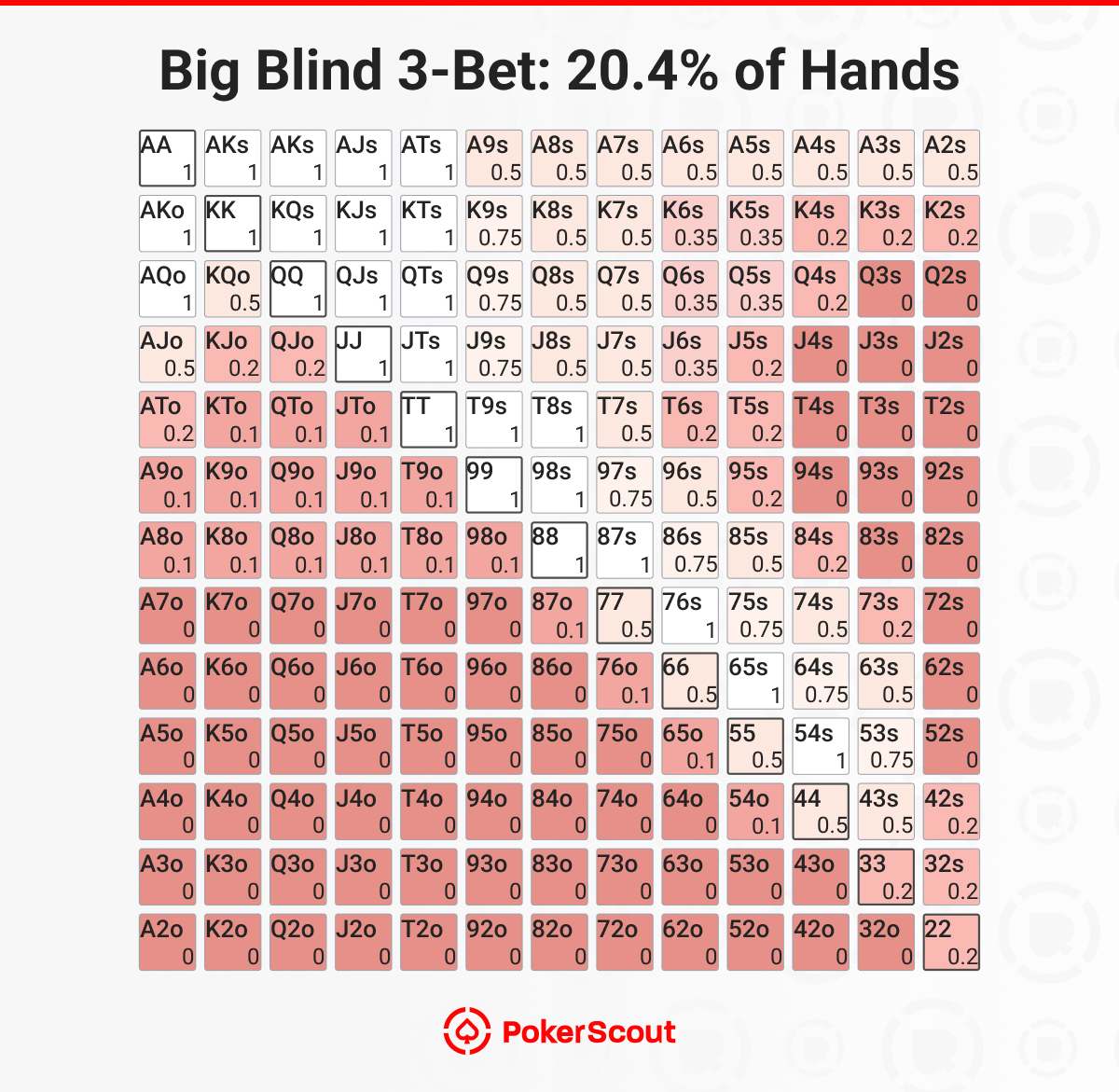
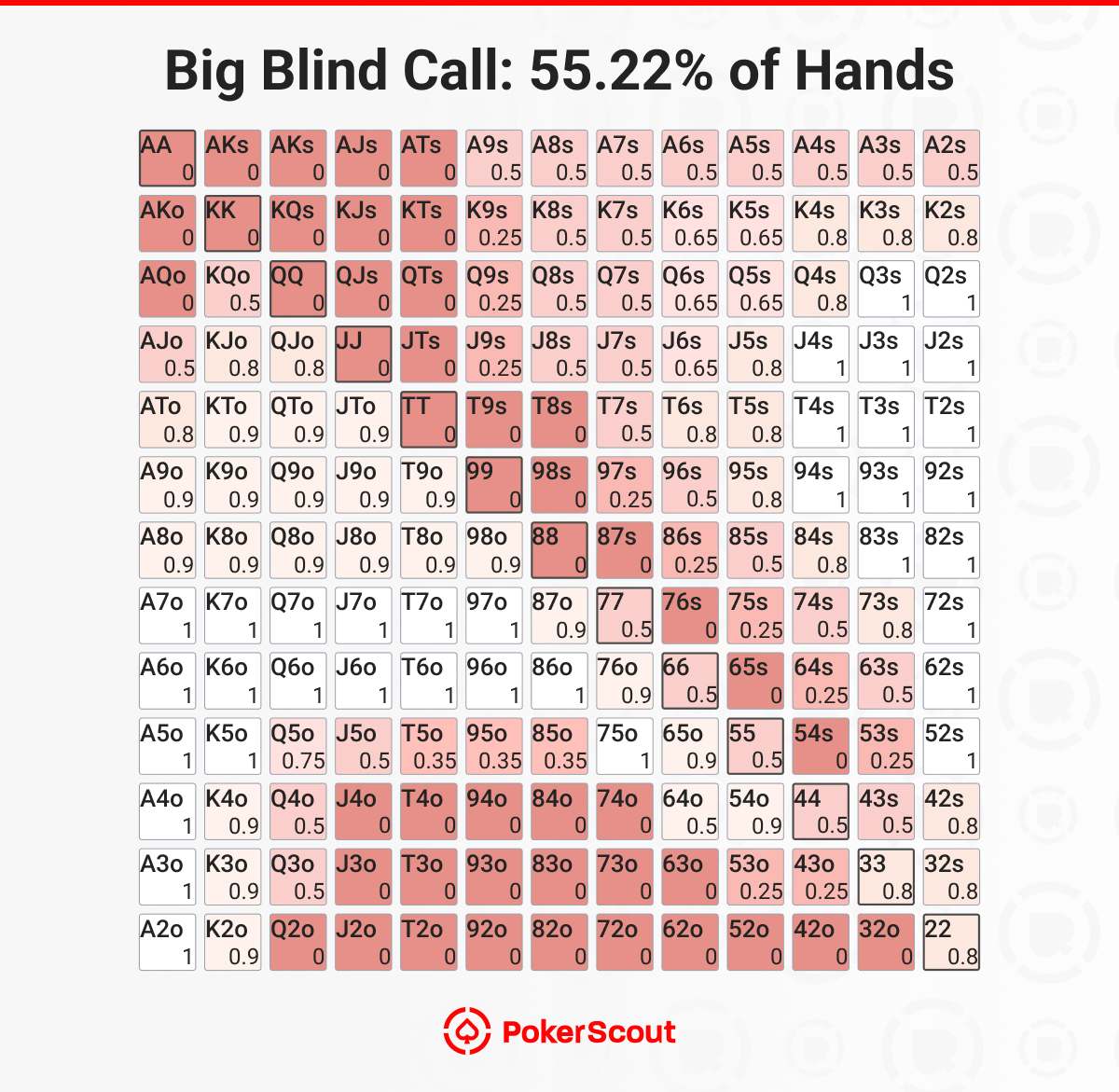
GTO Poker Charts
How do you achieve balance with a GTO poker strategy? By using the correct frequencies, i.e. you need to bet, call, raise, and fold a certain amount of the time depending on the situation, using a mixture of value hands and bluffs.
Poker charts are an accessible place to begin learning about GTO ranges.
Two quick points here:
- Calculating the game theory optimal move for a given scenario is complex and time-consuming, which is why we use solvers and GTO poker charts.
- It’s almost impossible to memorize the GTO move for every possible situation, so the aim is to learn optimal moves for common situations and work from those anchor points.
As with any poker strategy, GTO plays start before the flop. The GTO poker charts below are from PokerCoaching.com.
I’ve picked out four charts to give you an idea of what they look like:
Poker Tournament Strategy: First into the Pot Raising Ranges with 75BB Stack from UTG
6-Max Cash Game: First into the Pot Raising Ranges with 100BB stack from Button
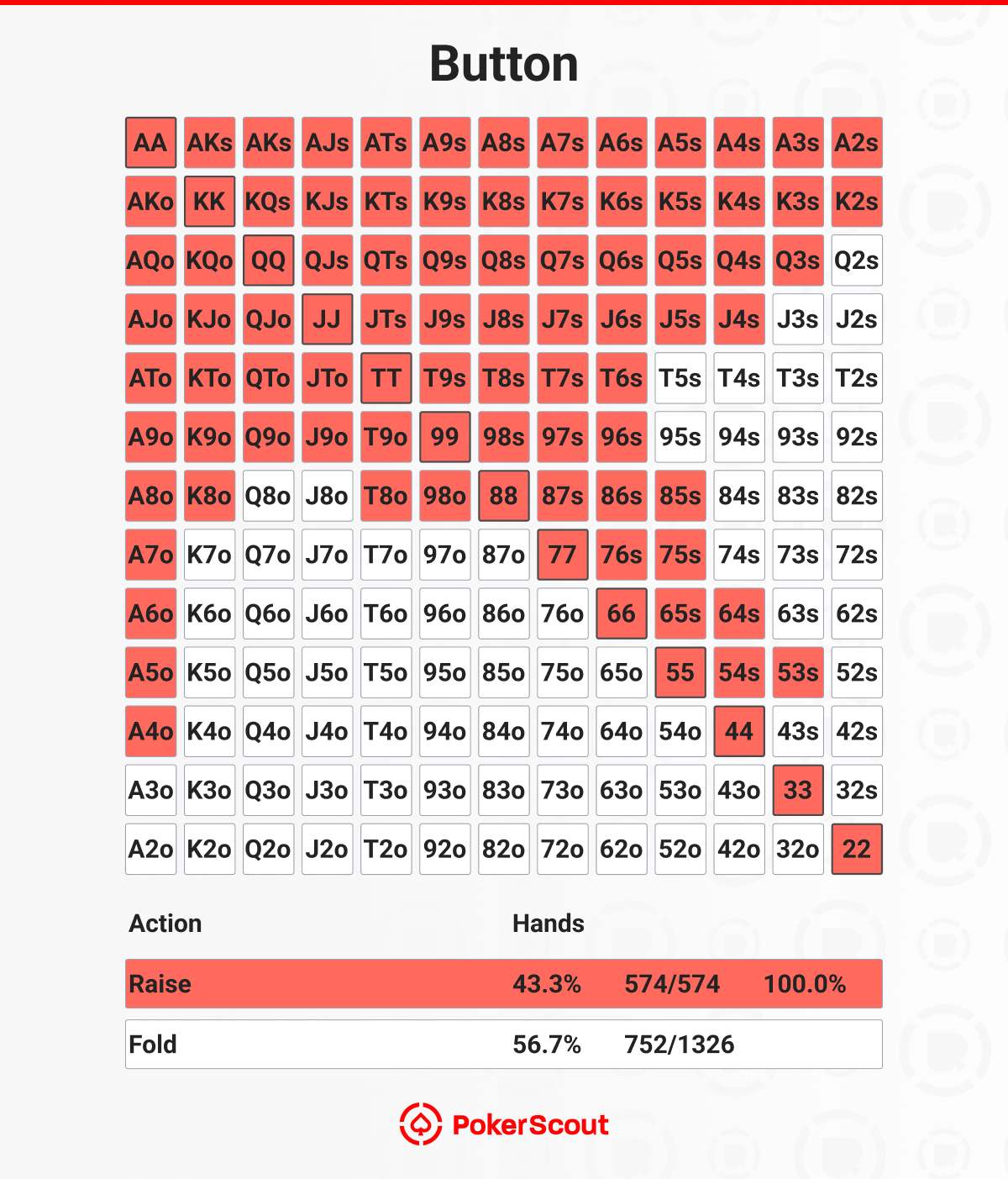
6-max button raising range
Heads-Up: Big Blind 3-Bet and Calling Ranges
Poker, as they say, is easy to learn but difficult to master.
That’s why you should see poker as a journey. Start with basic poker strategy and build a solid foundation before you try to build an empire. Once you’re comfortable with the basics, start adding intermediate and advanced Texas Hold’em strategy concepts to your arsenal.
Eventually, with enough study and time at the tables, you’ll become a competent player capable of effortless switching between GTO and exploitative play.