Poker Expert


If you’re new to learning poker, brace yourself – the concept of poker positions can be challenging. Mastering poker seat positions and how to adjust your strategy accordingly is what will make you a great player. This guide explains poker positions, their importance, and how to play them effectively.
All You Need to Know
- Poker table positions determine the playing order for the hand. The dealer button rotates around the table so that players take turns in each position.
- Poker positions also have significant strategic implications, affecting your starting hand selection and approach post-flop.
- You should play a much tighter range of hands from early positions in poker. From late positions, you can open up and play a much wider range.
- Playing in position postflop gives you more information and ways to control the pot.
What Are Poker Positions?
On the most basic level, poker positions simply refer to your seat at the table. Your seat determines when it’s your turn to act, so poker seating positions establish the order of play for the hand.
However, positions in poker are about so much more than just playing order. They are also a huge factor when it comes to your starting hand selection and postflop poker tournament strategy. When you are in late positions, you’ll make your decision after everyone else, which is a huge advantage. You want to go last.
The dealer button rotates around the table, so that players take turns in each position for one hand during an orbit.
What is it? Poker positions refer to your seat at the table and determine the order in which you play.
Why is it important? It is an advantage to go last in the poker seating positions.
The Different Positions in Poker: Poker Positions Names
Now, let’s break down the poker positions to table arrangements. Most live casino tables play “full ring” and have nine poker seat positions per table, while online cash games tend to only have six.
Poker table positions – nine-handed:
- Under-the-gun (UTG)
- Under-the-gun + 1 (UTG+1)
- Under-the-gun + 2 (UTG+2)
- Lojack (LJ)
- Hijack (HJ)
- Cutoff (CO)
- Button (BU)
- Small Blind (SB)
- Big Blind (BB)
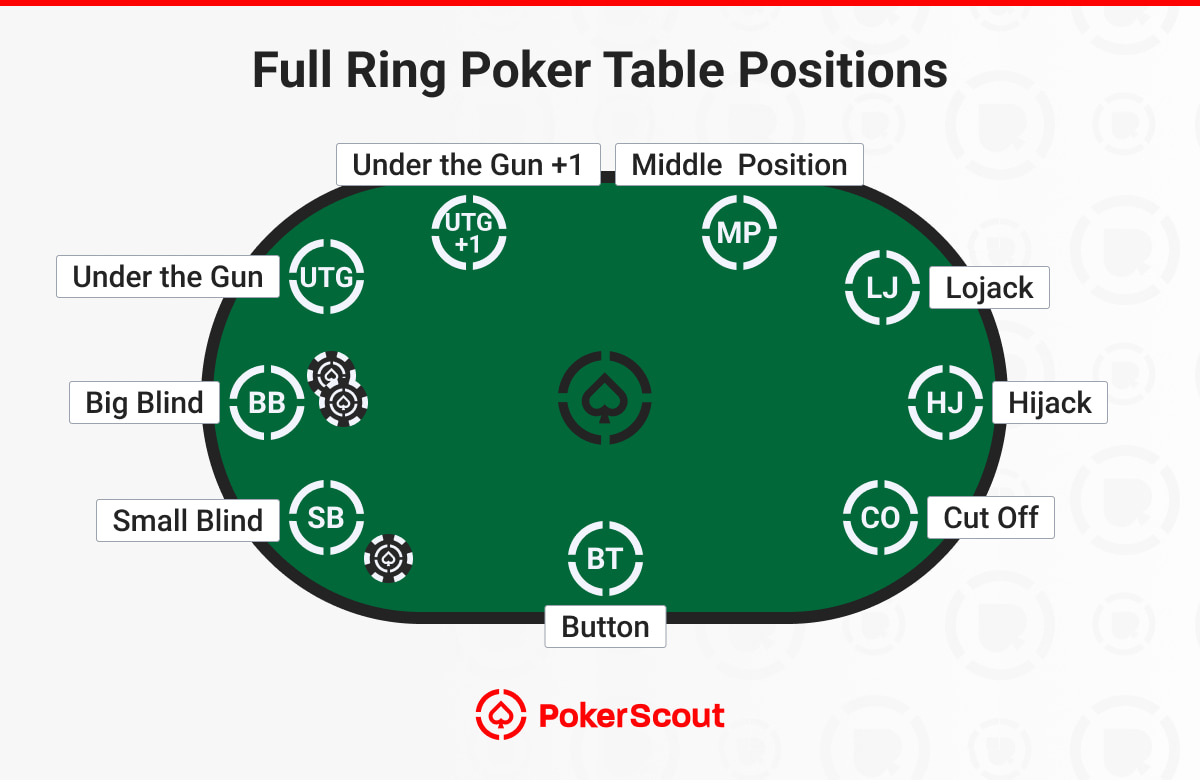
Poker table positions – six -handed:
- Under-the-gun (UTG)
- Hijack (HJ)
- Cutoff (CO)
- Button (BU)
- Small Blind (SB)
- Big Blind (BB)

As you can see, the poker position names are the same. Six-handed poker table positions simply exclude a few seats. Eight-handed poker table positions are the same as nine-handed, but exclude the UTG+2 position.
Poker Position Strategy Preflop
For each of the poker positions, you’ll want to adjust your strategy for which starting hands you play preflop. To simplify situations, you can put the positions into three categories: early position, middle position, and late position.
The general idea is that you should play far fewer hands from early poker positions than you do from late position:
- From early position, you have the whole table still to act behind you, making it likely someone else has a strong hand. You’ll also be out of position postflop, which is a massive advantage. Stick to pocket pairs, strong broadways, and just a few bluffs for balance.
- From middle position, you can start to loosen up your open-raising range to include other strong to medium broadway hands, smaller pairs, and high suited connectors.
- From late position, you should be open-raising with around 50 percent of your starting hands in many situations, including a lot of suited hands, offsuit Ax, Kx, and Qx, suited connectors, one-gap suited connectors, and so on.
Adjusting your ranges in this way helps to mitigate the disadvantages of having players left to act and of being out of position postflop, because when you enter the pot from earlier positions, you’ll have a stronger selection of hands.
For exact specifications on which cards to play in each position, poker software tools are your best resource. They will provide raise/fold guidelines for just about every situation as a poker player.
Poker Table Positions Explained
Now, let’s explain poker table positions one by one so you can get a feel for how each seat affects your play. Here are the nine poker positions at a full-ring table.
Why Position is Important Postflop in Poker
Hopefully, we’ve convinced you by now that poker positions are a can’t-miss concept when learning how to play poker. With each of the poker table positions now explained in terms of preflop implications, let’s explore why position is so important after the flop.
You Gain More Information In Position
Poker is a game of limited information. As the hand progresses, you’ll need to narrow down your opponent’s range based on the board and their betting actions. When you’re in position, you get the benefit of seeing what your opponents do before making your own decisions.
This gives you more information throughout the course of the hand. For example, if your opponent checks to you on the flop and turn, this suggests weakness. If they check-raise the flop and bet the turn, they are giving off signs of strength.
Of course, opponents can always try to deceive you. However, they will have a harder time doing so from an out-of-position. Your poker position strategy allows you to gain an edge.
Control the Pot, Extract Value, Find Bluffs
The additional information you gain from later poker positions on the table, combined with the fact that you can act last on every street, gives you a lot more control over the betting action and size of the pot. This is useful in any situation, whether you want to keep the pot small, make it bigger, or take it down with a bluff.
- With medium strength hands, you can keep the pot small by checking to take free cards or flat calling bets to close the action. The aim is to make it to showdown for cheap.
- With strong value hands, you’ll be able to use the information you gain to bet, raise, or trap to gain the maximum amount of chips.
- With draws, you’ll be able to take more free cards by checking, as well as find opportunities to semi-bluff.
- With weak or missed hands, it’s easier to apply pressure and bluff from one of the late positions in poker.
You could rightly say that every type of hand is easier and more profitable to play in position than out of position, which is why poker position strategy is so important for your results.
Playing Out of Position is Tough
When it comes to playing from the early positions in poker, the reverse is true. Here is what makes being out of position difficult.
We can’t emphasize these two points enough:
- When you have a good hand, it’s hard to get paid: Your opponents will be able to see what action you take before they have to act. When you bet into them or check-raise, they are much more likely to fold with worse hands or use pot control to keep the betting relatively small.
- When you have a weak hand, it’s hard to navigate: With weak or medium strength hands, it’s unlikely you’ll make it to showdown when out of position. Bluffing is much more troublesome when you have less information than your opponents – they might have an extremely strong hand, and you won’t even realize it. They can also float weaker hands in position. Bluff too often out of position and you could be lighting your chips on fire.
Because the early poker seat positions suffer such a considerable hindrance, it is recommended that you only play top-tier hands. Folding everything except premium hands in early poker positions is a strategic compensation for the disadvantage, as the hand strength makes them less likely to lose.
Annette Obrestad Wins a Tournament Blind
Annette Obrestad is the youngest person to ever win a World Series of Poker bracelet, and once won an online poker tournament without looking at her cards. She beat 179 opponents playing poker “blind.” Obrestad put tape over her screen so she couldn’t see her cards and filmed the whole tournament.
In Obrestad’s words, she wanted to “show just how important it is to play position and to pay attention to the players at the table.”
Watching other players act first gave her all the information she needed. Rather than relying on her own hand, she observed the actions of those ahead of her and made decisions based on what she estimated about their hands. This is how you play position and your opponents, rather than your own cards.
If Annette can win a poker tournament without ever looking at her cards – succeeding through poker positions alone – then mastering poker position strategy is certainly worth the investment.