iGaming & Poker Expert


Hosting a poker night at home is an excellent idea if you know where to start. Fortunately for you, we do. Here’s our handy guide on how to run a home poker tournament — let the games begin!
All You Need to Know
- Home poker tournaments are completely legal as long as you don’t take a rake. All buy-in money must go directly into the prize pool.
- Aim for 5-7 players per table. Too few gets boring, too many (over 8) makes everyone play too tight
- Choose 4-12-minute blind levels and don’t wing it. Start players with around 100 big blinds
- Allow only one rebuy during the first 1-2 blind levels, or skip them entirely to keep the game moving
Hosting a Home Poker Tournament — Step-by-Step Guide
So you’ve got your crew and are ready to host a poker night. Here’s what to do first.
Step 1: Gather the Players
The reason home poker tournaments fail is that they simply can’t manage a headcount. You need enough players; if there’s only two or three of you, it’s going to get awkward fast. One player will be bored waiting around while the others finish up. Plan for a minimum of five players on your guest list. That way, even when someone busts, they’ll have other people to hang out with or play a cash game instead.
Are you blessed with a circle of friends? In that case, arrange for multiple tables. For example, if you have 15 players, don’t try to cram them all at the same table. Split the players into two groups: seven on one table and eight on the other.
Limit your home poker tournament setup to 8 players per table. Having too many players increases the likelihood that one person will have a mighty hand. Others will then adjust their strategy to play tighter (that’s no fun!)
A lot of players can lead to nuts or nothing poker, which in turn completely handicaps the ability to bluff. You can’t bluff as much 10-handed vs 3-handed, as players will have stronger hands when playing 10-handed. A good sweet spot is 5-7 players per table. That’s ideal.
Designated Shuffler
Make sure at least one person in your group can shuffle and act as the Dealer. You can either assign this role to someone or have players take turns in dealing.
Step 2: Purchase the Equipment
Now that you’ve got your players assembled, the next step in running a home poker tournament is gathering your equipment. We’ve prepared a home poker tournament checklist to make things easy:
- Decks of Cards: At least 2 per table so that the next dealer can shuffle in advance.
- Dealer Button: To indicate the dealer position and maintain order consistency. If you don’t have a dealer button, any unique-looking item will do.
- Poker Chips: A standard set with multiple denominations (you’ll need enough chips for each player’s starting stack plus rebuys if allowed).
- Table & Chairs: A sturdy surface with enough seating so players are comfortable. A poker-specific felt table is ideal but not required.
- Timer: This is used to track blind levels and maintain a consistent pace throughout the tournament.
- Blind Structure Sheet: A printed schedule, digitally available document, or whiteboard that shows blind levels and times, ensuring everyone’s on the same page.
Optional: If you have beginners in attendance, consider printing or ordering a sign (poker wall decor!) displaying poker hand rankings.
Step 3: Home Poker Tournament Blind Structure
The other major factor that trips up home poker tournaments is not having a set blind structure. Don’t just wing it. While you can make changes on the fly if your home poker tournament is running too long or too short, you’ll want a blind structure established in advance.
There are two variables in deciding your home poker tournament structure:
- The length of each blind level (time interval).
- The size of each increase (how fast the blinds escalate).
For example, blinds could be increased every 5 minutes, but if they only go up by small increments, the pace feels slow. On the flip side, if blinds double too quickly, half the table may be short-stacked before they’ve even finished their first drink.
You also need to balance logistics:
- Do you want one long, deep tournament for the evening? Go with slower levels.
- Or do you want multiple winners and faster turnarounds? Choose shorter levels.
- Remember: very short levels (1–2 minutes) are hard to manage since someone has to keep track of the time.
Additionally, you must consider that everyone will need to be reminded each time the blinds increase. A home poker tournament with blind levels that change every minute will be extremely hard to manage.
Pro Tip: Stick to blind levels that are anywhere from 4 to 12 minutes. That’s short enough to keep action moving, but not so fast that it feels like a total coin flip.
Recommended Home Tournament Blind Structures (With Starting Chips)
Try one of these home poker tournament structures depending on your time and skill level.
Quick & casual (1–1.5 hours total)
- Starting stack: 1,500 chips
- Levels: 6 minutes each
| Blind Level | Small Blind / Big Blind |
|---|---|
| 1 | 25 / 50 |
| 2 | 50 / 100 |
| 3 | 100 / 200 |
| 4 | 200 / 400 |
| 5 | 400 / 800 |
| 6 | 800 / 1,600 |
| 7 | 1,500 / 3,000 |
Classic game night (2–3 hours total)
- Starting stack: 1,500 chips
- Levels: 6 minutes each
| Blind Level | Small Blind / Big Blind |
|---|---|
| 1 | 25 / 50 |
| 2 | 50 / 100 |
| 3 | 75 / 150 |
| 4 | 100 / 200 |
| 5 | 200 / 400 |
| 6 | 500 / 1,000 |
| 7 | 1,000 / 2,000 |
| 8 | 2,000 / 4,000 |
Deep & serious (3–4+ hours total)
- Starting stack: 5,000 chips
- Levels: 12 minutes each
| Blind Level | Small Blind / Big Blind |
|---|---|
| 1 | 25 / 50 |
| 2 | 50 / 100 |
| 3 | 100 / 200 |
| 4 | 150 / 300 |
| 5 | 200 / 400 |
| 6 | 300 / 600 |
| 7 | 400 / 800 |
| 8 | 600 / 1,200 |
| 9 | 800 / 1,600 |
| 10 | 1,000 / 2,000 |
| 11 | 1,500 / 3,000 |
| 12 | 2,000 / 4,000 |
Should You Change the Blind Times Based on the Number of Players?
- Small group (4–6 players): You might want slightly longer blind levels (e.g., 10 minutes instead of 6–8) so you don’t finish the whole game in under an hour.
- Medium group (8–12 players): Standard blind times (8–12 minutes) usually feel just right.
- Large group (12–20+ players): Keep the exact blind times, but you’ll probably need to cap rebuys or make blind jumps steeper later on — otherwise, you could be playing all night.
Here’s a Word About Rebuys
Rebuys keep the action going and grow the prize pool, but you’ll want to set boundaries. Too many rebuys can make the game go on forever and feel dull.
You can choose to allow rebuys during the first few blind levels (usually up to level 3 or 4), similar to a real casino. Still, we don’t recommend it for most home poker tournament atmospheres, as it can make the vibe too wild and unserious. If you’re running a home poker tournament, be conservative with rebuys.
Pro Tip: Limit your home poker games to only one rebuy on the first 1-2 blind levels.
And if the game still ends too early? You can always get a friendly rail going for an intense spectator-sport version of the online poker grind, and grab your laptop to play late into the night!
Step 4: Settle on an Equitable Payout Structure
Here’s the fun part of setting up a home poker tournament – establishing the payout structure. Unlike when hosting a poker night cash game, where one chip equals $1, tournament buy-ins vary.
Let’s say everyone buys into your home poker tournament for $100 and each receives 1,500 chips. It makes no difference to the prize pool or your home poker tournament whether $100 gets you 1,500 starting chips or 5,000.
The only thing that matters is the prize pool and how it’s divided.
If you have 10 friends buying in for $100, then your prize pool is $1,000 (assuming no rebuys). Every buy-in contributes to the overall pool. Next comes the payout decision: how do you divide that money?
The Easy Way to Calculate Home Poker Tournament Payouts
Do you want to make running a home poker tournament simple? Then use the following payout structure:
- First place: 50% of the prize pool
- Second place: 30% of the prize pool
- Third place: 20% of the prize pool
The 50/30/20 rule for payouts makes hosting a poker tournament easy. A $1,000 prize pool would allocate $500 to the winner, $300 to second place, and $200 to third.
Of course, you can come up with your own home poker tournament rules and any payout structure you like. You can go for winner-takes-all, or a flat survivor-style structure where everyone who cashes earns the same amount. Just avoid being too charitable with paying the bubble or minimum cash-outs — make sure there is a juicy cash pot to play for.
Step 5: Most Importantly of All – Have Fun!
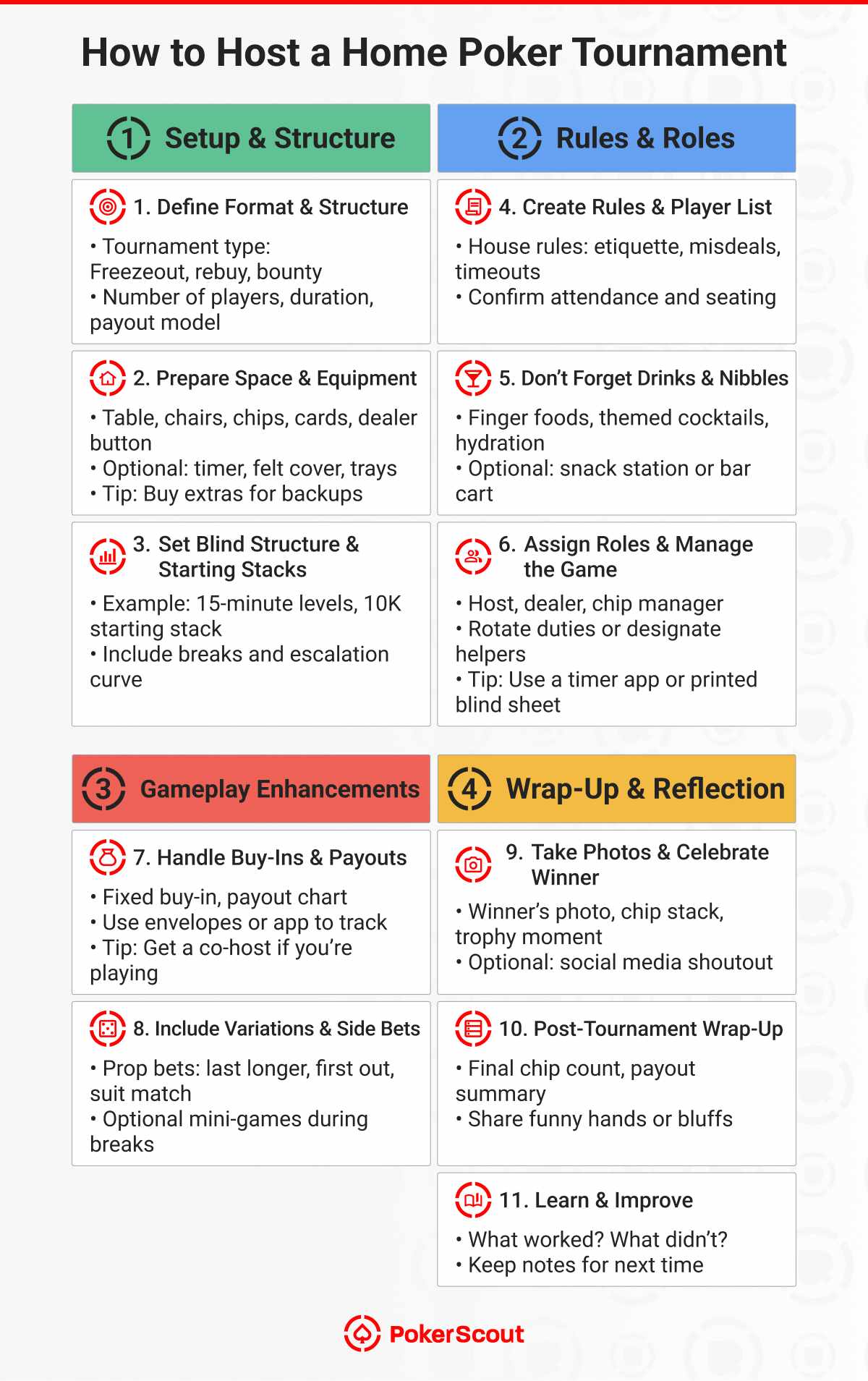
There’s a lot to navigate when you’re first learning how to set up a home poker tournament. But done correctly, it can be a blast, and much more affordable than a casino-run event. We’ll leave you a cheat sheet of sorts to guide you when hosting a poker tournament at home with your friends.
For When You Get Hungry on Home Poker Nights
Good food dictates the evening almost as much as the cards do. The trick is to keep things easy to grab, easy to clean up, and not too messy for handling chips and cards. Ordering Chinese takeout is always a great option because it forces people to use a fork. Plus, paper boxes mean no dirty dishes.
Food to Avoid
Finger foods can get gross. Unlike typical parties where chips and dip are a good choice, when you’re hosting a poker tournament, it’s best to avoid Cheetos. Even pizza can be a poor choice as it increases the chances of getting greasy cards. Avoid wings with sauce or cheesy mozzarella sticks that require double-dipping.
To Drink or Not to Drink?
This is totally up to the host. Beer and cocktails work for some crowds, while others are perfectly happy with sodas and sparkling water. Ask your friends ahead of time what they prefer. Who knows? You might even prank (we mean surprise) them by purchasing a few non-alcoholic beers.